What's next for the Bolojan Government after the PSD decided last night to withdraw its support. Scenarios and calculations for the next few days

Romania has officially entered a political crisis whose end is unclear. The calculations in the Parliament clearly show that without the PSD, the other parties in the current governing coalition do not have the number of votes necessary to support Bolojan in the position at the Victoria Palace. But even PSD cannot pass a motion of censure against the Government without votes from other parties.
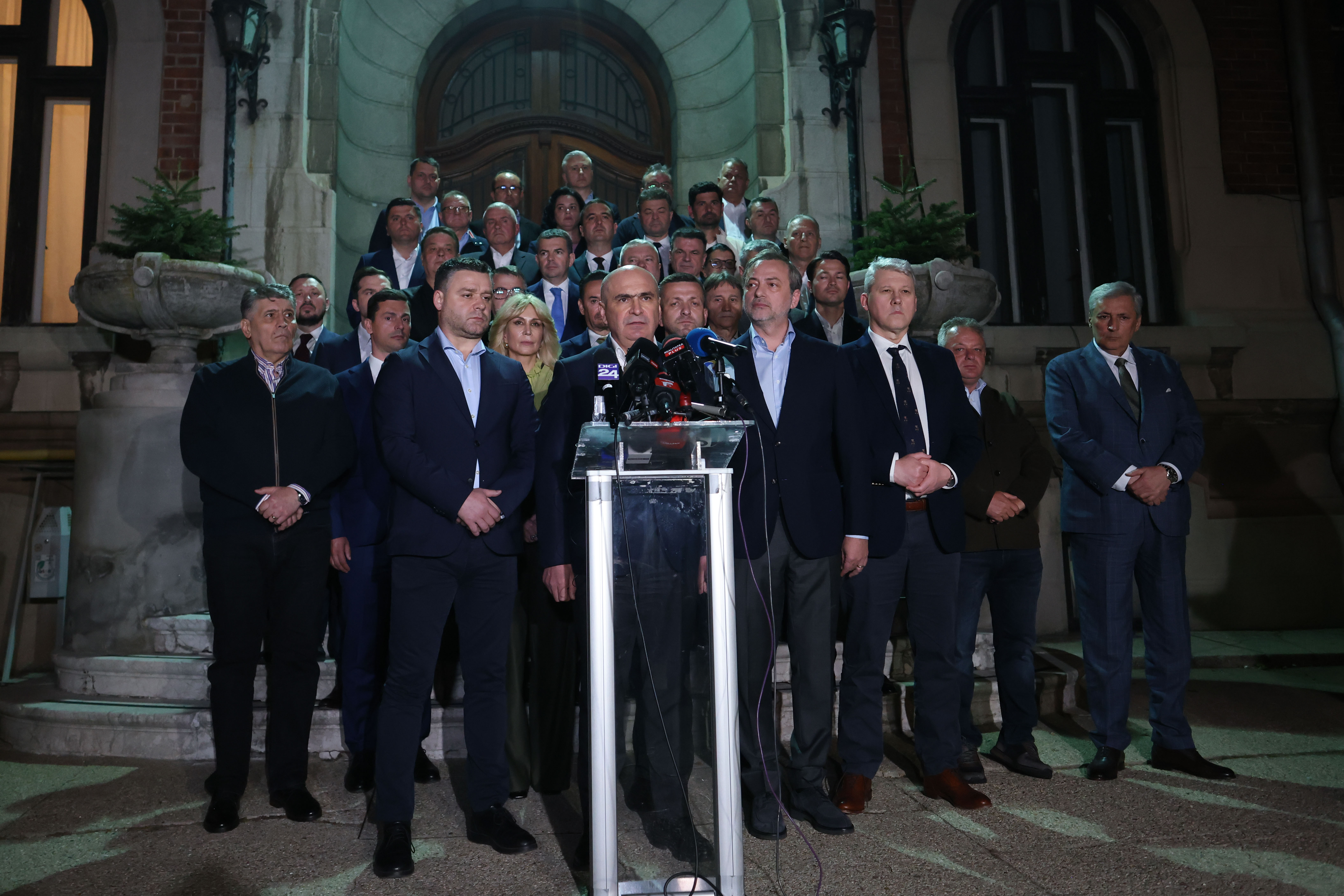
The PSD is currently waiting for the resignation of Prime Minister Ilie Bolojan, who has repeatedly said that he will not resign and he also said it last night, in the PNL court in Modrogan, after the PSD vote: “Considering the responsibility that I have and have towards our country, we will continue to ensure the governance of our country, so that we can get through this complicated period for our country”.
Ilie Bolojan has on his side those from USR and UDMR, who have announced that their ministers will not withdraw from the Government and, moreover, the parliamentarians of these parties will not vote a motion of censure against the current Executive.
“We have no reason to withdraw from the Government,” said Kelemen Hunor.
“We cannot return to negotiations with the PSD if it initiates a motion of censure and causes the dismissal of this government. What guarantee would we have that the PSD does not betray again and again? For now, this government is still standing and the PSD must explain to us how they want to govern Romania. We remain on the barricades,” said Dominic Fritz on Monday evening.
PSD is waiting for the resignation that will not come
This means that the PSD is forced to resort to step two: the withdrawal of the social-democratic ministers from the Government. Sources close to the talks say this will most likely happen on Thursday, when it will be clear to the PSD that Bolojan is not giving in.
Even with the withdrawn PSD ministers, the Government does not become a minority one, but will continue to function as one with full powers. That's at least 45 days – if there's no censure motion that will displease him. After the eventual resignation of the PSD ministers, the prime minister will appoint interim ministers, who can remain in office for a maximum of 45 days. However, it is not provided what happens if the 45-day period is exceeded.
Who will Ilie Bolojan appoint instead of PSD ministers
The idea was put forward in the media that Prime Minister Ilie Bolojan will appoint people not politically involved – technocrats instead of PSD ministers. This scenario is, however, excluded, sources close to the prime minister tell HotNews.
“A possible change with technocrats can only be done with the vote of confidence of the Parliament. And that on the condition that no censure motion is passed,” political sources explain the situation.
Moreover, the Constitution also provides that in case of “government reshuffle or vacancy, the President revokes and appoints, at the proposal of the Prime Minister, some members of the Government”. In other words, interims will be appointed from among the ministers who remain in the Government, from PNL, USR and UDMR.
The decisive role of Nicușor Dan
President Nicușor Dan has a decisive role, at least procedurally, both in the process by which the PSD ministers resign, and in the moment when Ilie Bolojan will propose replacements for them.
The Constitution specifies that in the event of a “vacancy”, the president “revokes and appoints, at the proposal of the prime minister, some members of the Government”. This means that in order to officially acknowledge the resignations of the social democrats, the decree signed by Nicușor Dan is needed.
And for the replacements of the social democrats, Nicușor Dan's signature is needed. Interim ministers are appointed by the president, by decree, at the proposal of Prime Minister Ilie Bolojan.
On Monday, President Nicușor Dan refused to discuss possible scenarios after the PSD decision.
“We will have as many rounds of negotiations as are necessary to find a stable solution”, stated Nicușor Dan. Asked if he supports Ilie Bolojan, the president stated that he wants to maintain his role as “mediator” because there is “social tension”.
The censure motion from the PSD is under question
At the moment, at the level of the PSD leadership, it is not clear if and when they could submit a motion of censure against the Bolojan Government. The Social Democrats have not made any decision in this regard because they are waiting to see how things will unfold after the announcement of the withdrawal of political support to Bolojan, party sources tell HotNews.
“Let's get there (…). The submission of a motion of censure by the PSD is a possible fact”, declared, on Monday, at the Parliament, the leader of the social-democratic senators, Daniel Zamfir.
AUR's censure motion
One of the leaders of AUR, Petrișor Peiu, explained that the party he belongs to will submit a no-confidence motion by May 13 at the latest. However, PSD would not want to vote on a motion of censure of AUR, because the social democrats do not want to associate themselves so directly with the party led by George Simion, according to HotNews sources.
On the other hand, for the PSD, the censure motion of AUR comes much too late anyway: “I think it is very late and an interim government cannot remain in operation until May 13”, Daniel Zamfir said on Monday.
“PSD cannot vote on a motion by AUR, because at that moment it is the definitive and irrevocable end of PSD”
PNL vice-president Alexandru Muraru spoke, in a dialogue with HotNews, about the scenario of a censure motion. He says that he does not see this option as possible.
“PSD cannot vote on a motion by AUR, because at that moment it is the final and irrevocable end of PSD. It's not like you vote on a motion of censure from the opposition. AUR is the party that buried them electorally and will put their definitive tombstone, the moment they vote on this motion,” said Muraru.
“Also, I don't think that the AUR will vote for a PSD-ist motion, because the AUR does not want to be an annex of the PSD, but to be an independent party and to take away as many PSD votes as possible”, added the PNL leader.
“If they withdraw their ministers and create this political crisis, they must also say what their alternative is,” said Diana Stoica, the leader of the USR deputies, when asked by HotNews about the scenario of a censure motion.
“Responsibility for this crisis is also with the PSD. They want to turn everything upside down. The small sliver of stability that was created, which also helped us on the economic side… If the PSD does not find a dram of responsibility in these few hours not to blow up the country, the Romanians will pay the bill: we will see price increases in the chain”, believes the deputy.
Ilie Bolojan can be forced by the CCR to go to Parliament
PSD and AUR have 219 of the 232 votes needed for the fall of the Government. With votes from SOS Romania and POT, or even unaffiliated parliamentarians, they reach a large majority for the passage of a no-confidence motion. But beyond the calculations, a political understanding is also needed between these political formations.
If PSD and AUR do not reach an agreement and the censure motion does not pass, then Ilie Bolojan may end up in a situation where he will be forced by the Constitutional Court of Romania (CCR) to go for a vote of confidence in the Parliament. The CCR can be referred for a ruling by the Parliament itself, more specifically by Sorin Grindeanu, who is the president of the Chamber of Deputies.
A similar situation was in 2019, when Viorica Dăncilă wanted to appoint interim ministers after the breakdown of the PSD-ALDE coalition. Then, the CCR was notified by the Executive and decided that the Government must go for a new vote of confidence in the Parliament, but also that the president is obliged to sign the decrees by which interim ministers are appointed, as reported by Europa Libera.
Parliament's calculations and a difficult scenario: Ilie Bolojan can try for a new majority
At the moment, the ruling parties (PSD, PNL, USR, UDMR and National Minorities) together have 310 MPs, well over the 232 votes needed for a majority – out of a total of 463 MPs.
PSD has 129 senators and deputies.
The opposition (AUR, SOS Romania, POT and PACE) has 131 votes. The 22 unaffiliated MPs could be added to them. That brings the total to 153 members.
PNL, USR and UDMR, the parties that announced that they continue to support Ilie Bolojan, have only 164 MPs in Parliament out of the 232 required for a majority. They could be added, in an ideal scenario for Ilie Bolojan, the 17 deputies of the National Minorities and the 22 non-affiliated ones. That would lead to a total of 203 votes, still insufficient to support Bolojan in Parliament.
HotNews asked PNL vice-president Alexandru Muraru if Ilie Bolojan will discuss with unaffiliated MPs, for example, to seek support.
“With or without these discussions, I personally don't think it will discuss, but with or without these discussions, if the Government remains a minority, it will be. I mean, what majority to discuss? If it is a minority government, it means that it does not enjoy transparent support, but functions by virtue of the inertia of the parliamentary majority that invested it at a certain moment. Anyway, we are far from that moment. Post-December logic and history tell us that all the time after such a period, things have not improved solved neither in two weeks, nor in a month, nor in two,” Muraru stated.
At this moment, the votes in Parliament are divided as follows:
“The scenario of a minority government was never the best, that's why we ended up in this coalition. PSD, until another time, said that it had a problem with Bolojan, not with the government program, although it denies it every day”, says USR's Diana Stoica.
What happens if a motion of no confidence passes
If Ilie Bolojan does not pass the Parliament's vote, he remains interim, while negotiations begin to form a new majority.
PSD leader Sorin Grindeanu has stated several times that he wants to continue governing in a pro-European formula and that he rules out a coalition with AUR.
On the other hand, USR and PNL decided at the end of March that in case the PSD will trigger a political crisis and overthrow the Government led by Ilie Bolojan not to negotiate a new majority with the social democrats.
At the same time, many PSD members do not agree with the joining of the party led by Sorin Grindeanu and USR. A Government without USR, consisting only of PSD, PNL, UDMR and the National Minorities can collect 251 votes, 19 votes more than the required minimum of 232.