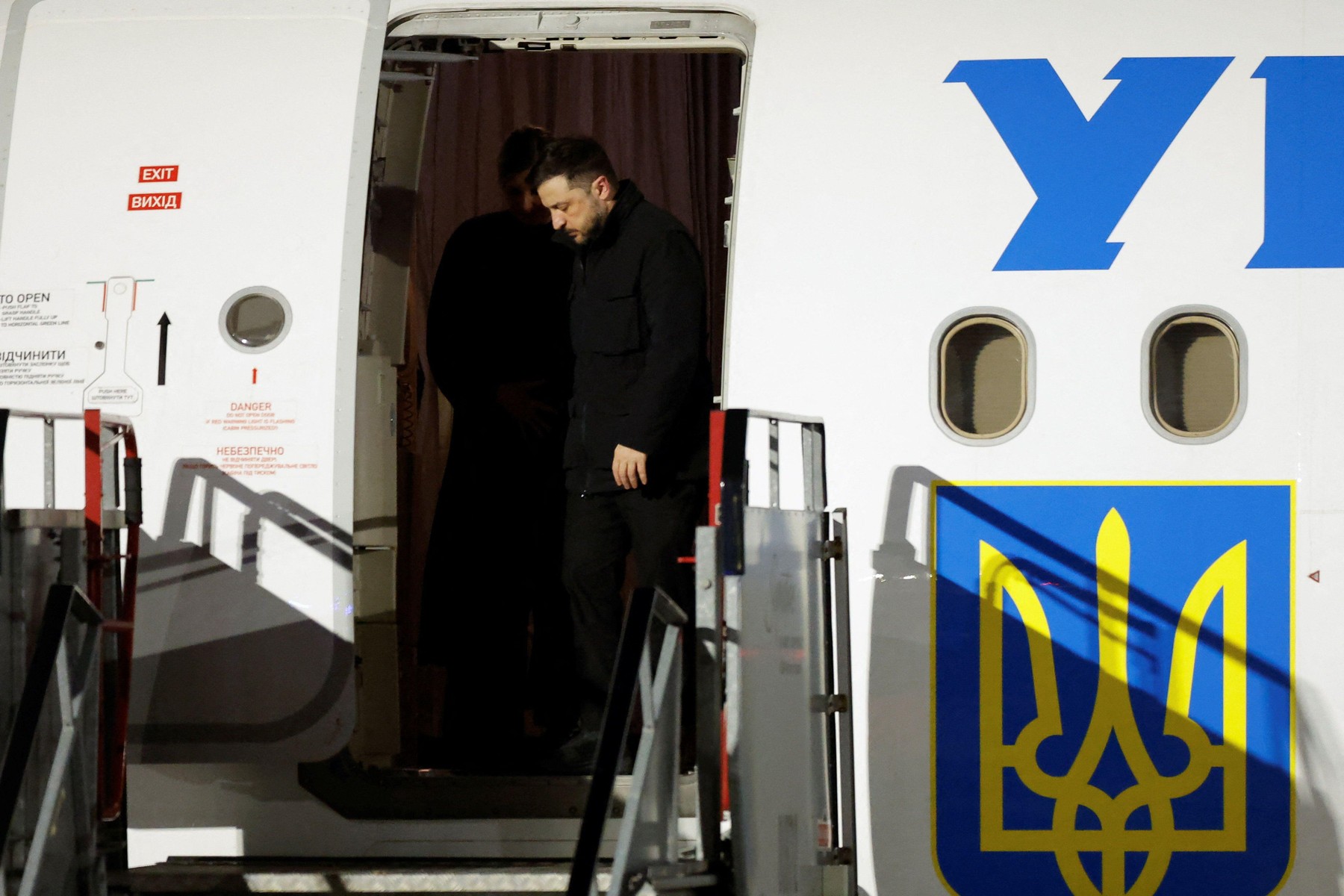
Four unidentified military drones breached a no-fly zone and flew into the flight path of Ukrainian President Volodymyr Zelensky's plane offshore near Dublin Airport late Monday night, The Journal writes.
The presidential aircraft landed shortly before the scheduled time, just moments before the incident, which occurred around 11:00 p.m. local time. The drones arrived at the spot where Zelenskiy's plane was expected to pass, just as the aircraft was due to appear.
The drones then orbited above an Irish navy ship that had been secretly dispatched to the Irish Sea for Zelenskiy's visit.
Sources told the Irish publication that the drones took off from north-east Dublin, possibly near the town of Howth, and flew for up to two hours. Investigations are currently underway to determine whether the drones took off from land or an undetected ship.
It is not yet known who launched and controlled the drones or where they are now.
Military drones are capable of performing a wide range of functions. In this case, the fact that the drones had their lights on led security forces to suspect that the aim was to disrupt the flight's arrival in Dublin.
Garda Commissioner (the national police force of the Republic of Ireland) Justin Kelly was informed of the incident in the early hours of Tuesday morning. Ireland's justice and defense ministers were also informed in the hours following the incident. It is not known whether the Irish authorities have informed the Ukrainian president's team.
Possible hybrid attack
The incident echoes similar drone incursions in Europe in recent months, which have led to the closure of airports in Brussels and Denmark and caused significant security tensions.
Irish security services found that the drones in the Irish Sea were large, extremely expensive, military-spec, and that the incident could be considered a hybrid attack.
Hybrid warfare includes the use of military and non-military tactics, such as drone raids, cyber attacks, sabotage, and disinformation, to weaken or destabilize adversaries without declaring full-scale war. This is generally carried out by military and intelligence services at the state level.
The Journal also writes that the drones missed the approach of the Ukrainian leader's plane and then turned their attention to the LÉ William Butler Yeats, the Irish warship that was secretly deployed off the coast of Dublin. The drones operated within the 12 nautical mile limit of waters controlled by Ireland.
Irish commanders made the decision not to shoot down the drones, and the warship did not have the ability to disable them. There are also reports that an Irish Air Corps aircraft was also on patrol at the time but did not engage.
The Irish forces had limited options to deal with drones (UAVs). The hand-held equipment purchased by the Irish National Police could not have been used to shoot down the drones as they were out of range. There was also no air defense capability except for the warship's machine guns. LÉ Yeats has no airborne radar capability.
Most likely, observers on the deck working on the ship spotted the drones, which were illuminated against the background of the night sky.
No-fly zone
The Irish Aviation Authority (IAA) has established a no-fly zone for drones over Dublin and surrounding areas for the duration of the leader's visit to Kiev.
Irish authorities suspect the drones were quadcopters as they could hover above the military vessel. This type of drone has four propellers that allow it to stay in one position.
A high-level meeting between An Garda Sochána (the Irish national police), the Irish Defense Forces and senior national security officials was convened in Dublin on Wednesday to review the incident.
Zelenski's visit to Dublin was uneventful. However, his plane used a special take-off on departure from Dublin Airport to limit exposure to any kind of drone incident.
The incident echoes similar drone incursions in other parts of Europe in recent weeks. A swarm of drones recently forced the closure of Brussels airport after causing similar problems in Denmark in September. The Dutch military fired on drones in a similar incident.
A swarm of drones is not believed to have been involved in the Dublin incident. Instead, sources say the UAVs moved independently of each other, meaning they were likely operated by four pilots.
The incident comes just weeks after The Journal revealed significant concerns about Ireland's security lapses ahead of its EU presidency next year.
In a statement, the Irish Defense Forces said: “Due to operational security reasons, we do not comment on the details of any alleged incident. However, Defense Force support to the security operation, led by the AGS (An Garda Siochána, nr), was successfully implemented in a number of ways, ultimately leading to a safe and successful visit by President Zelenski to Ireland.”
A spokesman for An Garda Siochána said: “In general and without commenting on any particular incident, any incident of this nature that occurs in Irish waters falls under the jurisdiction of the Defense Forces.”
The Irish Ministry of Defense declined to comment.