Zăganul, the extinct bearded eagle from the Carpathians. The story of the “bone breaker” who ruled the sky of Retezat

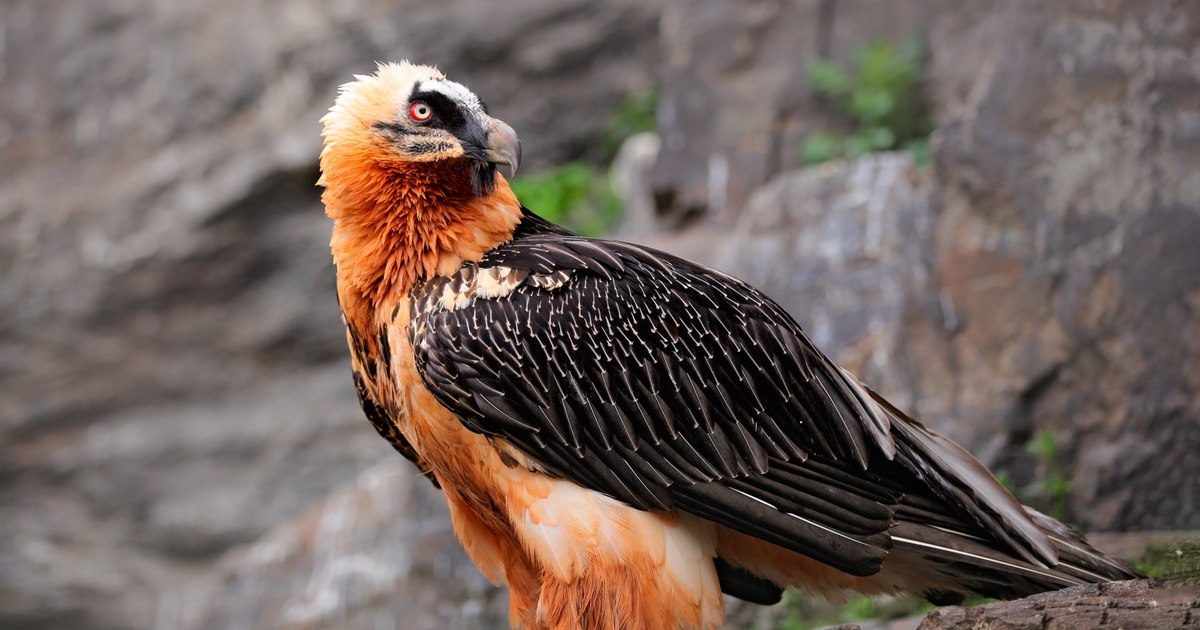
The Retezat Mountains were the last refuge in the Carpathians of the vulture, the bearded eagle that once inhabited the highest peaks in Europe. People's fear of vultures hastened their disappearance from Europe, but in some countries the species has been successfully reintroduced into the wild.
Zagan. Photo: Beard Vulture LIFE
The bearded eagle (Gypaetus barbatus), also called the griffon, was one of the four species of eagles that populated the Carpathian Mountains in the past, along with the black eagle, the griffon eagle and the griffon eagle. In past centuries, the buzzard nested in the high mountain regions of the Southern Carpathians.
“The species was already rare and localized in the mid-19th century, when ornithologists warned that poisoning, direct hunting and excessive trophy hunting could seriously affect its status in the Carpathians. Three traditional nesting sites were known: the Bucegi/Făgăraș Mountains, the Retezat-Parâng group and the Domogled-Cerna group”, showed a study published by ornithologists Márton A. Kelemen, Attila D. Sándor and Annette Mertens, entitled “Vultures in Romania, their past and present”.
Bones, the main food of gnats
The wild land of the Retezat had been, until the middle of the 20th century, one of the last refuges of the “bone cracker”, as the hawk is called, after its diet rich in bones.
“The bearded eagle is the only known species in the world that feeds exclusively on bones. Because of this, it must fly between nine and eleven hours a day to reach the 350–400 kilograms of bones it needs annually to survive and raise a single chick.” informs Gerardo Báguena, vice president and director of the Bald Eagle Conservation Foundation.
Woodpeckers feed mainly on bones, which make up 70 percent of their diet, while 25 percent is soft tissue and 5 percent skin. During the breeding season they need more soft tissue. They prefer large bones, up to 25 centimeters long and 3.5 centimeters in diameter, and they drop bones that are too large from heights of 20 to 70 meters to collect and consume the marrow.
According to the specialist, these birds do not hunt, do not fish, do not parasitize food and do not cause the death of other species, but wait until the other animals eat.
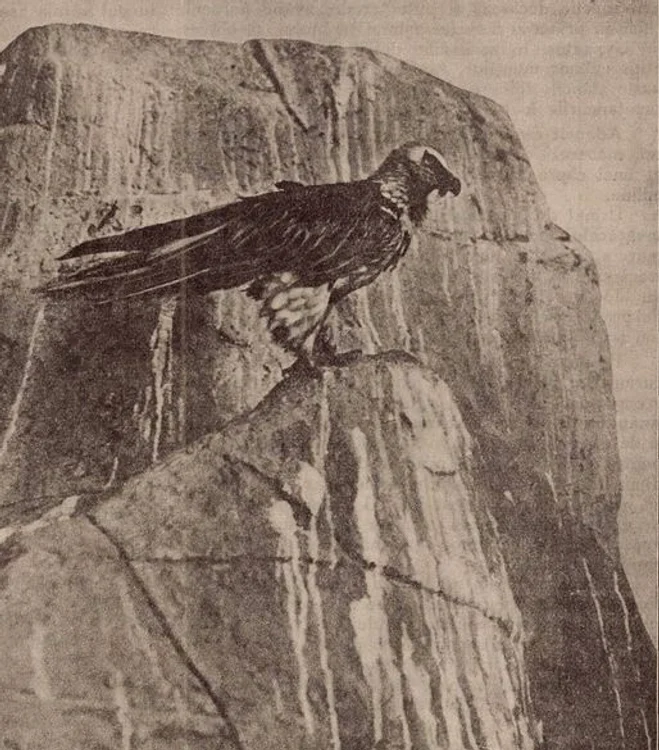
Zagan. Source: Carpathi magazine, 1930s
“Bearded vultures wait for vultures to eat, tear apart the carcasses, and then consume the remaining bones, recovering the protein from them. They usually eat limb bones, which are the easiest to digest. In just 6–7 hours, a 30-centimeter lamb leg bone can be absorbed and dissolved. For larger bones, they throw them against rocks to break them, where they come from and the name”Gerardo Báguena showed.
The species lives in isolated mountainous regions with steep relief, usually at altitudes above 1,000 meters. In Europe, Africa and Asia, it is found in areas where large predators such as wolves, snow leopards and mountain eagles live, but also herds of mountain goats, ibex and sheep. They are mostly monogamous, but can also form trios of two males and one female. They build large nests on isolated rocks or in caves, which they reuse over the years.
Breeding occurs from December to September in Europe and northern Africa. The eggs are incubated for an average of 54 days, and the chicks leave the nest after almost four months. In cases where two eggs are laid, the larger chick usually kills the smaller one, a behavior common in large raptors known as “cainism”.
Ancient poet accidentally killed by a vagrant
An ancient legend recalls the death of the poet Aeschylus, who was killed by a giant who would have broken his head, letting a turtle fall on him from a height.
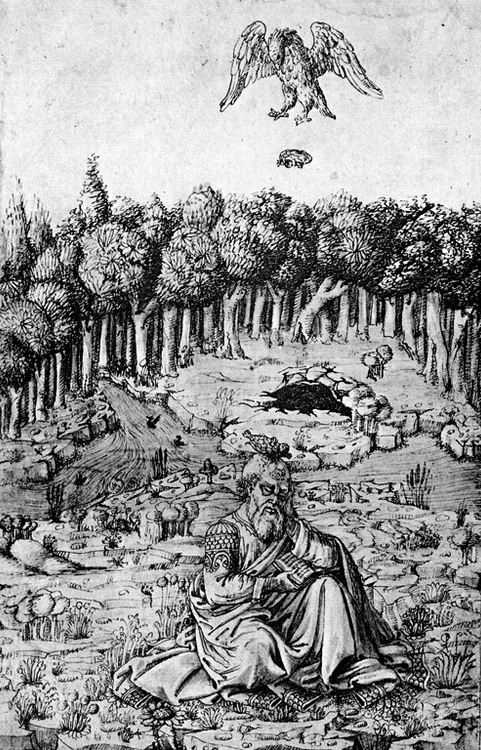
The death of Aeschylus. Source Florentine Picture Chronicle WIKIPEDIA
“I died struck in the forehead by what escaped an eagle's claws,” it was written on the tombstone of the great Greek dramatist, who had lived two and a half millennia ago.
In past centuries, the majestic eagles, distinguished by their rusty coloring, huge wings and “beards” of dark feathers, populated vast lands of Europe, especially in the Alps, Pyrenees and Carpathians.
For a long time, people looked at them with fear. The false image of a bloodthirsty bird that abducted children and killed cattle contributed to their extermination from many areas of Europe.
Prince Rudolf, fascinated by Retezat
Since the 19th century, Retezat had remained one of the few refuges of the vulture, and the fame enjoyed by this species even attracted Prince Rudolf (1858–1889) of Austria-Hungary here.
Passionate about natural sciences, hunting and ornithology, in 1882 the archduke participated in an expedition to Retezat, after which he left posterity a precious testimony about this land. He recounted in his diary that, arriving at the edge of the village of Râu de Mori, at the foot of the mountains, he placed an animal carcass as bait for the eagles he wanted to observe.
It was once the wildest place in the Carpathians. Retezat before the construction of the huge dam at Gura Apelor
“When I came down to the plains from the higher regions of the Retezat, for a single day, I had but little time to visit the decoy, and spent only two hours there, waiting in vain for the birds of prey to appear. Just as we left the place, only a few hundred yards from the roost, a very large griffon vulture (Vultur fulvus) flew over our heads.”wrote the explorer.
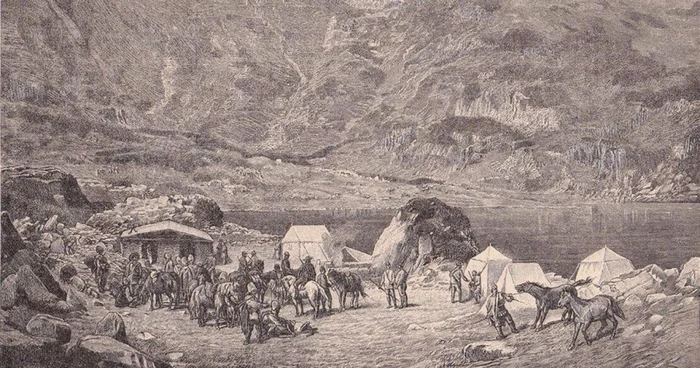
Prince Rudolf's expedition to Zănoaga. Illustrated
The heir to the imperial throne would be conquered by the view of the Zănoaga glacial lake, located at almost 2,000 meters above sea level, in Retezat, a place guarded by the Zăgani.
“We spotted the first bearded eagle (zagan) among the desolate heights near Lake Zănoaga, when the imposing bird swooped gently towards us and we could perfectly see its shaggy black beard and yellow-orange plumage, a sign of advanced age”wrote Rudolf in the volume “Notes about sport and ornithology” (1889).
By the end of the 19th century, the wild boar had almost completely disappeared from Romania, both because of hunting, being sought as a “trophy”, and because of poisoning. The species disappeared from the Domogled-Cerna area in the second half of the 19th century, the last known nest dating from Valea Cerna, from 1878.
In Făgăraș, the last known nest was found in the Dâmboviței Valley, in 1887, and in Galbenare, in the Bucegi Mountains, in 1886. In Parâng, the last nest of the shrike was observed in 1873, but there were observations of some specimens until 1910.
“The species survived the longest in the Retezat Mountains, where the last known successful reproduction took place in 1928, in Stănuleti. In the same winter, one of the adult birds was shot. Birds were still observed there until January 20, 1933, when the last gannet was seen in Romania”. noted the authors of the research “Vultures in Romania, their past and present”, published by the Romanian Ornithological Society and the Milvus Association.
Retezat, the last refuge of the zagans
In Romania, some of the last specimens could still be observed in the middle of the 20th century in captivity, but also Retezat, the wild land of glacial lakes, which became the first national park in Romania in 1935.
“The pride of the eagle family and a real monument of nature in the Retezat is the vulture (bearded eagle, Gypaëtus barbatus grandis). A huge bird, extinct in the Alps since 1894 and shamefully exterminated from the Făgăraș Mountains, by strychnine, it appears almost every year in the Retezat, nesting on precipitous subalpine peaks, where eggs through January and February,” noted the scientist Alexandru Borza, in 1933, founder of the Retezat National Park.
In the middle of the last century, the Retezat Mountains were, according to ornithologists, the last bastion of the Zagans.
“After the Retezat massif became a royal hunting territory, then a national park, a pair reappeared in the same region, about 7-8 years ago, and settled here again, nesting every year, according to the observations of the guard staff. A specimen, probably a descendant of this pair, was shot in 1927 on the Surul mountain (Făgăraş) and is in the museum of the Society of Sciences in Sibiu. Today they are protected by law. Let's avoid the use of strychnine altogether, for which we are responsible for posterity. The old naturalists, from 400 years ago, remembered the zagan as a well-known bird in our Carpathians, but today they can be counted on the fingers, even in the Balkan Peninsula numerous.”, informed in 1937 the scientist Dionisie Linția.
The animal brought back from the Alps that conquered the Carpathians. Disappeared in the 19th century, it is now the star of the glacial lakes
Zăganul, reintroduced in the Alps and Pyrenees
The extensive population decline of the last two centuries, influenced by humans, led to the disappearance of these birds from most mountain ranges in Europe by the middle of the 20th century.
“The Balkan population was the last to disappear, only at the beginning of this century, and the species remained only in the Pyrenees, Crete and Corsica. Since the mid-1980s, the species has been reintroduced in several European mountain ranges, first in the Alps, and more recently in Andalucia (Spain), Grands Causses (France) and Picos de Europa (Spain), reaching a total of 207 pairs”. shows the Bearded Vulture LIFE organization.
Some Western states have supported the reintroduction of the jay into the wild through long-term conservation programs.
According to experts, the reintroduction of the vulture in the Alps, which began in the 1970s, was among the most successful and complex multidisciplinary reintroduction projects in Europe, representing an investment of millions of euros, supported by vulture specialists, hunters, local authorities, tourists, animal breeders and others, the organization noted.
The Zagans return to the Balkans
In 2025, the first three young zagans were released into the wild in Bulgaria, on the territory of the “Sinite Kamani” Nature Park, following a project funded by the European Union.
“This is not only a key step in the implementation of the project dedicated to the bearded eagle, but also a historic moment for nature conservation in Bulgaria. This majestic species was not only part of our natural heritage, but also became a symbol of the protection of flora and fauna in Bulgaria, thanks to the initiative of biologist Nikolay Boev”informs, in 2025, the organization Bearded Vulture LIFE.
It runs, from 2023 to 2030, a project aimed at restoring the buzzard (Gypaetus barbatus) and black vulture (Aegypius monachus) populations in Bulgaria and the Balkans. In Romania, in recent years, sporadic occurrences of vagrants have been observed.