Who will be the new UN leader and why it matters more than ever. Who announced his candidacy?

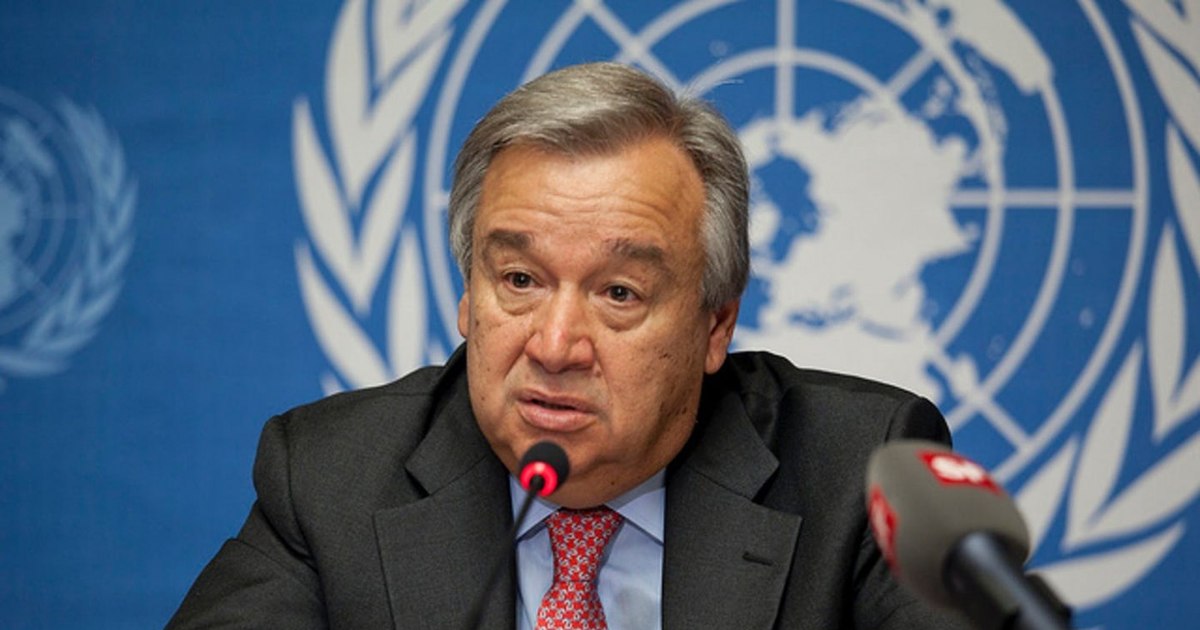
The Secretary-General of the United Nations is currently the last individual voice with a universal mandate that can demand that power obey the law. In this context, given that António Guterres will end his mandate at the end of 2026, the ongoing succession process takes on crucial importance, notes telus.fr.
António Guterres ends his mandate at the head of the UN at the end of this year/PHOTO: EPA/EFE
The UN was built on a fundamental principle: member states must legally justify the use of force. This principle is today under major pressure. On February 28, 2026, the United States and Israel launched strikes on more than twenty targets in Iran following the failure of nuclear negotiations mediated by Oman. Iran responded with missile and drone attacks on Israel and US installations in the Gulf, affecting the sovereignty of several states.
On the same day, António Guterres addressed the emergency UN Security Council. He invoked the prohibition of the use of force and emphasized that “international law and international humanitarian law must be respected in all circumstances.” He condemned both the US-Israeli attacks and the Iranian retaliation.
In this tense context, the European Union should pay much more attention to a process it treats largely with indifference: the appointment of the next UN Secretary General, who will take office on January 1, 2027.
International law, put to the test
Under the leadership of Donald Trump, the United States has moved from treating multilateral commitments as mere guidelines to promoting what its own doctrine calls a “war of choice.” When the principal architect of the post-1945 international order flouts the rules, the contagion effect is rapid. In such a context, the role of the Secretary-General becomes essential to insist that the use of force has a legal basis.
Although international law continues to facilitate coexistence and cooperation between states, it is losing its influence on those who should respect it. The permanent members of the Security Council — China, the United States, France, the United Kingdom and Russia — use their veto power to avoid responsibility, while Washington has withdrawn from several major international agreements.
António Guterres' statement that “even war has rules”, made in the context of the Gaza conflict, reflects this essential function of the UN Charter. But this constraint is questioned by leaders who say they do not need international law.
Charter vs “charter”
The situation in the Gaza Strip illustrates the consequences of abandoning these principles. Security Council Resolution 2803, adopted on 17 November 2025, created a “Peace Council”, formally authorized by the UN but designed to operate outside its oversight mechanisms. It operates on its own charter, which makes no reference to international humanitarian law or Palestinian self-determination, and designates Donald Trump as the inaugural president, with veto power.
Deadlock in the UN Security Council: France made a common front with Russia and China against the opening of the Strait of Hormuz through military intervention
States such as France, Germany and the United Kingdom refused to participate, citing the risk of legitimizing a structure lacking control. However, this reaction was defensive rather than constructive, not accompanied by clear alternative proposals.
This example shows how UN authority can be used to concentrate power while emptying the principles of the Charter. In such a context, the role of the Secretary General becomes even more important.
A decisive sequence
António Guterres' mandate, which began in 2017 and was subsequently renewed, will end at the end of 2026. The selection process, launched in November 2025, is decisive. However, the official criteria only cite “leadership qualities” and “extensive international experience”, without explicitly mentioning independence from great powers or commitment to international law.
So far, four candidates have announced their candidacy: Michelle Bachelet, Rafael Grossi, Rebeca Grynspan and Macky Sall. No clear favorite has emerged. The selection in the Security Council is expected by the end of July, and the official appointment at the end of the year.
Europe, an absent voice
The European Union presents itself as a guarantor of the UN Charter, but does not treat the election of the future Secretary General as a priority. His reaction to the attacks on Iran reflects the same ambiguity: he condemned the Iranian retaliation as “inexcusable”, without qualifying the US-Israeli strikes as violations of international law, although they have been assessed as such by the Secretary-General, legal experts and states such as Spain and South Africa.
Selective sentencing cannot be a tenable position. It weakens Europe's credibility, including in the process of appointing the future leader of the UN.
Many justify this reservation through political realism, arguing that it is the UN Security Council that decides. But this perspective confuses formal competence with political responsibility. A general secretary elected so as not to disturb the great powers will not insist on respect for the law.
A dialogue between European leaders on the essential criteria — especially independence and commitment to international law — would not disrupt the formal process, but would clarify expectations and emphasize the importance of this choice.
The Secretary-General remains the last individual voice with a universal mandate capable of demanding that power obey the law. If this voice disappears, it will not be the law that has failed, but the states that have chosen to ignore it.