Messages from astronauts who made history today: “It's amazing to see this side of the Moon”

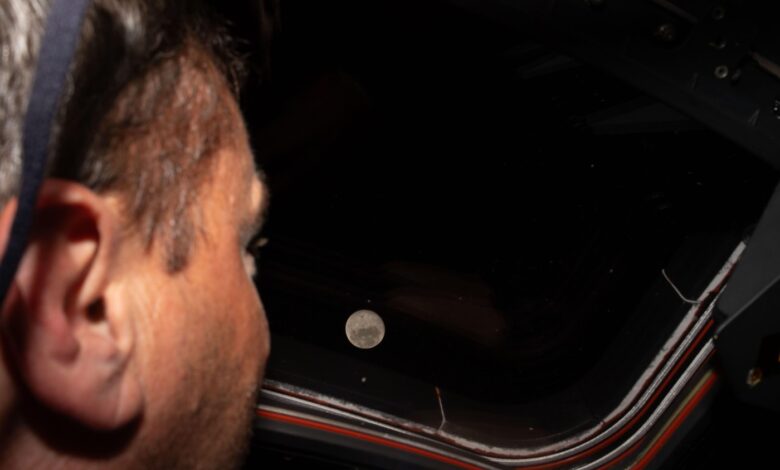
The crew of the historic Artemis II mission has officially begun its flyby of the Moon and is already making scientific observations, Sky News and CNN report. The astronauts reported to NASA's Control Center that they could see both the Moon and the Earth from the Orion spacecraft.
The four astronauts of the Artemis II mission – the Americans Christina Koch, Victor Glover, Reid Wiseman and the Canadian Jeremy Hansen – recently broke the record for the distance traveled by humans in space, surpassing the farthest point in relation to Earth that had been reached by the astronauts of the Apollo program in the 1970s.
They are now preparing to fly over unknown regions of the Moon and its hidden face for several hours. The Artemis II mission crew will work in shifts to photograph the Moon for the next six hours, CNN writes.
Christina Koch, the mission specialist who made history by becoming the first woman to fly on the moon, has revealed that astronauts are now “glued to the portholes” to admire Earth's natural satellite.
“It's amazing to see this side of the Moon”
“I wish you were up here to see all (our) smiling faces … we're just excited to get this day started,” said Artemis II mission commander Reid Wiseman.
Astronaut Christina Koch said for her part: “It's amazing to see this side of the Moon. (…) We couldn't be more grateful, we're ready to apply everything we know from the training we've been through.”
The crew also said that what they've already seen with the naked eye is “very impressive” and they can't wait to see the scenery ahead.
Artemis II crew already seeing 'amazing sights'
Astronaut Reid Wiseman of NASA and Astronaut Jeremy Hansen of the Canadian Space Agency are now positioned at the windows of the Orion shuttle and are already taking photos of the moon's flyby. NASA astronaut Christina Koch shares their observations:
“We just had an amazing moment when we realized that Hertzsprung is about the same size as our incredible Orientale,” Koch said of the two large craters on the moon. Hertzsprung is older than Orientale, which is why the science team would like to compare aspects of both formations.
“We also notice that the Moon gets noticeably bigger as we get closer, even when you watch it continuously,” Koch noted. “We can see the Moon and the Earth simultaneously right now. It's interesting because the Earth looks much brighter.”
Astronauts will fly behind the Moon and discover its hidden face, the one never visible from Earth.
They would not land on the moon, but their flight was still a first, as none of the Apollo lunar missions (1968-1972) had female astronauts, black astronauts, or non-American astronauts on board.
They will likely see “regions of this hidden face that none of the Apollo astronauts could see,” explained Jacob Bleacher, director of NASA's science exploration division.
The crew has already seen the Mare Orientale Basin, a gigantic crater dubbed the “Grand Canyon of the Moon,” which until now had only been seen in its entirety by spacecraft.
“It's just like training, only in 3D and it's just incredible,” exclaimed Jeremy Hansen.
Their lunar flyby will also allow them to witness a solar eclipse – the Sun disappearing behind the Moon – and a sunrise and sunset of Earth behind the Moon.
This is reminiscent of the famous “Earth Sunrise” photograph that revolutionized our view of the world in 1968 during the Apollo 8 mission.