The fate of the missing crew member of a US fighter jet shot down over Iran could be a decisive variable in an already volatile conflict, one that could reshape not only military strategy but also Washington's political calculations, reports The Telegraph.
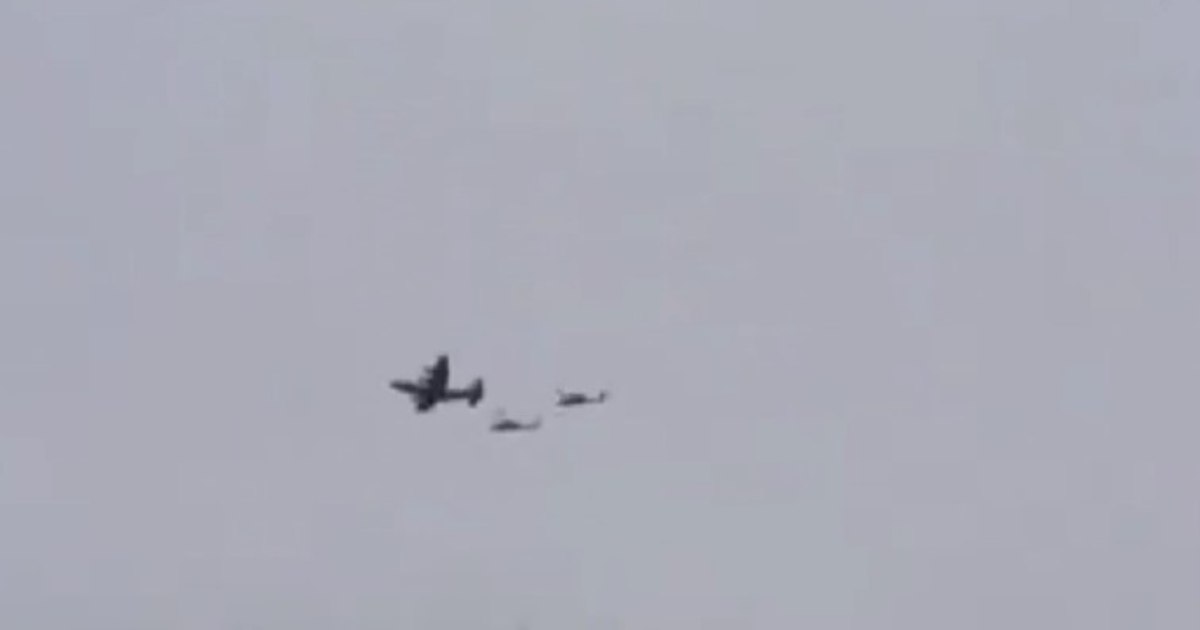
Rescue helicopters were spotted after the downing of the plane PHOTO video capture
US officials confirmed Friday that the pilot of the F-15 jet downed deep in Iranian territory was rescued by US forces in a high-risk operation. The recovery, conducted over hostile terrain, involved Black Hawk helicopters flying at low altitude through mountain valleys, supported by C-130 transport aircraft and reconnaissance drones. At least during this phase of the mission, officials said, the operation was conducted without further American casualties.
However, the relief generated by the pilot's rescue is overshadowed by uncertainty over the fate of the second crew member, a weapons systems operator who remains unaccounted for. His fate – captured, hidden or dead – could influence the next phase of the war.
The image of US aircraft operating relatively unchallenged over Iranian territory could already be influencing thinking in Washington. With Donald Trump considering the possibility of a ground invasion, such operational success could encourage a more aggressive approach.
But the situation could escalate in the event of a capture, and in this case several potentially dangerous scenarios are possible
One of them evokes a poignant historical precedent: the hostage crisis of 1979. For 444 days, American diplomats held captive in Tehran dominated the public agenda, influencing public opinion and contributing to the electoral defeat of President Jimmy Carter. A similar dynamic could repeat itself if Iran captures the missing serviceman and decides to do so publicly.
If Iran releases propaganda images of the pilot, Trump would immediately face pressure from Congress, military families, veterans groups and the American public to halt operations and negotiate his release. Under these conditions, continued airstrikes could become politically unsustainable, perhaps forcing Washington to conclude a cease-fire on less favorable terms.
Negotiated release
Another scenario would be for Iran to act discreetly — capturing the military without making it public, instead using it as leverage in negotiations. In this scenario, the captured military becomes a strategic asset.
A captured American serviceman could be worth much more to Iran than a simple truce, notes The Telegraph. Tehran could try to bundle several demands: an end to hostilities, control over transit through the Strait of Hormuz, limiting future US military operations and even easing sanctions.
Earthquake at the Pentagon in full war with Iran: the head of the US Army, forced by Pete Hegseth to immediately retire from office
Iran has consistently sought to turn the blockade of the Strait of Hormuz into a permanent transit control. Recent initiatives by parliament to formalize shipping fees and restrictions highlight this intent. Having an American airman would give Tehran a bargaining power it hasn't had in strictly military talks.
For Trump, such a scenario involves risks, but also a way out. Domestic pressure to recover the airman would be intense, but a negotiated deal could be presented as accomplishing several goals at once: recovering an American serviceman, weakening Iranian military capabilities, and getting a deal done. It would represent a possible de-escalation ramp.
The missing soldier is killed
The most dangerous scenario, however, remains the death of the airman – either during capture or in a failed rescue attempt. Such an outcome could fundamentally change the nature of the conflict, potentially triggering a ground invasion.
If the weapons systems operator dies and there is evidence that Iranian forces killed him after the launch, or if a rescue attempt fails with American casualties, Trump will face immediate pressure to respond, notes The Telegraph. In such a context, calls for restraint could be replaced by calls for decisive action, including ground operations.
Trump has already hinted at a possible escalation, announcing that the United States will hit Iran “extremely hard in the next two to three weeks,” threatening to hit electrical infrastructure and other critical systems. But a large-scale ground campaign would require a justification, and the death of an American serviceman could provide one.
Such a conflict would encounter formidable obstacles. Iran's geography presents a major challenge in itself. The Zagros Mountains stretch for 1,000 miles, with peaks over 4,200 meters and narrow valleys that can turn attacking troops into vulnerable targets. Only a few defenders can stop entire columns.
Beyond the land, there is also the local population. Reports indicate that local authorities are offering rewards for the capture or killing of the Americans, while local tribes have mobilized for the search. Detailed knowledge of the terrain would give them a considerable advantage over any invading force.
The situation has been compared to the 1993 “Black Hawk Down” incident in Mogadishu, where a planned one-hour mission degenerated into an 18-hour standoff that left 18 American soldiers and hundreds of Somalis dead.
So far, the pace and scope of the war has largely been dictated by Washington. But with a crew member still missing, that control could begin to erode. The fate of the weapons systems operator could thus become a turning point for the future direction of the conflict.