A leading banker warns that AI could lead to a “tragic end” for capitalism. “Superintelligence Phase”

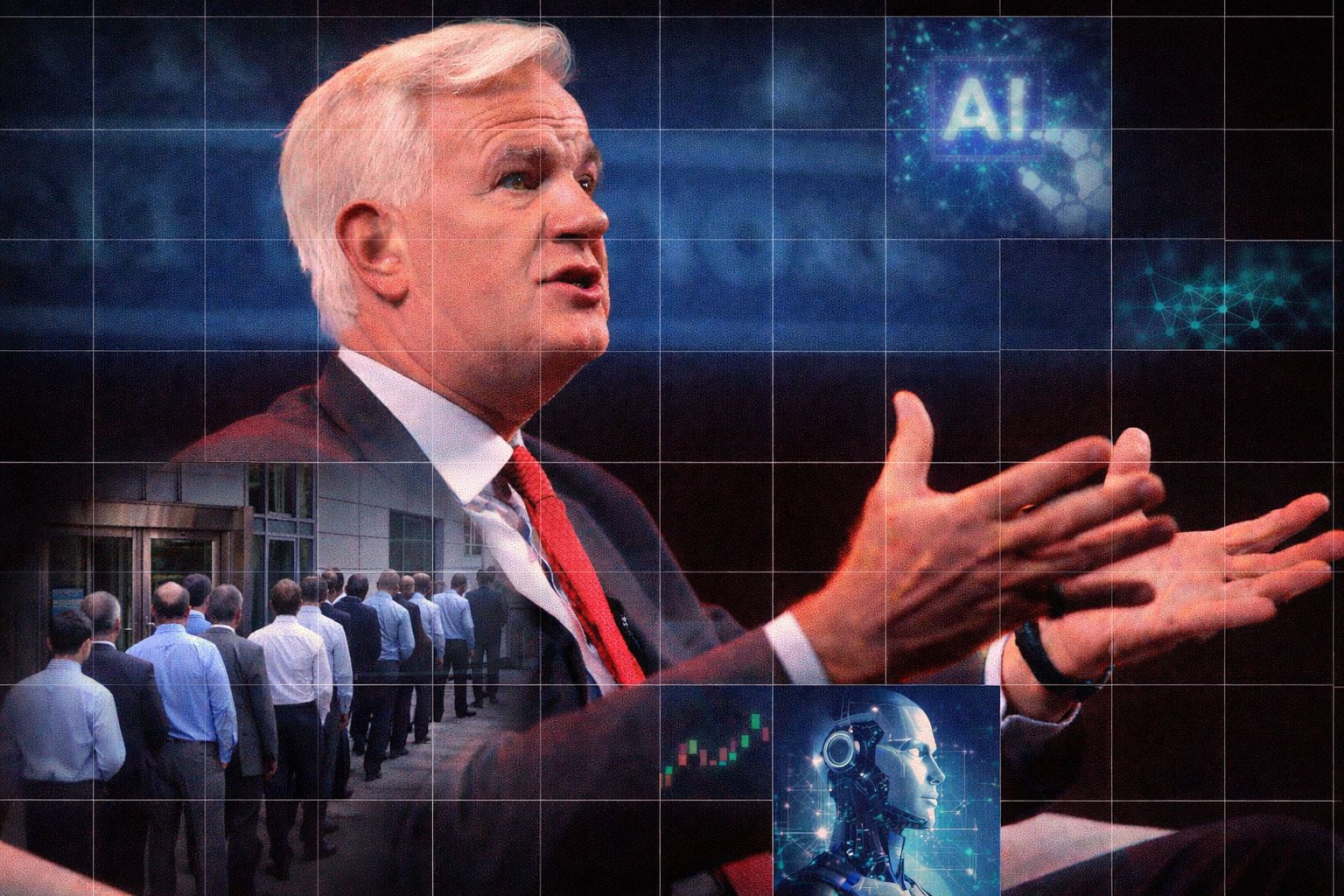
For Jay Collins, a veteran banker at Citi, the rise of artificial intelligence (AI) and robotics is a threat to the future of capitalism that cannot be ignored, reports Business Insider.
Collins, who is Citigroup's chairman of the public sector, has spent more than three decades advising government officials in times of financial crisis and distress.
He says in an interview with Business Insider that AI and robotics are challenges to capitalism that policy makers and business leaders must address head on.
“We have to adjust it (no – capitalism), reshape it, remake it to make room for these things, just like we did during the Industrial Revolution,” Collins told Business Insider. He pointed out that the alternative is “an authoritarian capitalist regime”.
Among other things, he explained the impact artificial intelligence and robotics could have on the workforce and why the middle class is at risk.
“The first wave is cognitive jobs. It starts with white collar jobs (no – office work), not blue collar jobs (no – manual labor). It affects students who thought a college degree meant everything, graduate students who said, 'If I can just learn to code, I'm safe'. It touches fields like software, finance, media, consulting, accounting and lawyers,” he says.
The banker warns that the development of AI will exacerbate inequality
Jay Collins says the situation must also be seen in the context of increasing inequality between the rich and the poor, which is sometimes described in the literature as producing a “K-type economy”.
In the US, Collins argues, half the population is at the bottom of the economy and only 10% at the top, with a net worth of $2 million or more.
“The middle class of the K economy has stagnated. They haven't been hit yet. But they don't own capital assets. So what happens over time as we move into the second wave? You have the 10% who not only have high salaries, but more importantly, are the biggest participants in the capital market. Basically, they're benefiting from wealth creation and increasingly separating themselves from non-participants, including the middle class,” he warns.
The second phase of the development of artificial intelligence
Collins sees four phases of AI development. The first, he says, is generative artificial intelligence, which creates content through chatbots such as ChatGPT, Claude, Gemini, and other tools.
But the banker says the technology has already entered its second phase, that of “agentive” artificial intelligence. So-called “AI agents” are artificial intelligence tools designed to perform various tasks head-to-head, as autonomously as possible and with minimal human input. An “AI agent” could replace, for example, an employee in charge of recruitment or an accountant in charge of keeping track of current operations.
More broadly, an agentic AI, whether bringing together multiple “AI agents” or standing alone, could automate the work of an entire HR or accounting department within a company, or even interconnected jobs across departments.
“Think of it as going from analysis and research to action. An agent can act,” Collins points out.
He says the third phase is so-called “physical” artificial intelligence, where advanced AI models are “embodied” in performing robots.
“And of course the last phase, where the future of capitalism faces its greatest challenge, is General Artificial Intelligence. The superintelligence phase,” he added. Artificial General Intelligence, or AGI, denotes that hypothetical stage in the evolution of AI where systems will be able to perform any cognitive task as well or even better than a human.
The next major wave of job disruption, by the end of this decade
Jay Collins says that, depending on the experts he consults, the next wave of major jobs turbulence is likely to occur in 2028 or 2029.
“We're not there yet to rush the integration of AI and robotics into manufacturing facilities. That's when the disruption to blue-collar jobs really comes in,” he warns.
“The smartest technologists I've talked to — leaders in technology, AI, and robotics — most of them would slow this down if they could, because we're not ready. It screams that we're not ready. And I see that we haven't really tested how to deal with that kind of situation. Why do they say they can't? They say they can't because of China. They say they can't because of the geostrategic component,” he says, referring to the “arms race” between the US and China in matter of AI systems.
A 'production dividend' to prevent a 'tragic end to capitalism'
Collins says that one possible answer would be to introduce a universal minimum income for the entire population, but that over the years the concept has become so politicized that it is now widely disdained and the measure would not be politically feasible.
However, he emphasizes that solutions are needed, because “no answer means anything other than a tragic end to capitalism and, potentially, democracy.” “I don't want to predict how quickly it will happen, but at some point, this disruption requires a response,” she added.
The banker mentions as a possible solution a “productivity dividend”, which can initially start with very small amounts.
“You can gradually adjust the level and see what effect that has on the incentive structure. Do people feel more confident about taking risks? Some would argue that. Others would say that the evidence shows that once you get past a certain threshold, you've been discouraged. But we need to experiment aggressively with this now, because we need to see what can be done,” urges Collins.
He says there are all sorts of ideas for getting the money for such a program, and lists taxing robots, taxing AI, taxing assets, taxing billionaires, adjusting corporate taxes, to targeting industries that drive AI and robotics right at their facilities.
“Think about what it would mean to have some mandatory equity participation; wealth creation either through a redistributive mechanism through a sovereign wealth fund or through a complete redesign of the welfare system. So it's not just about cash. There is actually equity participation,” he points out.