Jeff Bezos wants to save the Earth with an idea reminiscent of the Netflix movie “Don't Look Up”

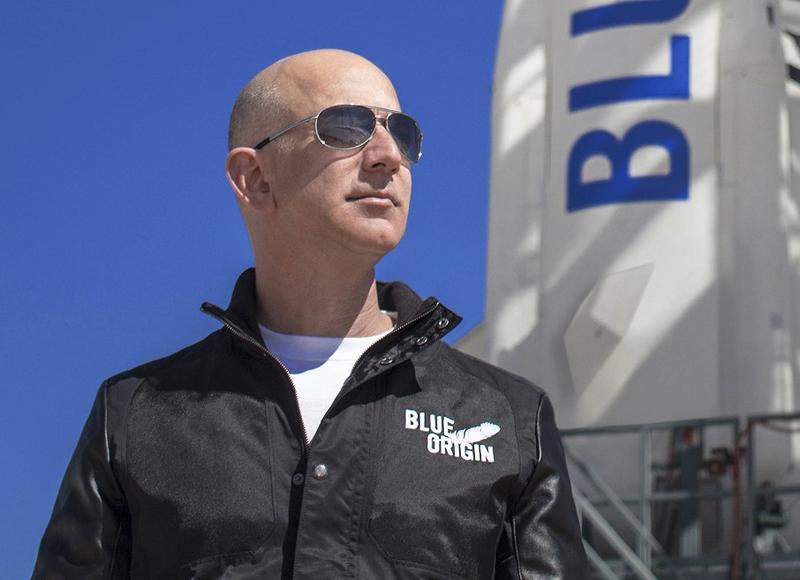
American billionaire Jeff Bezos' aerospace company Blue Origin aims to add the title of “defender of the Earth” to its portfolio by developing a new mission concept to deflect asteroids before they hit our planet, Gizmodo reports.
Blue Origin recently unveiled the mission it called “Near-Earth Objects (NEO) Hunter,” with the explicit goal of protecting Earth from potentially dangerous asteroids. Bezos' company is collaborating on the project with NASA's famous Jet Propulsion Laboratory and the California Institute of Technology to develop the mission concept and test several asteroid deflection techniques designed to redirect space rocks on an impact trajectory with our planet.
“Working with JPL/Caltech, we have developed a Near-Earth Objects (NEO) Hunter mission concept for planetary defense using Blue Ring. NEO Hunter is testing multiple asteroid deflection techniques, including ion beam deflection and robust direct kinetic impact, helping to protect Earth…” Blue Origin noted in a message it published on the “X” platform.
The Blue Ring is a spacecraft platform designed to support the operation of space vehicles under development by Blue Origin. The platform is designed to be capable of refueling, transporting and hosting satellites, with a prototype being launched with the maiden flight of the New Glenn rocket in January 2025.
Asteroid hunting with Jeff Bezos' company
Blue Origin's NEO Hunter mission consists of two parts, or phases. In the first phase, it would deploy a fleet of tiny CubeSat-type satellites to rendezvous with the target asteroid and measure its properties, collecting data on its composition, density and mass. The data received would help scientists determine the best method of deflecting the space rock.
The mission would be equipped with various tools to mitigate the threat posed by the asteroid, including directing a powerful ion beam (a concentrated stream of charged particles) at the object to alter its orbit. This method would gradually influence the momentum of the asteroid, changing its trajectory over time.
If the asteroid proves too large or too difficult to redirect with the beam, NEO Hunter can enter a second phase of the mission. “Robust Kinetic Disruption” is heavily inspired by NASA's DART mission, which crashed into the asteroid satellite “Dimorphos” in September 2022 and successfully altered its trajectory.
Similarly, NEO Hunter can aim for a direct kinetic impact, hitting the asteroid at high speed to deflect it from its Earth-oriented trajectory. The mission is also designed with its own “Slamcam”, a smaller satellite intended to document the impact to confirm its success.