The Streisand effect hits Microsoft. “Microslop” floods the Internet after Nadella's appeal


Microsoft employees first tried to solve the problem in the simplest way: they added “Microslop” to the list of banned words in chat filters. When users started bypassing the filter using zeros, dots and other tricks (“Micr0sl0p”, “M!cr0sl0p”), moderation tightened the rules. Ultimately, as thousands of identical messages flooded the channels, the company decided to shut down the entire server “temporarily to implement stronger security measures.” The message was laconic and typically corporate, but for hundreds of thousands of Internet users watching the matter, it had a completely different meaning: Microsoft is unable to cope with the criticism it has caused.
This is not just a regular spam and moderation incident. It's a symbol of how deep user frustration has run with the aggressive, pervasive implementation of artificial intelligence in Windows, Office, Edge and other Microsoft products. The company that recently celebrated billions of dollars in investments in OpenAI and promised a “new era of productivity” has come face to face with a wave of resistance that can no longer be silenced or ignored. And it all started with one, seemingly innocent speech by the head of Microsoft.
It all started at the end of 2025, when Satya Nadella published a widely commented entry on LinkedIn and the Microsoft blog titled “Looking Ahead 2026”. In a long, reflective text, the company's CEO appealed to the entire technology industry to change the way we talk about generative artificial intelligence.
“Too often we hear the term 'slop' – junk, worthless content generated by AI,” Nadella wrote. -It doesn't help anyone. AI is a scaffold for human potential, not a replacement. It's time to stop using this word and start building a future based on human-machine cooperation.
“Microslop” conquers the Internet
The statement was intended to be a signal to de-escalate tensions. Instead, it became a spark. The online community — especially tech forums Reddit, X and Discord — interpreted the Microsoft CEO's request as an attempt to impose a narrative and prohibit criticism. Within a few days, the “Microslop” meme appeared – a malicious play on words linking the company's name with the very term that Nadella wanted to eliminate from circulation – slop.
- Read also: Iceberg beneath Microsoft's deck. A change of course is needed
At the turn of January and February 2026, the meme took on a life of its own, but the real breakthrough came when an independent developer published a free extension for Chrome and Edge browsers called “Microsoft to Microslop”. The extension worked very simply: on every page visited, it replaced the word “Microsoft” with “Microslop” – but only visually, in the user's view. Links, filenames and searches still worked correctly. During the first week, the extension was downloaded over 180,000. times, and his GitHub page has collected thousands of stars.
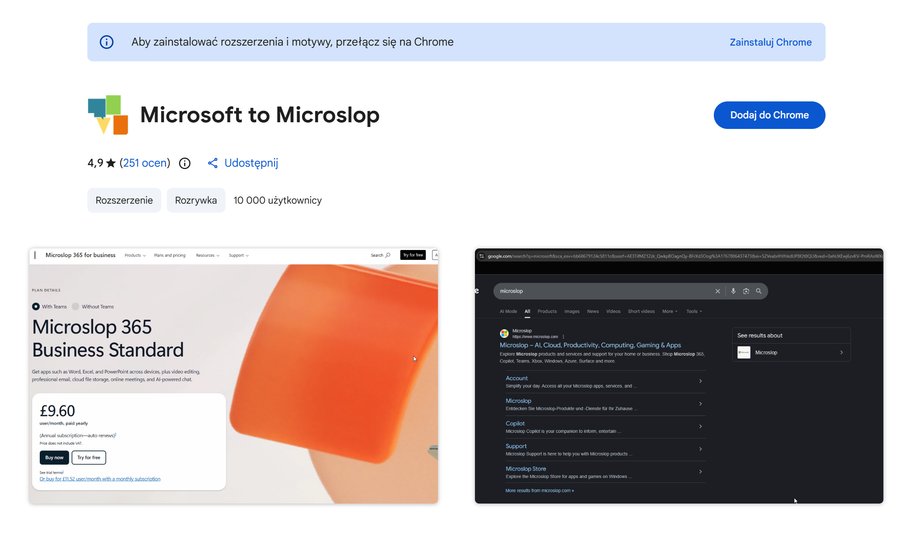
“Microsoft to Microslop” browser extension
At the same time, the first “Microslop” threads began to appear on the official Copilot Discord server – a place that Microsoft created as a central point of contact with users, developers and AI enthusiasts. Initially, these were single jokes in off-topic channels. However, soon users began to spam general, support and even bug reporting channels en masse. Within 48 hours before the server shutdown, the number of messages containing variations of “Microslop” exceeded tens of thousands.
On March 1, 2026, an official announcement from the Copilot team appeared and the server remains offline.
The Streisand effect always works
Satya Nadella, who has been at the head of Microsoft for years, wanted nothing more than to change the way the world talks about artificial intelligence. Nadella argued that the term “slop” tarnishes the image of the entire technology and that AI should be seen as a “scaffolding for human potential” rather than a cheap replacement. He wanted to steer the discussion towards a positive direction, emphasizing the cooperation between man and machine instead of focusing on errors and imperfections.
The Internet's reaction was immediate and completely opposite to expectations. Instead of dying down, the criticism exploded. The word “slop”, which Microsoft's president tried to discreetly withdraw from circulation, suddenly gained cult status. In December 2025, Merriam-Webster even named it its Word of the Year. Memes, graphics and jokes spread like wildfire on Reddit, X and Discord, and the “Microsoft to Microslop” browser extension only accelerated the pace.
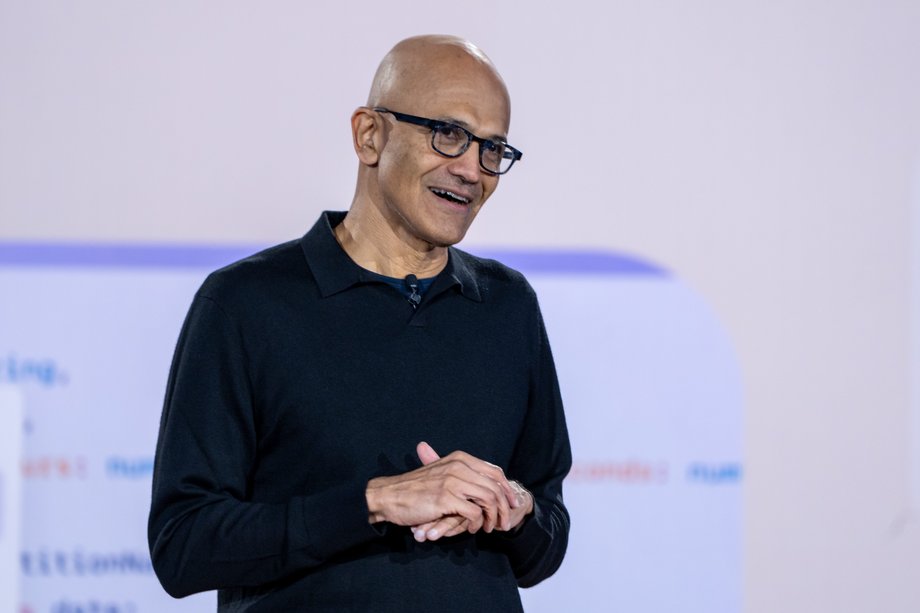
Microsoft CEO Satya Nadella
|
Stephen Brashear/Getty Images/Getty Images
This is a classic example of the so-called Streisand effect, a phenomenon that owes its name to singer Barbra Streisand. In 2003, she tried to legally remove photos of her estate from the Internet, arguing that it was a violation of privacy. Instead of disappearing, the photos went viral and within a few days were viewed hundreds of thousands of times more than if no one had intervened. The exact same thing happened now: the more Nadella and his team tried to suppress negative associations with AI, the louder they came back. Instead of calming down the situation, the Microsoft CEO's appeal acted like gasoline poured on a fire – at a time when no corporate announcement can stop a viral meme.
- Read also: Copilot read our private emails. Microsoft is downplaying the problem
Microsoft's Streisand effect shows something deeper than just a failed PR strategy. It proves that in the era of social media, trying to control the language and narrative around a controversial product usually ends in strengthening the opposition. Users did not feel heard – on the contrary, they felt that a large corporation was trying to impose on them what they should think about a tool that they increasingly perceive as irritating and forced. As a result, “Microslop” was no longer just a joke. It has become a symbol of a broader rebellion against Microsoft's implementation of artificial intelligence.
Pushing AI has a negative impact
The frustration that erupted on Copilot's Discord server didn't come out of nowhere and is not directed against artificial intelligence in general. People aren't rejecting AI as a technology – they're rejecting the way Microsoft has made its Copilot a ubiquitous and impossible to ignore element of almost every product. The assistant appears uninvited in Windows 11, suggests text in Word, generates slides in PowerPoint, suggests answers in Outlook and even in Edge suggests what we should enter in the search engine. For many users, this is not a help, but a constant, insistent reminder that the company treats them like test rabbits in a great automation experiment.
Copilot does not have a good reputation
|
BalkansCat / Shutterstock
The problem is made worse by very specific, measurable inconveniences. Independent tests, including those conducted by researchers from Harvard Business School at the turn of 2025 and 2026, showed that the constant operation of Copilot in the background significantly burdened Windows 11 computers. On an average business laptop, the performance drop reached up to 15-20 percent. during regular office work.
Added to this is the feeling that Copilot is being pressed forcefully. Microsoft doesn't offer a simple, straightforward “turn off everything” toggle. Disable options are scattered throughout various system settings, require a Microsoft account, and often return automatically after updates. Many users feel trapped: they pay for a Microsoft 365 subscription and in return they get a product that, instead of making their lives easier, forces them to constantly bypass or disable new “features”. This enforced presence creates resistance similar to that once created by Windows ads or forced updates.
Bill Gates warned
In February 2026, during an interview for the TBPN podcast, Satya Nadella himself publicly admitted that already with Microsoft's first billion-dollar investment in 2019, Gates expressed serious doubts.
“I remember it was still a nonprofit,” Nadella recalled, “and Bill said something like, 'You're going to burn through this billion dollars.'
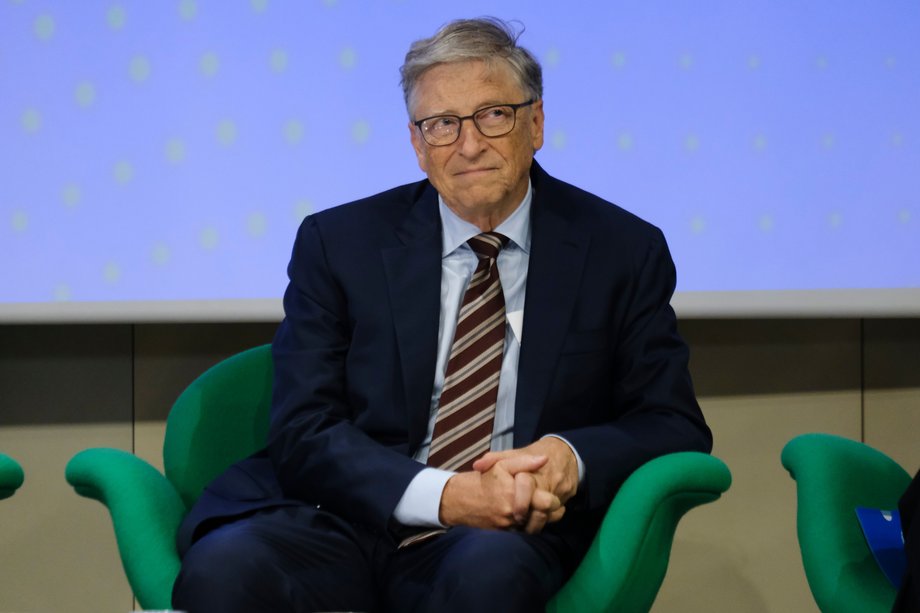
Bill Gates
|
Alexandros Michailidis / Shutterstock
Back then, no one took these words very seriously. Microsoft continued to pump money into OpenAI, and this amount eventually grew to over $13 billion. In the context of the current image crisis, Gates' words take on a completely new meaning. Nadella himself admitted in the same interview that the co-founder's initial concern was not so much about the return on investment, but about whether such a large amount of money would be wasted on a technology that is not yet ready for wide, widespread use.
- Read also: There is no such thing as a private conversation with AI. We are preparing a disaster for ourselves
Today, as “Microslop” has become a viral symbol of resistance, it turns out that Gates was right – not in a financial sense, but in a reputational one. Microsoft has earned billions on AI, but at the same time it has lost something much more difficult to regain: the trust of some users and developers. The investment paid off on the company's balance sheet, but the company's image as one that forced the use of half-baked tools was seriously damaged. The irony is twofold – the man who built Microsoft from scratch was warning against exactly the kind of enthusiasm that today led to the shutdown of his own Discord server and an avalanche of memes.