The beginning of 2026 brought a real earthquake to the silver market, which many had been waiting for for decades. Prices are breaking records and the market is analyzing all scenarios for the white metal. The latest forecast by The Silver Institute leaves no doubt: despite high prices, investor appetite is growing, and supply cannot keep up with demand.
The most important news from The Silver Institute's latest forecast is that the silver market remains in deficit. This is the sixth year in a row that global demand exceeds supply. Although mining and recycling are increasing, it is still not enough to satisfy market hunger. As indicated by the report of the institution that is to silver what the World Gold Council is to the royal metal, the silver supply gap in 2026 will amount to a significant 67 million ounces. This means the global economy has to dip into stocks once again, putting enormous pressure on the already tight physical market.
What is The Silver Institute?
The Silver Institute is an international non-profit association founded in 1971, bringing together representatives of the silver industry. It acts as the voice of the sector, promoting awareness of the role of silver in industry and investment. The Institute is a key source of data on silver supply and demand, producing the annual World Silver Survey report. Members include: miners, refineries and producers of silver products. Its headquarters is in the USA.
The company will conduct research and produce an annual report on the international silver market known as the “World Silver Survey”, which will be published on April 15. On February 10, the Institute published a forecast based on the analysis of Metals Focus, a renowned London consulting company dealing with precious metals research.
The silver revolution and $100 an ounce
The authors of the forecast remind us that the last dozen or so months have been a time of extreme volatility and records. The year 2025 was the best period for silver since 1979, which created a solid foundation for further increases. However, the beginning of 2026 brought a breakthrough event.
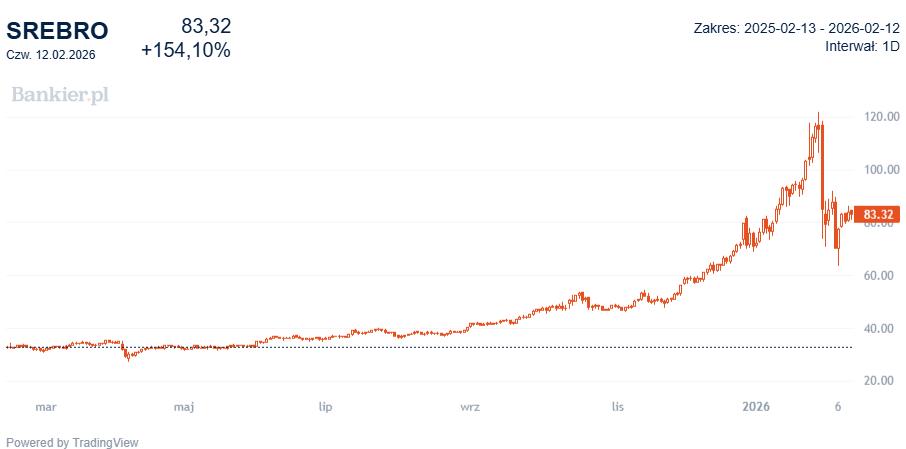
“After posting its highest annual gains since 1979 last year, silver prices continued to hit new highs in 2026, driven by growing investor interest. The metal hit multiple record highs in January, surpassing the psychologically important $100 level for the first time.” – reminds The Silver Institute.
Although the price corrected below $80 after this spectacular jump, the metal showed great resilience, building lasting technical support. “Previous uncertainty regarding China's silver export policy briefly raised concerns about supply disruptions, but these concerns have eased in recent weeks,” write the Institute's experts.
Importantly, the increase in the value of silver was faster than that of gold, which resulted in the gold/silver ratio falling below 50 – a situation not seen since 2012.
What is the gold/silver ratio?
The gold/silver ratio (GSR) is the ratio of the price of an ounce of gold to the price of an ounce of silver, showing how many ounces of silver are needed to purchase one ounce of gold. It is a simple quotient of the spot prices of both metals, used by investors to assess their relative valuation.
A high GSR (>80) suggests silver is undervalued, which may be a signal to buy it. Low GSR (
Historically, it oscillates between 40 and 100, depending on supply, industrial (silver) and investment (gold) demand.
Investment demand is the engine of growth
Investments will remain the main driving force of the market in 2026. The authors of the forecast predict that the demand for investment silver (coins and bars) will increase by 20%, reaching the level of 227 million ounces. Investors in the West, encouraged by the bullion's excellent performance and concerns about the stability of monetary policy and the independence of central banks (including the Fed), are returning to silver as a “safe haven”.
These increases effectively offset declines in other sectors. High silver prices hit the jewelry industry (down 9%) and other silver products (down 17%), especially in India, where demand is extremely sensitive to price changes.
AI supports the industrial use of silver
We are seeing an interesting shake-up in the industrial sector. Overall industry demand is expected to drop by 2% (to approximately 650 million ounces – the lowest level in four years), this is mainly due to savings in the photovoltaic (PV) industry, where producers are trying to replace silver with cheaper metals.
On the other hand, the dynamic development of data centers, technologies related to artificial intelligence (AI) and the automotive sector are creating new sales channels. Silver remains an essential element of modern digital infrastructure, which stabilizes its demand fundamentals.
Supply cannot keep up with market appetite
Even though the global silver supply is expected to increase by 1.5% in 2026, reaching a decade high of 1.05 billion ounces, and silver recycling will increase by 7%, exceeding 200 million ounces for the first time since 2012 (the result of the sale of old tableware and jewelry by consumers using historical valuations), this is still not enough to satisfy the world's hunger for the metal. The increase in production, mainly in Mexico, Canada and Morocco, is noticeable (an increase of 1% to 820 million ounces), but the market still has to rely on inventories, which increases tensions in the availability of physical metal.
The Silver Institute's forecast for 2026 paints a picture of a tense but promising market. Geopolitical uncertainty, supply deficit and the growing role of silver in future technologies make the “white metal” one of the most attractive assets of the current decade.
While price volatility will remain a constant in the market, the macroeconomic backdrop continues to favor precious metals. “Looking ahead, the global economic and geopolitical environment is likely to remain favorable for precious metal prices in 2026,” The Silver Institute summarizes its forecast.