publication
2026-03-06 14:30
The February US labor market report showed a surprising decline in employment and an increase in the unemployment rate. In this way, the BLS data completely diverged from the market consensus, which assumed a small increase in the number of jobs in non-agricultural sectors.
The number of jobs in non-farm payrolls in February 2026 was by 92 thousand less than a month earlier
– reported the government Bureau of Labor Statistics (BLS). This was a result that was very different from the market consensus assuming an increase of 60,000 jobs. Employment in the private sector decreased by 86,000. full-time positions. In this case, an increase of 65 thousand was expected.
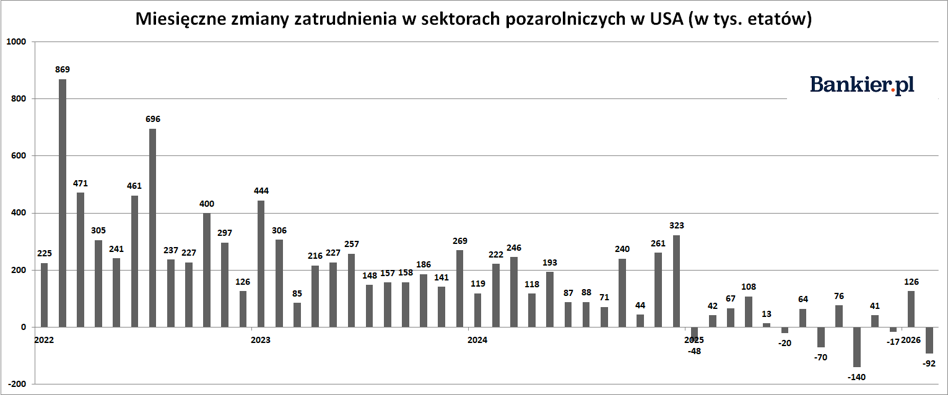
February's payrolls turned out to be much weaker than the sensationally strong data for January, when the Bureau of Labor Statistics showed 130,000. new jobs (and as many as 172,000 in the private sector). However, today these data have been revised downwards: to 126,000. in non-agricultural sectors and 146 thousand in the private sector. The NFP results for December were also reduced, which in total deducted PLN 71,000. FTEs for the previous two months
Advertisement
As of May 2025, the U.S. economy is no longer creating new jobs. The average monthly employment increase for the previous 6 months is -1,000, which is practically negligible in the scale of nearly 160 million full-time jobs in the US economy. Especially since BLS statistics are subject to frequent and very thorough revisions.
At the same time, in February the unemployment rate unexpectedly increased from 4.3% to 4.4%. Most economists assumed its stabilization at 4.3%. In absolute numbers, this translated into an increase in the number of unemployed people (i.e. people actively looking for work) by 203,000, while the number of working people decreased by 185,000. and an increase in the economically inactive population by 72,000. These are the results of an independent survey (LFS) used by the BLS to estimate the scale of unemployment.
The average hourly rate in January 2026 was USD 37.32 and was 0.40% higher than a month earlier and 3.84% higher than a year ago. The market consensus assumed an increase of 0.3% m/m and 3.7% y/y. This means that wages in the US continued to grow slightly faster than the officially reported CPI inflation. The average working time remained unchanged at 34.3 hours per week.
The publication contains affiliate links.