The death of the Iranian supreme leader: security error or ritual sacrifice? A Romanian woman reveals the unseen face of Iran


The world watches in amazement as Iran's leaders are “beheaded” by US-Israeli strikes. Ioana Mateș, expert in international relations and international law with years spent in Tehran, shows why, in Shia logic, Khamenei's death is not a defeat, but a calculated ideological fuel that can blow up the entire Middle East. For his part, General Virgil Bălăceanu explains, from the perspective of the military, the “beheading” of Iran.
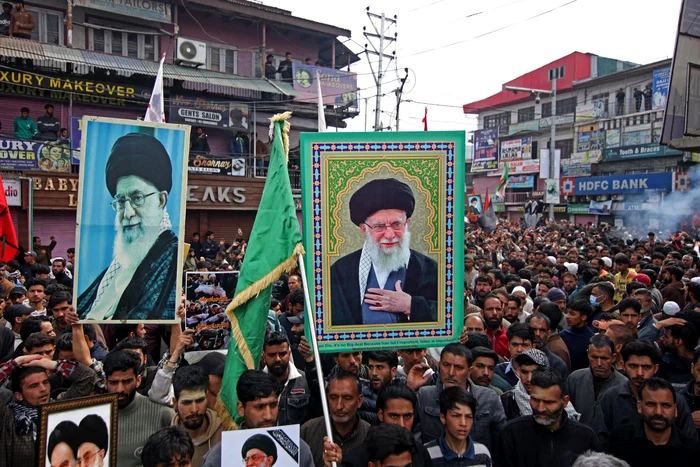
Shiite Muslims in Kashmir carry photos of Ali Khamenei on the 4th day of mourning PHOTO Profimedia
The United States and Israel attacked Iran, and Tehran responded with targeted strikes on American military bases in the region. Among some international analysts, there is a fear that once Iran has hit targets in Qatar, Bahrain, Kuwait and the United Arab Emirates, whether they are also American military bases, the risk of the war escalating, and in the first phase some of the respective states will also be involved, is increasing.
Beyond fears that the war, which has already become a regional one, could expand even further, there are many question marks that analysts hardly have an answer to. Why didn't Ayatollah Ali Khamenei hide in a bunker? Why did it seem so “easy” to eliminate the military elite in Tehran?
Many questions, few answers
In fact, the answers are not in the military manuals from Washington or Bucharest, but in the political theology of Karbala. Ioana Mateș talks about the psychology of Shiite martyrdom and explains why the recent airstrikes could, paradoxically, be exactly what the regime in Tehran anticipated to cement its legend.
“Martyrdom is a central element of Shia Islam. For Shias, and especially in Iranian political theology, to die as a martyr is not a tragedy, but a supreme honor. The concept derives from Imam Hussein's sacrifice at Karbala and has become, over the centuries, an identity and spiritual pillar.” says Ioana Mateș.
She asks the questions to which no one has yet found answers that are accepted by all analysts.
“In recent days, the public space has been flooded with information and speculation regarding the alleged killing of Ayatollah Ali Khamenei in American-Israeli raids. Beyond the veracity of the information, the lingering question is another: if an attack was foreseeable, why did he not withdraw? Why did he not hide? Why was he not protected in a bunker?”“, she says.
Two completely different philosophies
Things would depend, adds Ioana Mateș, on the fact that Iranian philosophy is different from the Western one, as well as the psychology of Iranians vis-a-vis Western culture.
“In Western political logic, the leader preserves himself. Power must be preserved. Institutional continuity is paramount. In the symbolic logic of revolutionary Shiism, however, martyrdom is not a weakness. It is a form of ultimate legitimization. Assumed death can become a message. It can become ideological fuel. It can reinforce a narrative of resistance and sacrifice. If a Shiite leader consciously assumes risk, it is not just a personal act. It is an act with theological valences and geopolitical. In Iranian political culture, martyrdom is not the catalyst. It is not the end of an idea – it is the beginning of a mobilization“, claims Ioana Mateș.
In his view, the right question would be not so much why it was so easy for the Americans and Israelis to kill the Iranian Supreme Leader.
“So maybe the question is not 'why was it easy?', but 'was it really a vulnerability…or an assumption?' History shows that in the ideological space of Shiism, death can be turned into an instrument of power. And sometimes, leaders do not run away from martyrdom. I choose him. But the consequences will be dramatic for the Muslim world,” concludes the expert.
On the other hand, General Virgil Bălăceanu (r) does not think that the “beheading” of Iran's leadership should be seen as a surprise. He says that the actions by which even the Iranian supreme leader was killed are specific to the Israelis, who have a special tactic. He confirms that it is a strategy of annihilation, but also that, in a modern conflict, all resources are used to “destroy the command and control system”.
“I would say yes, it is, but mostly it's not a surprise. To me, it really isn't. Yes, it may seem surprising from the outside, but the Israeli troops have been almost 100% successful in their actions. It's clear that the priority is to eliminate the Iranian political leaders and the military, which they succeeded in doing.”says General Virgil Bălăceanu.
Other important Iranian leaders were also killed
Iranian Supreme Leader Ayatollah Ali Khamenei is not the only Iranian leader killed. Important generals and religious officials died in the first days of the American and Israeli attacks.
Soon after, the public broadcaster included the name of Abdolrahim Mousavi on the list of high-ranking officials killed in the attacks on Saturday, February 28, thus confirming one of the worst losses suffered by the Iranian military leadership in decades.
Other important Iranian generals and gunmen have also lost their lives since the initial attacks. According to the same source, General Mousavi died along with other important leaders of the military and security apparatus of the Islamic Republic. Among them are the Minister of Defense, the commander of the Islamic Revolutionary Guard Corps, Mohammad Pakpour, as well as Ali Shamkhani, a close adviser to the supreme leader.
In response, Iran struck several US military bases in nearby countries. US bases in Qatar, Bahrain, Kuwait and the United Arab Emirates were attacked.