On September 26, 2025, the Sejm passed an amendment to the Act – Geodetic and Cartographic Law, which provides citizens with free access to data from the Real Estate Price Register (RCN).. This is a change of fundamental importance for a market worth hundreds of billions of PLN annually. For the first time, anyone can check how much an apartment, house or plot of land was actually sold for – without fees and without intermediaries.
The problem is that although the law has changed, the state's digital infrastructure still cannot keep up.
Real Estate Price Register – what is it and how does it work?
The Real Estate Price Register (RCN) is a public collection of data on transactions concluded on the real estate market, created on the basis of notarial deeds.. Starostas are responsible for its management, in accordance with the Geodetic and Cartographic Law. The data is then aggregated and published, among others: on the Geoportal website, run by the Central Office of Geodesy and Cartography.
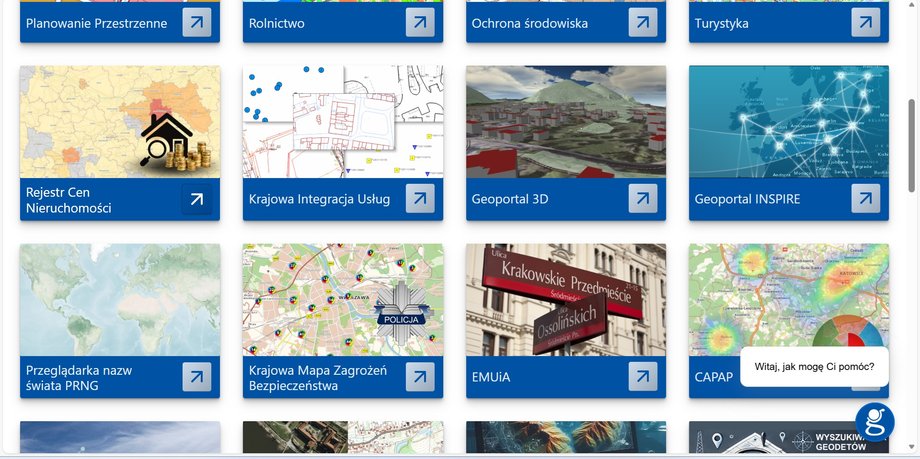
Access to RCN
|
RCN
Read also: Prices, 3D plans and land and mortgage registers. Here is a new knowledge base about plots and real estate
In theory, the system is extensive. The user can:
- view transactions on a map (WMS services),
- download data in GeoParquet and GeoPackage formats (WFS services),
- filter information by county, voivodeship or the entire country,
- check the details: gross price, VAT, type of market, area in square meters, number of rooms, floor, type of right to the property or purpose in the local development plan.
The following information is available for residential premises: usable area in square meters, number of rooms, floor number, gross price and VAT amount. For plots – number, registered area, intended use in the local plan, price. For buildings – type, usable area and transaction value.
Until recently, access to key data – including the transaction price – was subject to payment. The amendment of September 26, 2025 removes this barrier. This is a qualitative change: from a market with limited transparency we are moving to a model of full price transparency.
Free RCN – breakthrough or illusion of availability
On the website Geoportal reports that data from approximately 320 poviats is now available. In practice, however, users encounter a number of problems.
Firstly, the system is based on district services. The condition for the correct operation of the collective service is “the correct operation of district services and their compliance with the specifications”. If the district has not implemented appropriate solutions or did it inconsistently with the standard, the data is not displayed correctly.
Secondly, some information is still incomplete or unavailable. Messages on the website still refer to previous payment rules, which shows that the system has not been fully updated to the new legal status.
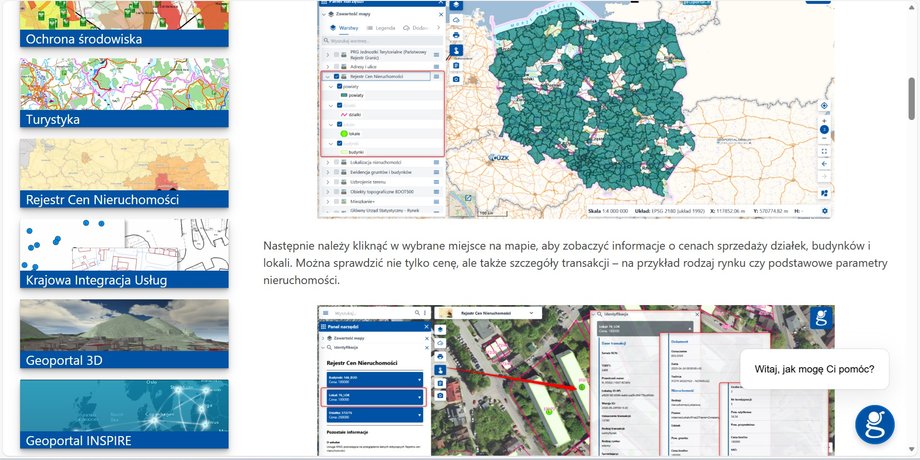
Tips
|
RCN
See also: House or apartment? Statistics show how Poles really live
Thirdly, the solution in its current form is temporary – until the regulation is amended and the specifications for network services are changed. The state has opened data, but has not yet built a stable, uniform architecture for sharing it.
As a result, access is formally free, but in many cases technically difficult.
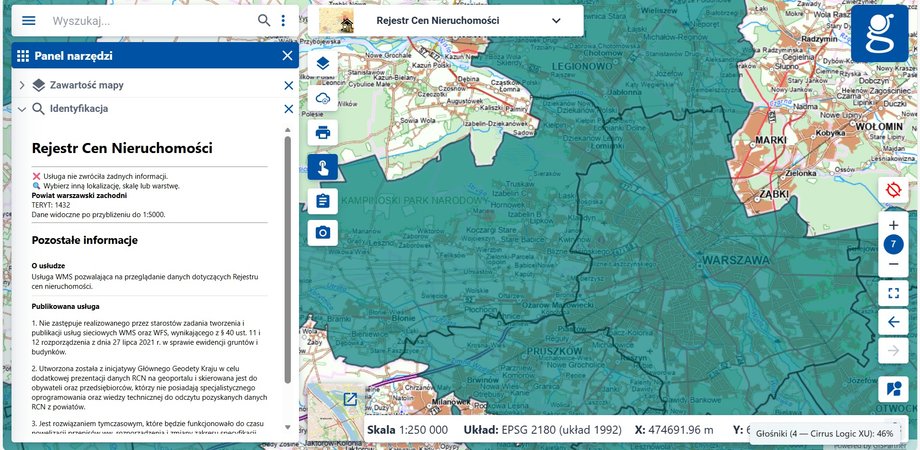
No information on Geoportal
|
geoportal.gov.pl
Worth reading: National e-Invoice System. Here's what every entrepreneur needs to know about it
Transparency of apartment prices – what will it change on the market?
The release of the RCN is another stage in increasing the transparency of the real estate market.
- The first stage is the years when data was dispersed and available mainly to appraisers, banks and large players.
- Stage two – the Price Transparency Act (entered into force in autumn 2025), which forced the publication of offer prices.
- Stage three – full, free access to transaction prices in 2025/2026.
— RCN reveals the true picture of the market for the first time. Transparency is becoming a new regulation mechanismwhich may change the way investments are negotiated, valued and assessed in the entire industry – says Jan Dziekoński, Head of Market Insights at RynekPierwotny.pl.
However, the expert cools down expectations for a price revolution.
— Full disclosure to the RCN — at least at this stage — will not significantly change developers' approach to shaping price lists or discount policies. The register contains property transfer, i.e. final, contracts. Meanwhile, development contracts concluded one or two years earlier are key on the development market, he emphasizes.
This means that the data in the RCN is historical. They show how much the premises were sold for after the investment was completed, and not how much it was contracted for during the construction stage.
Offer vs. transaction prices – possible adjustments in 2026
According to Dziekoński, a greater impact may concern the relationship between offer and transaction prices, especially on the secondary market.
— If transaction prices become widely available, offer prices may become more realistic. Transactions show buyers' real purchasing capabilities. In places where the differences were clear, some offers may be corrected – assesses.
The expert points out that it will not be a uniform phenomenon. In the case of apartments in top locations, the differences between the offer and the final price are usually small. In the segment of premises with a lower standard, legal or technical problems, the discount can reach several percent.
Transparency may also increase market differentiation. Very good properties will be clearly separated in price from average properties. It will be more difficult to justify a high rate for a low-quality place.
Developers: no storm, foundations decide
The development industry approaches changes calmly. Mateusz Bromboszcz, vice-president of Atal, reminds that similar emotions accompanied the introduction of transparency of offer prices.
— For Atal, a company that has long presented its offer transparently, it did not mean a revolution, but it forced the competition to implement a standard that was good for customers. It didn't cause a market tornado. Offer prices after the adjustment period are approximately at the same point – says.
And he adds: – We do not expect the disclosure of transaction data from RCN to cause an industry uproar. The price of apartments is influenced primarily by the price of plots, construction, standard and location, not the access to information itself.
From the perspective of microeconomics, it is difficult to disagree with this. Transparency does not change buyers' creditworthiness or construction costs. However, it may change the way of negotiations and the strength of the arguments of both parties.
The state system is failing. Private initiative works
The paradox is this although the state opens the data, its practical use is sometimes hampered by broken services, inconsistent implementation across counties and outdated messages.
In response to these problems Prof. prepared his own portal integrating publicly available data. Izdebski. We have already written about the project. The website aggregates information that is formally public, but is dispersed, unintuitive or technically unavailable in national systems.
This is a symbolic situation: today, a private initiative is more functional than a state solution, even though it uses the same public resources.
What's next for the real estate market?
The release of RCN is a step towards civilizing the market and bringing it closer to Western European standards. The potential impacts in 2026 are:
- greater price predictability,
- less information asymmetry,
- stronger negotiating position of buyers,
- development of analytical tools and valuation models,
- pressure for more realistic valuations in segments with a large gap between the offer and the transaction.
As Jan Dziekoński summarizes, free access can increase competition between providers of analytical tools, reduce the cost of valuations and facilitate the work of intermediaries in conversations with clients.
RCN is no longer a “black box”. Now the key question is: whether the state will be able to build an efficient, uniform system that will match the scale of the legislator's ambitions. Transparency is not only about access to data, but also about its real usefulness.