How does a heat pump work? Scheme, cost and subsidies. Here's the whole truth about this technology


True, its operation is not as obvious as that of a boiler or furnace, but spreading and repeating myths about the complete ineffectiveness of heat pump technology is a bit like questioning the effectiveness of a refrigerator.
The entire heat pump installation consists of several elements, however the most important is the so-called lower heat sources, which in the case of the most popular air heat pumps is a characteristic external unit with a fan. This is what takes in air from outside, from which heat is then recovered – how exactly does it work? Here's everything you need to know about heat pumps.
Read also in BUSINESS INSIDER
The working medium circulating in the installation, for example R32 (difluoromethane), has a low boiling point. Thanks to this it easily turns into a gas and is then sucked in by the compressor. In the compressor, powered by the home electrical network, the pressure and temperature of the medium increase, which is crucial because these parameters must reach a level enabling effective heating.
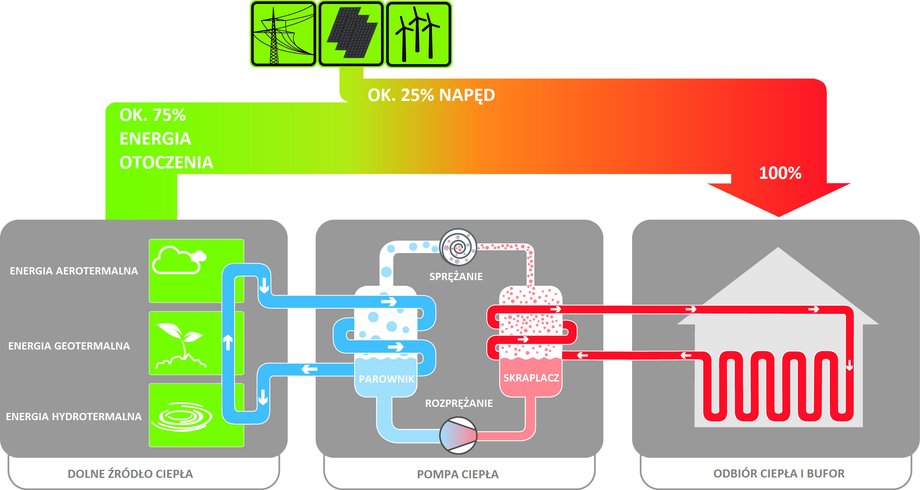
Heat pump operation diagram
|
PC PORT
Then the hot medium goes to the condenser, where it gives heat to the water circulating in the building's heating system. This, in turn, goes to the so-called upper heat source, i.e. radiators or pipes in the underfloor heating system. In the case of air-to-air heat pumps, the upper heat source is the indoor unit in the form of an air conditioner.
After the cycle ends, the parameters of the working medium return to their initial values, which allows you to start the process again. In this way, thermal energy taken from the environment is used for heating — air, ground or water — and the electricity necessary to operate the compressor.
- Read also: Why the confusion with heat pumps? These mistakes raise your bills
Thanks to this, it differs from strictly electric heating (e.g. fan heaters or electric radiators) The heat pump allows you to generate up to 3.5-4 units of heat energy using one unit of electricity. This means that from 1 kWh of electricity, heat pumps are able to release 4 kWh of heat (or more), and the effectiveness of a given model is indicated by COP factor. It is worth emphasizing that the efficiency of a heat pump depends largely on the building in which it is used (on its level of thermal modernization or heat receivers), which is why the selection is very important.
It is also worth remembering that a heat pump is not limited to heating only. It can also cool rooms in summerand many models also enable the preparation of domestic hot water (DHW). There are also heat pumps available on the market strictly for domestic hot water, which are used, for example, in tandem with a solid fuel boiler (pellet, coal). Thanks to this, in spring and summer, when the heating season ends, you do not have to turn on the fire to have hot water for washing.
Types of heat pumps
The energy needed to heat the working medium comes from the environment, which is the basis for dividing heat pumps according to the source of the consumed heat. Air-based devices are the most commonly usedbecause they are easy to install and the cheapest in terms of purchase costs. It is worth remembering that in addition to popular pumps air-waterthat work with a central heating installation, the previously mentioned models are available air-air.
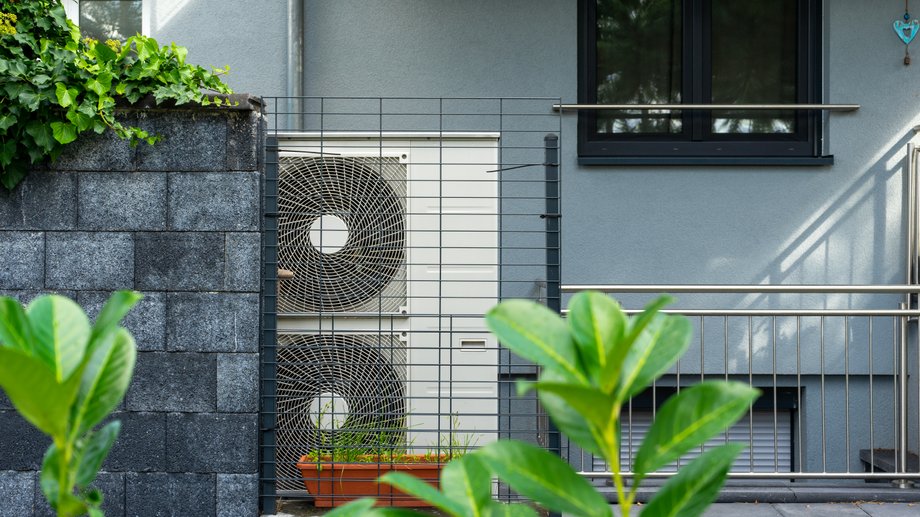
Heat pumps
|
Sevda Ercan/Getty Images
In practice they are air conditioners equipped with a heating functionalthough it is worth emphasizing that in terms of heat production, it is best to treat them as an additional heating system in new buildings or those after thermal modernization. If any sales representative tries to convince you that an air-to-air heat pump is suitable for heating any building, treat these declarations with caution. However, the market for these devices is changing dynamically and more and more efficient models with high COP are appearing, but the issue of selecting a heat pump for a building is almost always best left to a professional installer.
Air heat pumps. Split and monoblock
There are two types of devices among air heat pumps – split and monoblock. Split devices they consist of an external unit (evaporator, compressor and expansion valve) and an internal unit (condenser), and monoblock heat pumps have all these elements enclosed in one piece of equipment. For years, customers mainly chose split heat pumps because of: lower price dictated by a cheaper production process.
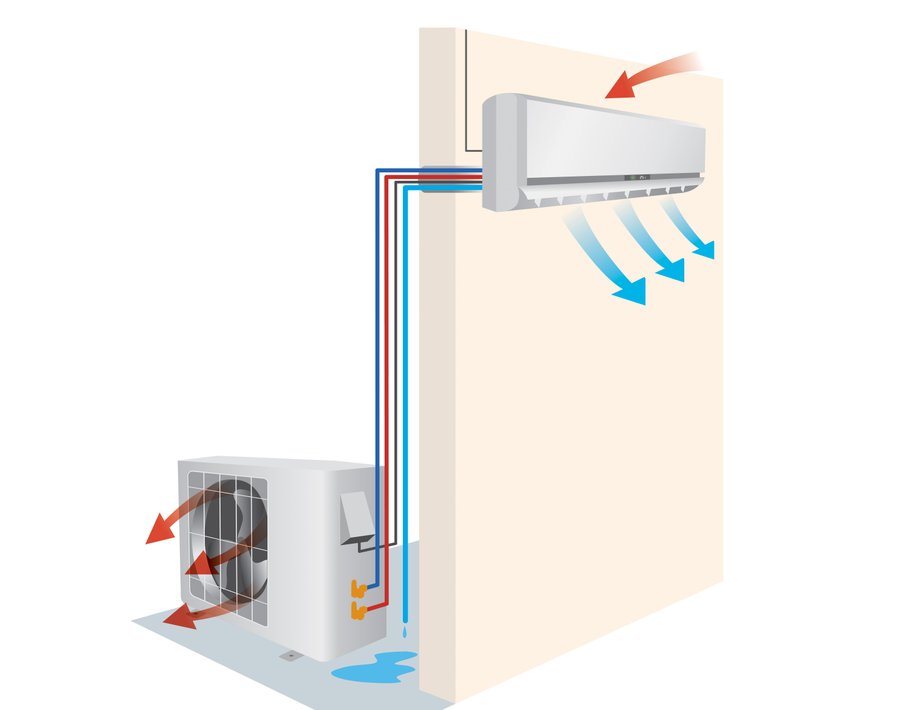
Operational diagram of a split air conditioner with an outdoor unit and an outdoor unit.
|
Studio BKK / Shutterstock
Some users also chose this solution for practical reasons. In case monoblock heat pumpswhere all the elements are enclosed in one unit, there is a certain risk that during a longer power outage, the water in the installation may freeze, which could lead to damage. There is no such risk in split structures. However, it is worth noting that in Poland, long-term power failures are extremely rareand modern monoblocks are equipped with protections that minimize the risk of freezing.
In practice, split and monoblock air heat pumps offer similar parameters, but due to the EU F-gas regulation, the market will soon be limited only to monoblocks. We wrote more about this in a separate article.
Ground heat pumps
An alternative to air heat pumps are ground-source models, which – as the name suggests – draw energy from the ground. However, this requires the installation of an appropriate exchanger. Their great advantage is stable, high efficiency all year round, because the ground temperature remains positive regardless of weather conditions.
A similar level of efficiency is offered by heat pumps that use energy stored in water, although in this case, it is necessary to have a well or a water reservoir on the plotsuch as a pond. However, purchasing and installing such a system is very expensive, which is why air heat pumps dominate in Poland and other countries.
How much does a heat pump cost?
For an air heat pump with a hot water tank, intended for a house with an area of approximately 150 square meters, you have to pay from PLN 30,000 to PLN 45,000. zloty. This amount includes assembly, though the final investment cost depends on the type of device selected, the specificity of the installation and any thermal modernization worksif the system is to be installed in an older building.
Ground heat pumps are usually more expensive than air source heat pumps by up to PLN 15,000-20,000. PLN, however offer stable performance all year round. The final price is influenced by, among others: the size of the heated house, available space on the plot and the type of system installed.
At the same time, it is worth emphasizing that these are approximate prices, and in addition to the quality of the device itself, it is also worth paying attention to assembly and selectionbecause these aspects largely influence satisfaction with the heat pump. Therefore, it is worth choosing proven installers and it is best to do it yourself relying on peddlers or sales representatives who wander around towns all over Poland from time to time could result in infamous horror bills.
Heat pump subsidies in 2026
In existing buildings, a subsidy for the purchase of a heat pump can be obtained from the Clean Air program, which supports thermal modernization. The table below shows the subsidy rates, with: not only the beneficiary's income is taken into account, but also the energy demand in his home. This is especially important for people interested in a 100% subsidy. net eligible costs.
| Subsidies for heat pumps in the Clean Air program | |||
|---|---|---|---|
|
Basic level of funding (40% of net eligible costs) |
Extended level of co-financing (70% of net eligible costs) |
The highest level of funding (100% of net eligible costs) |
|
|
Air-water heat pump |
12.6 thousand zloty |
22 thousand zloty |
31.5 thousand zloty |
|
Air-water heat pump with increased energy class |
14.08 thousand zloty |
24.64 thousand zloty |
35.2 thousand zloty |
|
Air-to-air heat pump |
4.48 thousand zloty |
7.84 thousand zloty |
11.2 thousand zloty |
|
Ground heat pump with increased energy efficiency class |
18 thousand zloty |
31.5 thousand zloty |
45 thousand zloty |
However, a program is available for owners of new buildings My warmth. Here, the amount of funding depends primarily on the selected device:
- up to 7 thousand zloty — in the case of air-air pumps (with additional elements) and air-water pumps purchased as a set with a buffer tank, hot water tank and other parts of the installation,
- up to 21 thousand zloty — for ground heat pumps with the necessary equipment, buffer tank and domestic hot water storage
It is worth emphasizing that the maximum amount of support cannot exceed 30%. value of the entire investment. The exception applies to holders of the Large Family Card – in their case, the refund offered by the National Fund for Environmental Protection and Water Management may amount to up to 45%. expenses for the purchase and installation of a heat pump.
Heat pump service. How much is?
Manufacturers state that the service life of heat pumps can be up to 25 years, and most models do not require daily maintenance. However, this does not mean that the user can completely give up regular checks. An inspection should be performed once a year, during which, among other things, the following are checked: compressor operating parameters (in the case of air pumps), filter condition and pressures in individual circuits. The electrical installation is also assessed and possible errors stored in the controller are analyzed – the latter activity is the responsibility of the service technician.
Such inspections allow you to quickly detect and remove potential irregularities. Although you can find instructions online showing how to perform a basic inspection yourself, it is much safer to entrust this task to professionals. The average cost of an annual inspection is approximately PLN 400, with some companies adding an additional fee for traveling to the client.
What do a heat pump and a refrigerator have in common?
Although the heat pump is presented as a new device, this technology has been with us for over 150 years and is very closely related to the development of cooling systems, i.e. refrigerators and coolers. There's a reason why the simplest way to explain how a heat pump works is simply “like a refrigerator, but in reverse.”
The heat received from the interior of the chamber in which we store food goes to the heat exchanger and then, thanks to the operation of the compressor powered by electricity, it is transferred outside the device. In the case of a heat pump, the process is the opposite – the device absorbs thermal energy from the environment (air, ground or water) and uses the working medium to transfer it to the building.
We wrote precisely about the close connection between the first refrigerators and heat pumps in Komputer Świat – and although this is a very simplified scheme of operation, it shows that questioning the effectiveness of heat pumps is not supported by facts or science.