
What can happen to the CCR, after Lia Savonea requested the referral to the Court of Justice of the EU. “Why haven't they done it before?” / What happened in two cases when this request was made


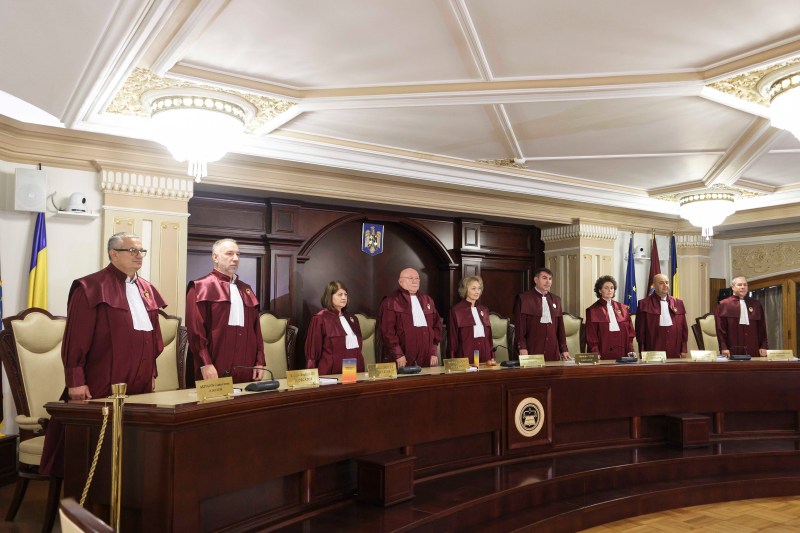
The nine judges who form the Constitutional Court Photo: Inquam Photos / Octav Ganea
The decision of the Supreme Court to ask the Constitutional Court of Romania (CCR) to refer the Court of Justice of the European Union (CJEU), one day before the CCR meeting on the subject of magistrates' pensions, is seen by lawyers as a new reason to delay the decision. At the meeting on Wednesday, a postponement is expected anyway because one of the CCR judges went on prenatal leave and according to the CCR operating regulations, decisions cannot be taken without the presence of a judge who participated in the debates.
- In the past, the CCR had two other requests regarding the referral to the CJEU in relation to the reform of the judicial system in Romania, but both were rejected.
After four times postponing the verdict on the magistrates' pensions, the CCR judges meet again tomorrow, starting at 10 am, but another postponement of the judgment is inevitable. In addition to the absence of judge Gheorghe Stan, who went on prenatal leave even before the scheduled deadline in the special pensions file, the CCR has another reason: the request of the ICCJ sent before the meeting requesting referral to the CJEU. Such an approach requires a new court term to take note of the ICCJ's request.
“There is also the option for the President of the Court to decide to put the case back on the docket and try it with judges who are present, but it is unlikely that he will do it because the tension is too high”, CCR sources told HotNews.
The judges are obliged to discuss the request of the High Court and will have two options: either they send the referral to the CJEU with the objections raised by the supreme court, or they reject the action as inadmissible.
The action of the supreme court is seen as an act of strategy for the protection of rights also by the former judge Augustin Zegrean.
“The ICCJ was able to get in the way until now, because I am a party to the process. Why didn't they do it until now? I am a lawyer now, I probably would have done the same. When I have an interest in a process, I try to defend the client with all possible means. They probably suspected that the Court would give an answer to their liking, and then they proceeded in this way. They defend their rights and needs, and the nation,” commented Augustin Zegrean for HotNews.
The former president of the CCR stated that if the referral is sent to the CJEU “it takes about two years until the file comes back with a solution”.
Two other requests to refer to the CJEU, rejected by the CCR
In the past, the CCR had two other requests regarding referral to the CJEU in relation to the reform of the judicial system in Romania, but both were rejected by the Constitutional judges as inadmissible.
This is a decision given by the CCR in 2018.
The CCR then reasoned that “the retirement of magistrates belongs to the exclusive competence of the member states, being a purely internal situation, which does not bring into question the law of the European Union”, therefore “the request regarding the preliminary question is clearly inadmissible”.
In 2019, the CCR rejected another request regarding the referral to the CJEU on the reform of justice laws, made by a group of USR and PNL deputies.
The Court motivated the rejection of the referral by showing that the aspects reported by the authors of the referral “concern the appropriateness of the legislation. However, such aspects cannot be the object of the constitutionality control carried out by the Court”.
“Decisions 533/2018 and 137/2019 of the CCR say that a request to refer to the CJEU with preliminary questions is inadmissible when it comes to a priori control, because it is an abstract control, not a concrete one, as in the case of a posteriori control”, a specialist in constitutional law explained to HotNews, subject to confidentiality.
What the CJEU could decide
I asked the former president of the CCR what could happen if the ICCJ referral reached the European Court.
“The CJEU will never tell you that you are or are not right. It will communicate what the European legislation says about that issue,” replied Zegrean.
The clarification of some interpretation criteria in the sense that the amendment of the law so that the magistrates' pension by reducing the amount to 70% of the net, is the scenario expected by the supreme court.
A single referral made by CCR to the European Court
To date, the CCR has referred the CJEU in only one case. This is the case of Coman Hamilton, a gay couple who applied for recognition of their marriage. The EU Court of Justice confirmed in 2018 that the term “spouse” includes same-sex partners legally married in the EU.
CJEU decisions are binding.


