“Waterrr”, “Aqua”. Certainly, most Poles remember these names from the shelves in Polish stores, at least visually. These are products of large corporations. Moreover, the drinks are colorless. It looks like pure water and the name suggests this conclusion, adding the note “still water”.
Of course, there is water in the composition, even most of it, but the thing is that these drinks contain certain additives. Thanks to these additives, on the one hand, drinks are considered healthy because they have alternatives to the word “water” as a name, and on the other – they benefit from preferential VAT.
Tax absurdity, i.e. relief for sweetening juice
In accordance with the regulations in force today drinks containing at least 20 percent fruit juice are subject to a VAT rate of 5%. Meanwhile, pure water without additives is charged a basic rate of 23%. This is one of the absurdities of the Polish tax system.
Read also: This new system is in the spotlight of entrepreneurs. Andrzej Domański puts an end to speculations
And it was the misleading nomenclature that Polish offices dealt with. The Ministry of Health recently responded to an interpellation from PiS MP Edward Siarka.
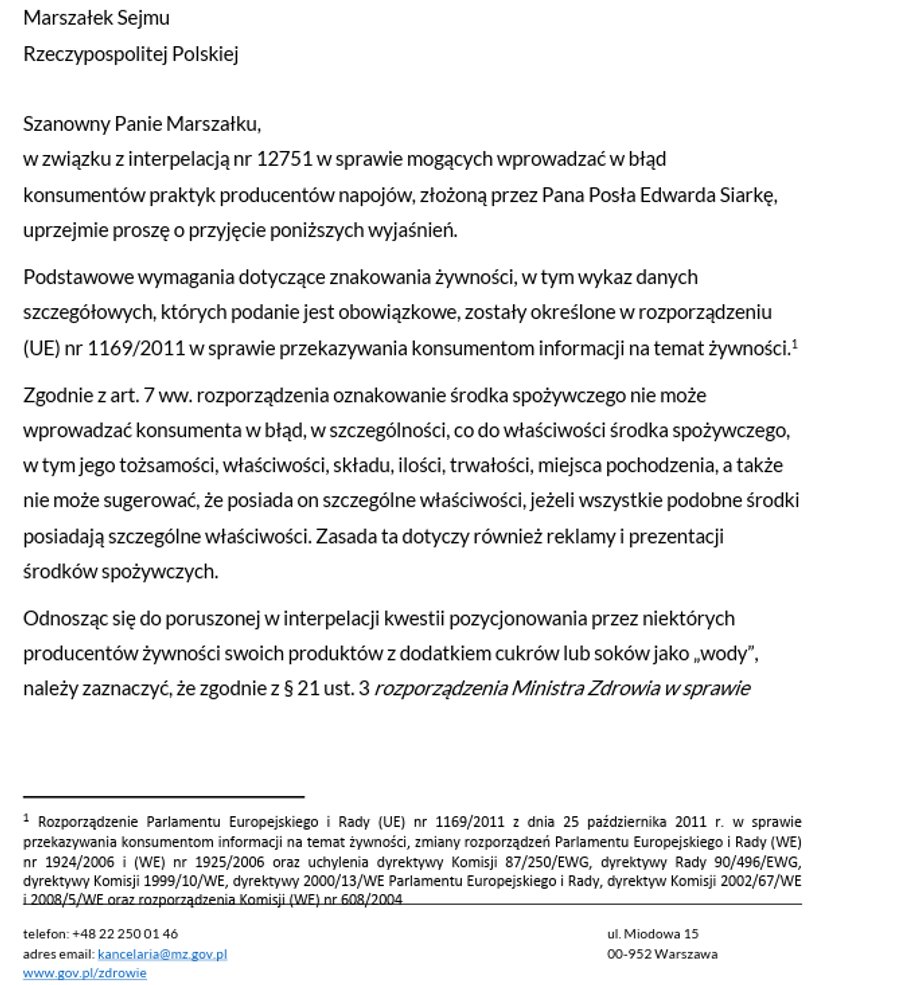
Response of the Ministry of Health to the parliamentary question
|
Ministry of Health
“Referring to the issue raised in the interpellation of some food producers positioning their products with added sugars or juices as 'water', it should be noted that […] That producers of flavored drinks are obliged to provide information on food packaging reliably and honestly. Correct labeling of a food allows the consumer to make an informed choice. An important element is that consumers read labels and, on this basis, purchase appropriate products. This is especially important for flavored drinks. The label of these products provides their composition and nutritional information, i.e. regarding the content of carbohydrates, including sugars,” we read in the response of the Ministry of Health.
The Ministry announced that it had not received any complaints about practices that mislead consumers, but also revealed that the proceedings were being conducted by the Office of Competition and Consumer Protection. “According to the information obtained by the Office of Competition and Consumer Protection, the Office is currently conducting four explanatory proceedings regarding the preliminary determination of whether there has been an infringement justifying the initiation of proceedings regarding practices violating the collective interests of consumers in connection with marketing activities regarding non-alcoholic beverages containing 20% or more up to 30 percent fruit juice,” we read further.
It was noted that water – implicitly clean water – belongs to the catalog of basic food products and, consequently, should be subject to a preferential VAT rate.
“We want water to be the drink of first choice when quenching thirst/replenishing fluids. As the Ministry of Health, we emphasize that the competitive price of bottled water is a particularly important element in promoting the consumption of this drink,” writes the ministry.
The Ministry of Finance wants tax increases
The Ministry of Health has already addressed the Ministry of Finance on this matter several times. Andrzej Domański's ministry is already in the process of changing the VAT regulations. By design the tax rate for non-alcoholic equivalents of alcoholic beverages and energy drinks is to be 23%. regardless of their juice content.
However, the project only includes a tax increase and for this reason it will most likely be vetoed by the president. The state budget urgently needs money, because the holes in state finances have reached record sizes. If it also included a reduction in the tax on clean water to 5%. and an increase for flavored waters to 23%, then there would be a greater chance for the president's signature.
The proposal to reduce VAT on water was also put forward as part of public consultations on the draft act amending the Act on Goods and Services Tax, which has been processed by the Ministry of Finance and Economy since December.