The American ISM index is the equivalent of the PMI, known in Poland, an activity measure measured by the responses of purchasing managers in companies. However, it has a longer tradition, because it has been counted since 1931. The results published on Monday concern 300 industrial companies from the USA and present their situation and prospects. What do they do, what orders do they have, do they hire or lay off, do they raise prices?
AND the latest reading is finally optimistic. “Finally”, because the Donald Trump administration had been waiting for a good reaction from the industry for almost a year, when it started introducing duties to equalize the VAT effect in other countries, and in some cases, punitive duties. The tariffs were intended to create space on the market for own production.
The ISM index for January was 52.6 points. and was higher by as much as 4.7 points. compared to December. Such large increases do not happen often. Moreover, economists predicted a reading of only 48.5 points. so they greatly underestimated the capabilities of American companies and the scale of improvement. The last time the ISM was higher was in June 2022, and above 50 points, i.e. in the positive territory, it was previously in February 2025, and it was not without reason then.
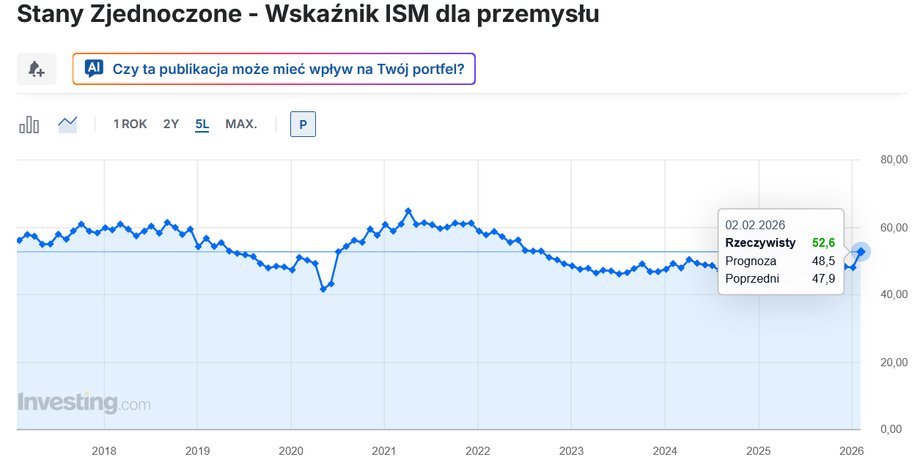
ISM index for US industry
|
Investing.com / https://pl.investing.com/
Since February, the introduction of customs duties was announced and it was then that importers realized that they had to rapidly increase their stocks in order to meet the customs duties and fill their warehouses at lower prices, i.e. without the new fee. The foreign trade results show that there were enough stocks until September. The latest ISM index measurements prove that the industry recovery took place only in January.
How much more in terms of employment, we can talk about maintaining the mood to reduce it, although on a smaller scalebecause the sub-index amounted to 48.1 points. and increased from 44.8 points. a month earlier (below the neutral threshold of 50 points), that's it orders for manufacturers have significantly increased. The relevant sub-index for them jumped to 57.1 points. from 47.4 in December. On increased opportunities to raise prices indicates another sub-index of prices paid, which amounted to 59 points compared to 58.5 points. a month earlier. This suggests that even if inflation has not had a tariff effect so far, this may soon change because there is less competition for domestic producers.
Increasing production to stock. US Manufacturing PMI
Positive information for the American industry also comes from research by S&P Global and its companies PMI index. It increased to 52.4 points. with 51.8 points a month earlier with a forecast of 51.9 points.
“News about the largest increase in factory production since May 2022 are overshadowed by reports of persistent, moderate sales growth – Chris Williamson, chief business economist at S&P Global Market Intelligence, said in the report.
“Consequently production growth significantly outpaced the growth in new orders at the beginning of the yearwhich led to further accumulation of unsold inventory,” he continues.
He emphasizes that over the last three months, research has shown that factories produced more goods than they sold to a degree unprecedented since the global financial crisis in early 2009.
“This one is amazing the unusual situation is clearly unsustainablewhich suggests a risk of slowing production and a potential knock-on effect on employment unless demand improves significantly in the coming months,” Williamson said.
According to him, the weak growth in sales and order book is related to customer resistance to price increases, the cause of which is often seen as tariffs, as well as increased uncertainty about the economic prospects.
“Although slightly below trend, expectations for economic growth in the coming year remain as companies expect demand to improvethanks in part to lower interest rates, reduced import competition due to tariffs, and greater government support. However, political uncertainty is still the main factor inhibiting business sentiment,” says the analyst.