Chinese people line up to sell their family jewels. They have machines that give money for gold


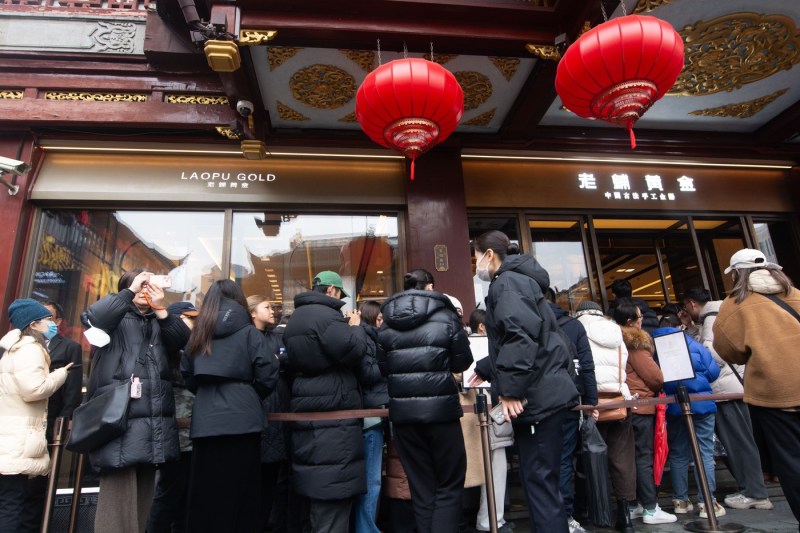
Queue at a gold vending machine in Shanghai Photo: Ying Tang/NurPhoto / Shutterstock Editorial / Profimedia
In a shopping center in Shanghai, a crowd formed around a vending machine that buys gold: as the price of the precious metal skyrockets, the Chinese rush to conclude profitable transactions by parting with family jewels, informs AFP, quoted by Agerpres.
“I never thought that prices would rise so dramatically,” admits Ms. Wu, 54 years old. She explains to AFP that she came to sell gold coins with the image of a panda, which she bought in 2002, after the birth of her daughter.
Gold, a safe haven for investors, is taking advantage of global geopolitical tensions and uncertainties and breaking record after record. The price of an ounce of gold exceeded $5,500 for the first time in history on January 29, after which it declined.
Ms. Wu explains that she has already sold a ring inherited from her late father at the vending machine, earning about 10,000 yuan (just over 1,200 euros), a considerable increase from the 1,000 yuan her mother paid for the same ring decades ago. Her mother saw this gold recycling machine as a chance to supplement her modest pension. “Everybody is suddenly talking about gold, and that's what caused this reaction to her,” says Ms. Wu.
A screen built into the machine shows price fluctuations on the Shanghai Gold Exchange, as well as a live video in which a robotic arm moves gold scraps onto a scale and then under a device that measures their purity using light waves. “Gold prices remain at historically high levels; now is the time to sell,” encourages one ad.
Long queues at the machines
Some people told AFP that they waited in line for more than an hour to deposit their gold pendants, rings and other commemorative pieces into a slot in the machine, under the supervision of an employee.
At the tail, Zhao wears a finely carved gold medallion on a necklace of jade beads and bright bracelets on his wrists. But she came to the machine to deposit her late grandfather's ring. The ring is adorned with the Chinese character for “luck” and tiny images of traditional gold bars. Zhao believes her grandfather bought it sometime between the 1950s and 1980s, and explains that her mother recently gave it to her. When he gets to the machine, Zhao enters his name, identification number and bank details and accepts the conditions displayed on the screen, then watches the gem melt live.
The employee assures her that she will receive the full amount estimated for the car, 12,000 yuan (approximately 1,450 euros), by bank transfer before the end of the day. “In other places, the authenticity of the gold is verified by light burning, but here, the evaluation is done directly, openly and transparently,” Zhao explains, admitting that he trusts the machine more than a traditional broker.
The machine, designed by the company Kinghood, based in Shenzhen (southern China), attracts passers-by curious about the sellers' earnings.
“God!” one of them exclaims, noting that a private person just cashed in 75,000 yuan (about 9,045 euros) getting rid of old jewelry. An explosion of excitement was created around a retired couple when the machine announced the value of the thin, finger-sized gold bar they had just sold: 122,000 yuan, or about 14,800 euros.
China is the world's largest consumer of gold, traditionally purchased by families for special occasions such as birthdays and weddings.