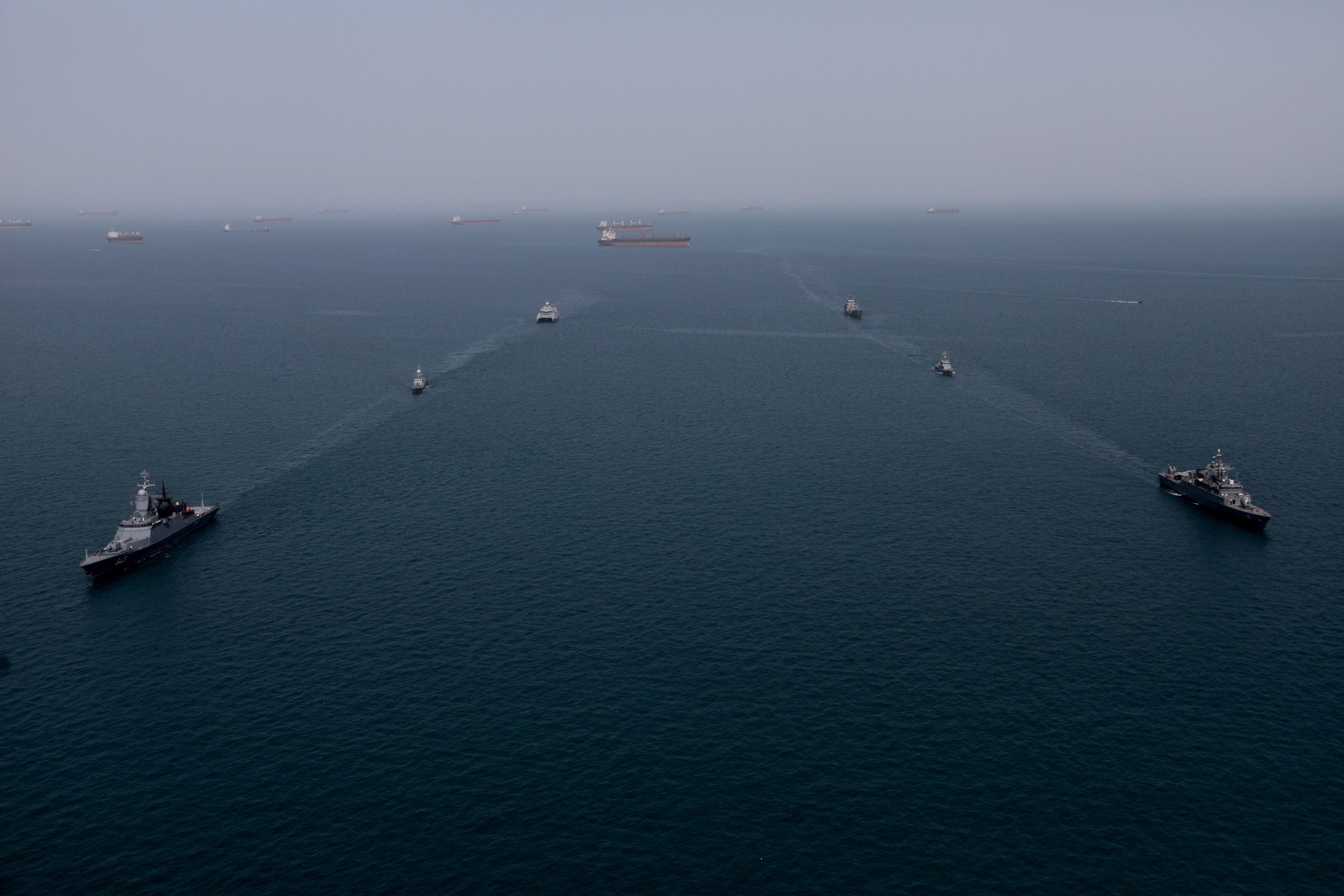
Kremlin adviser Yuri Ushakov said on Thursday that the Strait of Hormuz is open to Russia, Reuters reports.
“It is open for us,” Ushakov said in an interview with state-run Vesti television, according to the Interfax news agency.
The US-Israeli war against Iran has almost completely blocked the shipping of about a fifth of the world's oil and liquefied natural gas through the strait, causing disruptions in crude supplies and skyrocketing prices, especially for fuel.
In late March, Russia's Foreign Ministry said it opposed Iran's blockade of the Strait of Hormuz, but added that the situation must be viewed “in the context of the broader global situation.”
What Lavrov discussed with Araghchi
Also on Thursday, the head of Russian diplomacy, Sergey Lavrov, discussed the situation related to the safety of navigation in the Strait of Hormuz, in a telephone conversation with his Iranian counterpart, Abbas Araghchi, at the initiative of the Iranian side, the Russian Foreign Ministry announced in a statement.
“The parties exchanged views on discussions within the UN Security Council regarding the safety of navigation in the Strait of Hormuz and addressing other consequences of the US and Israel's unprovoked aggression against Iran,” the ministry said in a statement.
Lavrov discussed with Araghchi efforts to “de-escalate tensions” in the conflict, Lavrov's ministry said.
Putin's proposal
The day before, Russian President Vladimir Putin commented on the situation created on the international market by the blockade of the Strait of Hormuz and the war in Iran, stating that Russia can play an important role in creating a new global architecture of logistics and foreign trade.
“Russia can offer the world these solutions and can play an important role in the formation of a new global architecture of logistics and international trade in general,” said the Kremlin leader, in a message addressed to the participants of a transport and logistics forum held in Saint Petersburg, according to the EFE and Agerpres agencies.
Putin noted that “the events in Iran are already directly affecting the energy markets and the transportation of oil and gas through the Strait of Hormuz.”
This situation, he argued, forces many countries and companies to evaluate the cost and duration of transporting goods.
“The safety and stability of transport routes that are less affected by crises, armed conflicts and other external risks become a decisive factor” in the current situation, the Russian head of state said.
Consequently, Putin argued that Russian logistics routes “can be beneficial to their partners both from an economic point of view due to the reduction of transit times, and from the perspective of diversifying world transport flows.”
President Putin signaled that the long-term challenge is to achieve “a real technological revolution in the sphere of transport and logistics” through an ever-wider application of IT solutions and artificial intelligence.
“We need to take into account the processes taking place and evaluate them several decades ahead. This refers to the development of the most important logistics corridors based on qualitatively new technologies and, without a doubt, to the implementation of the latest generation means of transport,” he argued.
The Russian president particularly highlighted the possibilities of robotic and autonomous technologies that replace routine processes in airports and railway stations, in warehouses and logistics centers. He noted that Russia is willing to share its experiences in this regard and train specialists capable of developing transport and logistics of the 21st century.
For years, Russia has been promoting the Northern Maritime Route (NMR), an option that is becoming increasingly relevant as a result of global warming and that allows goods to be transported between Europe and Asia in shorter terms.