Ielele and Sânzienele: Legends, superstitions and mysteries of Pentecost and Saint John who still frighten the Romanians

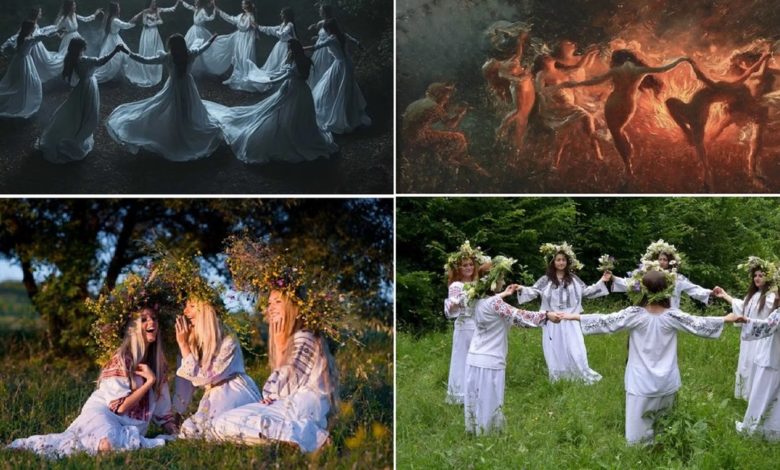
At the beginning of summer, two close holidays in the calendar-the descent of the Holy Spirit (Pentecost) and the Birth of Saint John the Baptist-bring two mythological characters to the fore. Even when the dance of the jelly and the flight of the Sânziene do not meet the same day, the magic often turns into confusion.
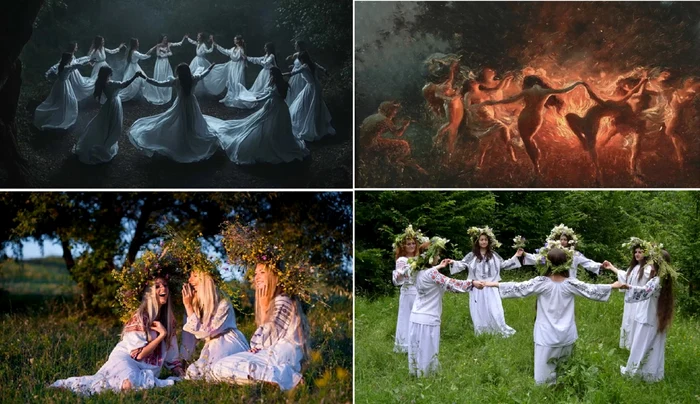
Ielele and Sânzienele – the fairly confused summer fairies, but opposite in magic collage
Pentecost and Sânziene are frequently tangled, especially because both holidays involve fairies, mystery and summer rituals in Romanian villages. And when the data from the calendar aligns strangely, and the holidays seem to step on the beating, one of the oldest and persistent confusion of the Romanian folklore returns in force: are the same beings with the Sânziene?
Let's handle this confused mythological thread.
Detail that confuses the fairies: Date from the calendar
There are a lot of subtle differences between the two holidays and their mythological beings – from names and origin, to symbols and rituals.
Pentecosts draw their names from the old Roman holiday Rosalinddedicated to the dead or flowers, while the Sânziene derives, according to some researchers, from Sanctae Dianae – the Roman goddess of the forest, kept in the Romanian folklore in the form of a solar fairy, protector of summer and love.
At Pentecost, the guards play to chase away and protect the community. From Sânziene, the unmarried girls collect yellow flowers, weave crowns and throw them on the roofs, in the hope of dreaming of the bear.
Typically, Pentecost is celebrated 50 days after Easter (the date varies from year to year – in 2025, they fall on June 9), while Sânzienei have a fixed date: June 24. In the years when the two holidays overlap-as it happened in 2024-it is as if two completely different mythological worlds would collide in one day. And from here to confusion it is only one step of jelly … or a strange tropit, as the elders say, given that the jelly are often imagined with goat's legs – a sign of their supernatural and deceitful nature.
“The calendar overlap is accidental. But in the collective mind, it creates the feeling that the jelly and the sânziene are one and the same magical creature. In reality, their mythologies are totally different.”explains the ethnologist Doina Ișfănoni.
The confusion persists even when the two holidays are separated by only a few days.
The jelly – the mysterious dancers who punish mercilessly
On the night of Pentecost, when the veil between the worlds are thinned, the Ielele – aerial and unseen beings – begin their magic time. Capricious and ruthless, sometimes with goat's foot, sometimes with the power to drive them crazy, they arouse fear and mystery. They avoid pelin, garlic and prayer, and when they dance on the field, the grass dies under their steps.
Anyone wanders unexpectedly through their playgrounds – at the edge of the forest, at the crossroads or in desert spaces – risks “Taken by Pentecost”: A cruel fate, which can mean paralysis, scrape or even losing limbs.
In some areas, the jelly are seen like the dark sisters of the Sânziene, women-dancing, either empty or in steamy dresses, meant to lure men in their world.
In this dark light, they were considered the causes of all evils, including personifications “The plague and cholera”as the ethnologist Alexandru Chiselev tells us, from the Institute of Eco-Museum Research “Gavrilă Simion” Tulcea, in his work “Magic in Romanians and Ukrainians in northern Dobrogea”.
Sânzienele – solar fairies that bring love and plenty
Sânzienele, on the other hand, the princesses of light and fertility, symbolize gentleness and plenty. On the magical night between June 23 and 24, they fly among the flowers, perfume the fields and bring rich fruit in orchards. It is said that the sânziene weave destinies and urge true love.
On this holy night, the unmarried girls interweave wreaths of yellow flowers and throw them over the houses, in the hope of luck and a love that will be fulfilled.
Although they are considered beneficial fairies, the Sânziene can become as dangerous as Pentecost, bad fairies, if not respected.
Two faces of the same fairy tale but with opposite roles
If the jets bring warning and punishment, the Sânziene represents hope and blessing. The first category is invoked with fear, the other – with desire. To confuse them means to transform a solar fairy into a vindictive spirit … and vice versa.
Although both are generic called “Fairy”they embody two opposite forces: one of light and fruit, the other of danger and chaos.
“It is one of the most spectacular overlaps in our traditional imaginary: two mystical femininities, two types of sacred, in a silent battle”, The note of the late Cultural Anthropologist Vintilă Mihăilescu in a deep analysis of the Romanian mythological dualities.
Conclusion
When the Pentecost and Sânzienele fall the same day or the same month, it does not mean that the fairies and jelly are shaking-but that we are in a whirl of beliefs, fears and hopes for centuries. A fascinating territory, where the Romanian mythology breathes the deepest and where the tradition still shapes the way we understand the unseen world around us.
The rituals and habits related to these holidays are not only echoes of the past, but living bridges to the identity and soul of the rural communities, keeping the connection between people and the mysteries of nature alive.