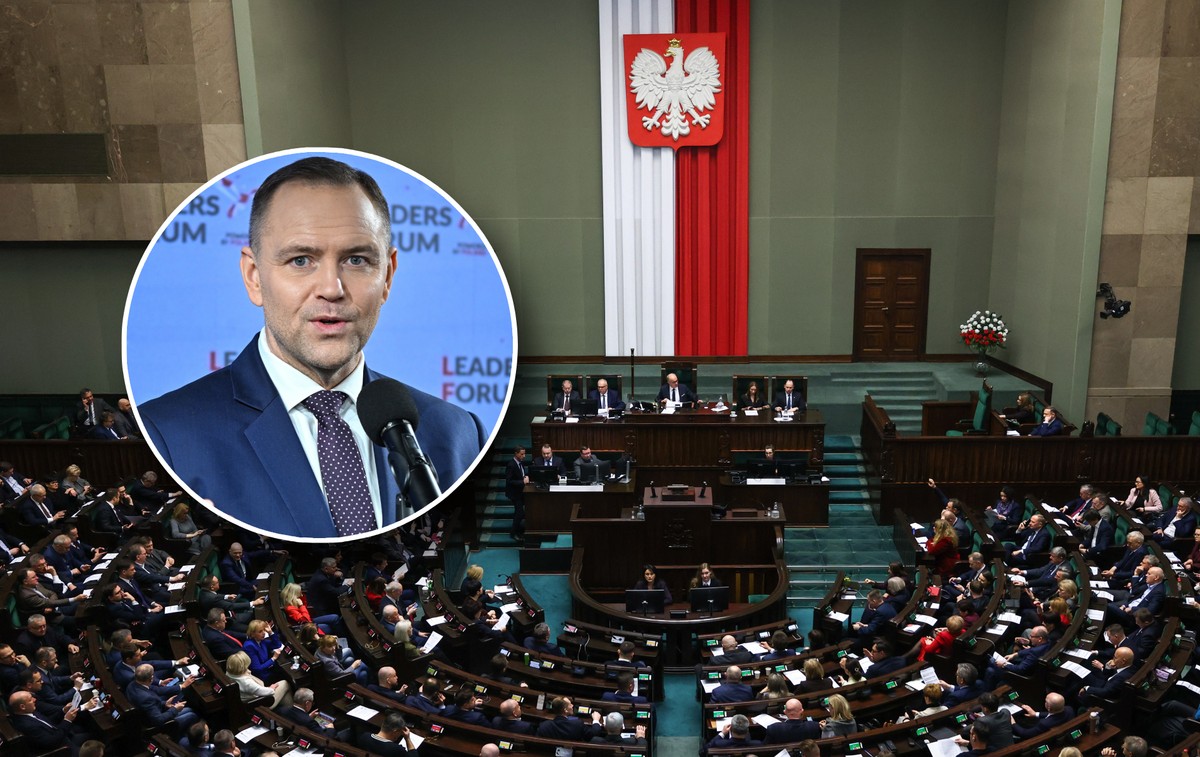
During the last sitting of the Sejm, Deputy Marshal Szymon Hołownia joked that “the competence of a senior rapporteur has probably already been achieved.” This is not surprising, because within three days the MPs managed to start and finalize work on two important reforms. One concerns the courts, the other concerns Ukrainian citizens.
In addition, they passed major changes to the Code of Criminal Procedure and the Act on the National Cybersecurity System. Karol Nawrocki may have reservations about these provisions. Zbigniew Bogucki, head of the Chancellery of the President, has already announced that he will veto the bill on cryptoassets for the second time. Here is a brief summary of the Sejm's decision.
Elections to the National Council of the Judiciary under new rules. (Impossible?
On Friday, the Sejm passed an amendment to the Act on the National Council of the Judiciary. According to it, judges, not MPs, are to elect members of the reformed Council, and the so-called neojudges. 232 MPs voted for the amendment, 183 were against and 12 MPs abstained. Earlier, the Sejm rejected PiS's motion to reject it in its entirety.
According to the act now adopted, 15 judges and members of the National Council of the Judiciary will be elected by judges in general elections organized by the National Electoral Commission. The right to run for a member of the Council will be granted to a judge who, on the day of voting, has had at least ten years of experience as a judge. Now the bill will go to the Senate.
However, it is already known that President Karol Nawrocki will not sign it. This scenario was suggested by Zbigniew Bogucki in the Sejm. “You want to go back to judges electing judges without any control,” he said. And he emphasized that the president did not consent to this.
This is the second attempt of the coalition on October 15 to change the rules for electing members of the National Council of the Judiciary. The first amendment, prepared when the Ministry of Justice was headed by Adam Bodnar, was questioned by the Constitutional Tribunal at the request of Andrzej Duda.
New rules for one million Ukrainian citizens
The Sejm quickly passed an act that will radically change the rules of residence and employment of Ukrainian citizens in Poland. This concerns the act on the termination of solutions resulting from the act on assistance to citizens of Ukraine in connection with an armed conflict on the territory of this country and on amending certain other acts. The government adopted it on Tuesday, January 20 this year, and the Sejm passed it on Friday, January 23.
The new regulations are to enter into force on March 5 this year, because only the Ukrainian special act is in force until that date. The Sejm practically did not introduce any substantive amendments when it comes to the employment of Ukrainian citizens. The employers' demands submitted during the express work of the Sejm committee were not taken into account.
The act extends the legality of stay of Ukrainian citizens fleeing the war only for one year, until March 4, 2027. During this time, they must submit an application for legal stay and obtain a permit.
Read also: The government adopted a controversial law affecting one million Ukrainian citizens and thousands of Polish companies. There will be new rules
Restriction on trade in agricultural land
The Sejm passed an act that extends the period during which the sale of agricultural land from the state resource will be suspended for another 10 years, i.e. until 2036. The ban was scheduled to expire on April 30 this year. The new regulations also increase the acreage of state land from 2 to 5 hectares, which can be sold to a farmer without the consent of the Minister of Agriculture.
This concerns an amendment to the Act of April 14, 2016 on the suspension of the sale of real estate belonging to the Agricultural Property Stock of the State Treasury. Now the amendment will go to the Senate.
Major reform of criminal proceedings
The Sejm also adopted a major amendment to the Code of Criminal Procedure. In total, these are combined government and parliamentary proposals, which, as a rule, are to come into force three months after their announcement. Now they will go to the Senate.
Deputy Minister of Justice Arkadiusz Myrcha said in the Sejm that this is “one of the largest, if not the largest, comprehensive reform since 1997.”
The reform is intended to encourage courts to use pre-trial detention more judiciously. How? The upper limit of prison terms – understood as severe – will be raised from eight to 10 years. However, a severe penalty is the basis for pre-trial detention.
Additionally, it stipulates that “it is unacceptable to take and use evidence obtained for the purposes of criminal proceedings by means of a prohibited act.” It's about prohibition of the use of illegally obtained evidence. It was also clarified that “the use of evidence obtained during the application of operational control may only take place in criminal proceedings in the case of a crime or fiscal offense in relation to which the use of such control by any authorized body is permissible.”
The key to Poland's digital security
The Sejm passed an amendment to the Act on the National Cybersecurity System, implementing the EU NIS2 directive. This is the result of the work of both the PiS government and the October 15 coalition. The amendment was first made public in September 2020. Three years later, the project was submitted to the Sejm, but the government withdrew it before work began. After the Coalition took power on October 15, work on the regulations started again and was finally finalized.
The Act implements the Directive on measures for a high common level of cybersecurity within the Union, which has been applicable since October 2024. The European Commission has already called on Poland to explain the delays in implementation.
Thanks to the act, the national cybersecurity system (KSC) will be expanded to include new economic sectors, such as sewage disposal, postal services, space and the production and distribution of chemicals and food. This means that more companies will have to comply with the requirements of the NIS2 directive.
The most important change, however, concerns high-risk suppliers, i.e. those suppliers of new technologies, hardware or software who do not guarantee security. Entities important for the functioning of the state will not be able to introduce products from high-risk suppliers into their systems, and if they have any, they will be obliged to withdraw them within 7 years. A supplier who does not agree with the decision will be able to file a complaint to the administrative court.
Cryptoassets are going to the president again
On Friday, the Sejm considered the Senate's amendments to the act on the crypto-assets market. The upper house wanted the maximum fee for the supervision of the Polish Financial Supervision Authority over this market to be increased, but the Sejm rejected it.
The remaining provisions of the act are identical to those included in the act vetoed by President Karol Nawrocki. Only the date of its entry into force was changed.
As a result, Zbigniew Bogucki, the head of the Chancellery of the President, has already announced his veto again.
Read also: Will there be another veto by Karol Nawrocki? It's about cryptoassets 2.0
A support portal will be created
The Sejm also positively considered the Senate's amendments to the amendment to the Electoral Code. It provides for the possibility of collecting signatures of support for candidates in general elections in electronic form. The change will apply to the presidential elections, to the Sejm and Senate, and to the European Parliament. The introduction of this solution does not mean abandoning the traditional form of collecting signatures. The bill will now go to the president.
Currently, signatures can only be collected in the traditional form, i.e. paper lists of support are created and sent to the National Electoral Commission. As a result, information about irregularities appears in every election. The digitization of support lists is intended to reduce the so-called “dead souls”, which involves entering non-existent or deceased people on lists.