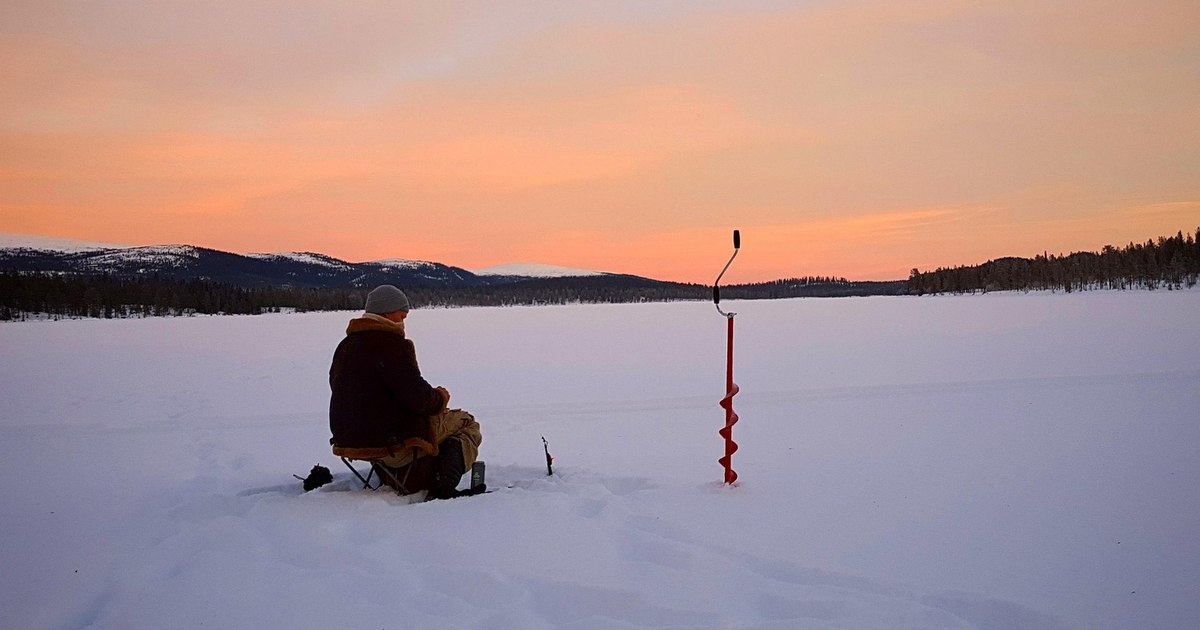
The ancient tradition of longline fishing was, over time, one of the essential means of survival for the ancestors of the Romanians. The increasingly mild winters of recent years have diminished its importance, and climate change could bring the cod fishery to the brink of extinction.
Troll fishing has archaic origins. Photo Fiskeavisen / Pixabay.com
In winter, fewer and fewer lakes in Romania remain completely covered with ice, but the past inhabitants of the Carpathians went through long periods of harsh winters, when fishing was one of the most accessible means of survival.
Fishing with a line, an ancient tradition
Fishermen hollowed out or cut through the crust of ice that covered the waters, stalking or luring the fish that moved into the “hole” formed to breathe. Then they either hung them on hooks, or pierced them with spears and other sharp tools, or captured them in traps made of baskets or nets. The methods of gillnet fishing were extremely diverse, supplemented by the skill of the fishermen and adapted to the kinds of fish hunted.
Two millennia ago, the locals on the shores of the Danube, called Istrians by some scholars of Antiquity, took out abundant prey of carp, raven fish, swordfish, sturgeon and catfish from the frozen river, the ancient authors showed.
“The fishermen take hammers and break the ice where they please, making a round hole to the water. You would say it is the mouth of a fountain or a huge vessel, very bulging. Then multitudes of fish, desiring to escape the ice that presses upon them like a roof, and longing for the light, swim with joy to the opening, come in untold numbers, crowd into each other, and, being caught in a space narrow, they are easily captured”, note in the 1st century Plinius the Elder, author of the first great Roman encyclopedia, Naturalis Historia.
Longline fishing remained a necessity even in the medieval period, marked by the Little Ice Age, between the 13th and 19th centuries, characterized by long and frosty winters, in which the waters frequently turned into expanses of ice. The inhabitants of the Dobrogean settlements on the Danube were not afraid of the winter frost, even if the river often brought large blocks of ice that destroyed their villages, noted the scholar Evliya Çelebi, in the middle of the 17th century. Fishing was their main occupation during the winter.
“Many fishermen, digging holes in the ice, catch morons and sturgeons weighing up to a hundred oca (no equivalent to about 120 kilograms). The inhabitants of Silistra keep pieces of the sloi and use them in the month of July, dipping them in a compote as clear as Murano's mirror, of cherry, and drinking the liquid to cool themselves. Many others gather in large groups, bring earth, place it on the ice and make fires on which whole roasts of sheep and cattle are roasted, and then they eat and make merry. The inhabitants of this town, whether they be adults or children, are not afraid of the cold of winter. Situated in the middle of the fifth climate, the winters here are terrible, but all the inhabitants are healthy.” informed the Ottoman chronicler.
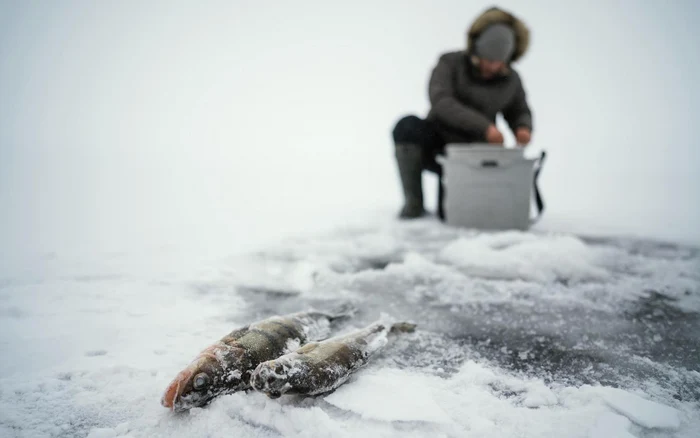
Ice fishing, an endangered tradition. Photo. Freepik.com
In the past centuries, winter fishing continued to retain its importance in Romanian traditions, including for religious reasons. During fasts, when food was limited, fish was one of the accepted animal foods.
Encyclopedia of fishing, written by Grigore Antipa
The naturalist Grigore Antipa (1867–1944) extensively described the tools used by Romanians at the beginning of the 20th century to catch fish from frozen waters. The rocks were meant to oxygenate the ice-covered waters, he said, and the fish couldn't resist their attraction.
“Based on these few simple principles, and especially from long observations of the habits of fish life, fishermen devise all kinds of means and construct all kinds of instruments, according to the kind of waters in which they fish, to entice and concentrate fish in the narrowest places, so that you can then catch them with the greatest ease.” note Grigore Antipa, in the book “Fishing and Fishing in Romania” (1916).
In Oltenia at the beginning of the 20th century, he observed, the locals used to fish in the winter with a basket, like this: they dug a hole as big as possible with an ax and let the crushed ice stay inside for a while.
“The dazed fish rises to the surface and mingles among the floes. Then a scoop is taken — that is, a large, wide-mouthed basket — with which the broken ice is scooped up and thrown ashore, from which the fish are then gathered from among the floes.” informed the scientist.
In other areas, he added, the hostis were used, a kind of fork with which the fish was pierced, but also other piercing instruments and hooks, of different sizes and shapes. In large ponds, fishermen used nets that they inserted under the water, under the ice layer, to capture fish, and on rivers they set nets (nets) and ostretes (made of reeds) or set up “coops” for catching animals. The traps were often extremely ingenious, and in some villages the trap fishing brought together almost the whole community.
In the Dobrogean lands of the Danube, fishing in winter was a tradition preserved from ancient times.
“The industriousness of the Turtuca fisherman is clearly seen when groups of people wander the frozen Danube, armed with axes and chisels or with picks, used to make hooks, with the help of which they can penetrate deep into the water, where they hunt the fish, which do not escape their weapons even in this season. In winter, fishing is done mainly with lines, inserted inside the hooks, catching all kinds of fish — in trout — and among the nets the oria stands out, a tool specific to this season, adapted especially for catfish, instruments with which the fishermen abundantly maintain the city's food supply”sociologist Theodor Mărculescu Dunăre noted in 1939.
The art of hook fishing, described by Sadoveanu
In the deep valleys of the Carpathian mountains, carp fishing had become a real art, noted the writer Mihail Sadoveanu, in the middle of the 20th century, describing the winter atmosphere of Valea Frumoasei, in the Șureanu Mountains.
“The people had sunk the net, gathered together in folds, into a crack in the ice at the deep end of the ellipse. Tying the ends of the wings, they held them on one side and the other on the line of products: the rods in which these wings were fixed slid under the ice, appeared successively at the products (holes, stitches – no) and were driven forward by skilled men, from product to product. Thus, through two parts, the wings of the net advanced towards the other end of the ellipse. Here, in another break in the ice, the men drew the ends of the wings and crossed them. Then, harnessing themselves in two strings, they began to pull the net to the light. And you can believe that God alone ordered it to find such carp and not too far away to be cousin Zoe, who knows what use to give them. With such words and with two sledges full of carp, we returned to the yard.” wrote Mihail Sadoveanu.
Over time, angling has become a recreational activity, practiced on lakes, but often considered risky due to the thin layer of ice. Archaic gear has been replaced by modern equipment, nets, casts and nets have given way to rods and baits, but regulations have become stricter and the milder climate reduces the number of days that can be allocated to this activity.