The semi-illiterate giant who became the first barbarian emperor of Rome. He liked to drink several liters of wine a day

In 235 AD, a warrior of Thracian origin ascended the throne of the Roman Empire. He was the first barbarian to rule the huge empire founded by Octavian Augustus. His name was Maximinus, he was of gigantic stature, and was renowned for his physical strength, but also for his resistance to drink.
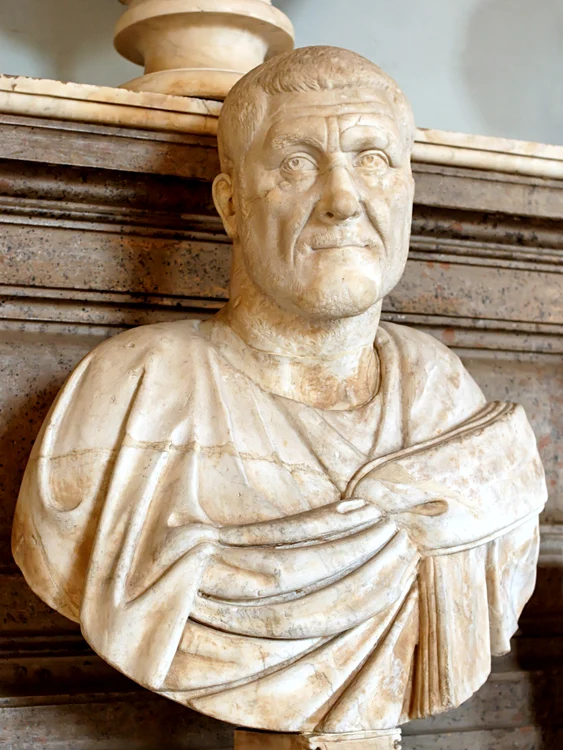
Maximinus Thrax PHOTO wikipedia
In AD 235, the Roman Empire, a military and political force that dominated much of the known world, was entering a period of dire crisis. The days of the great emperors who had built a true “empire of the world”, bringing Latin civilization to three continents, were already over. Trajan, Hadrian, Marcus Aurelius and Septimius Severus had departed among the ancestors and the empire entered a period known in history as “military anarchy”.
It all started in 235 AD, when the emperor Alexander Severus was assassinated by the revolted legions. The emperor had tried to avoid a war with the Germanic tribes by diplomatic means. Many Roman soldiers considered this strategy weak and shameful. The emperor was killed along with his mother, and this moment opened a period of deep crisis that spanned nearly half a century.
There were decades characterized by frequent changes of emperors, all chosen by the legions they commanded. Most of the emperors of this anarchic period met a violent end, often killed by the very people who proclaimed them emperors. Obviously, this anarchy was also caused by barbarian invasions, the financial crisis, inflation and epidemics.
The first Roman emperor who came to rule during the period of military anarchy was, at best, a Thracian. He was the commander of the South Danubian legions and was elected by the soldiers after the brutal murder of Alexander Severus. His name was Maximinus Thrax, he was of humble origin, and he rose only by courage and strength of arms. Maximinus Thrax was the first Roman emperor of barbarian origin, and also the first Thracian ever to reach the imperial throne.
Maximinus, a man of Herculean strength, of the race of the Thracians
Maximinus Thrax, the first barbarian emperor of the Roman Empire, was actually called Gaius Iulius Verus Maximinus, and his story begins in AD 173 in Thrace, a region northeast of Macedonia, in present-day Bulgaria. Its origin has been hotly debated, especially since ancient historical sources lend more to the version. In the “Historia Augusta” it is said that Maximinus was born to a Goth father and a mother from the tribe of Alans (Iranian nations). Another ancient author, Herodian, believes that the emperor was of Thraco-Roman origin. To top it off, also in the “Historia Augusta” there is a passage that contradicts the previous one and would suggest that Maximinus was of the same race as the Getae, but from south of the Danube.
Precisely because of the contradictory passages, the “Historia Augusta” is treated with suspicion from certain points of view. Most opinions, however, show that Maximinus was the son of a Thracian farmer in present-day Bulgaria, and who had Roman citizenship. Maximinus was a strong-willed child who did not shy away from hard work. That is precisely why, at the age of 20, he is said to have had Herculean strength. That is, he could crush rocks, pull loaded wagons, and pull a horse's teeth with his bare hands. When he became emperor it is said that his thumb was so thick that he wore his wife's bracelets like rings. Obviously, many of these stories are mere exaggerations.
In order to escape the work of the land and the humble life, Maximinus enlisted in the year 190 AD in a Thracian auxiliary unit. Due to his physical qualities but also his special courage, Maximinus quickly distinguished himself on the battlefield. Also proving great qualities as a leader, Maximinus advanced from a mere auxiliary soldier to legion commander. In 232 d HR, he commanded a legion in Egypt, and in the same year he was appointed interim governor of Mesopotamia. Two years later, he commanded a legion in Germany. Maximus was also a particularly popular commander among the soldiers. Fight like a lion and drink like a true follower of Dionysus. Also in the “Historia Augusta”, it is said that he drank 26 liters of wine a day. Obviously, another exaggeration. But as there is no smoke without fire, Maximinus was certainly a notorious reveler, especially fond of wine.
The barbarian emperor who never saw Rome
In the early spring of 235 AD, the Roman emperor Alexander Severus and his mother attempted an offensive against the Germanic tribes in order to improve the young emperor's image with the Roman army and people. Alexander Severus chose to negotiate rather than fight. The army was furious and killed Alexander Sever, but also his mother Iulia Mamaea.
All this time, Maximinus Thrax was with his legions in Germany, near the present city of Mainz. Being an extremely popular figure in the army, a true “father” to many Roman legionnaires, Maximinus was acclaimed as emperor on March 20, 235 AD. The Roman Senate, although reluctant to this election of the legions, especially since Maximinus was considered a barbarian and inferior by his social status, had no choice. The favorite of the soldiers, the Thracian giant became the first barbarian emperor of the Roman Empire. His son, Gaius Julius Verus Maximus, would be named Caesar.
Maximinus ruled Rome like a barbarian. He never reached Rome, being the only emperor who never set foot in the Eternal City. He didn't even know what he looked like. He preferred to rule from military camps, waging wars and hoping to restore the former glory of the Roman Empire. Although beloved among the legions, Maximinus was despised in Rome, and considered a brutal and uneducated barbarian. Maximinus was semi-illiterate, barely able to write his name.
The bizarre way in which the Dacians faced the extreme phenomena attributed to the god Gebeleizis
“His character was by nature barbarous”
But Maximinus was an intelligent commander. He immediately realized the situation. He realized that the Roman Empire had entered a period of crisis and maximum instability. He was aware of the contempt of Roman senators and patricians. He knew that he was not part of their world and that they would constantly plot to remove him from the throne. So he preferred to do what he knew best: make war.
He knew this would keep his legions satisfied and loyal. “Building a pontoon bridge and crossing the Rhine, the new emperor advanced further into Germany, pillaging and burning villages along the way. After a fierce battle near Württemberg and Baden and despite heavy losses, he was proclaimed Germanicus Maximus. Peace was restored to the region. Between AD 235-236, he advanced to the Danube, earning the titles of Dacius Maximus and Sarmaticus Maximus.”specified specialist Donald L. Wasson in a specialized article for “World History”.
Although he was phenomenally successful militarily, pacifying many of the barbarian tribes that were giving trouble to the Empire, his campaigns drained the empire's finances. At the same time, in order to finance his campaigns, Maximinus Thrax reduced the subsidies for Rome's grain supply.
A substantial political blunder that damaged his reputation with the residents of the Eternal City. In addition, he tried to impose himself by force and with unusual brutality where he knew that he was not appreciated and wanted. That is, he turned against the patricians, the senators, and the Roman vassals. He cut left and right, confiscated assets and even dipped into the empire's finances to finance his campaigns but also to increase his wealth. He even took from the budget for gladiator shows and public parties, which was considered inadmissible by many Romanians. “His character was by nature barbarous, as was his race. He had inherited the brutal nature of his countrymen, and intended to strengthen his imperial position by acts of cruelty, fearing that he would become an object of contempt to the Senate and people, who might be more conscious of his humble origin than impressed by the honor he had won.”wrote the historian Herodian, in his work “History of the Roman Empire”.
The same Roman historian continues and says that “After Maximinus had impoverished most of the distinguished men, and confiscated their estates, which he considered small, insignificant, and insufficient for his purposes, he turned to the public treasury; all funds which had been raised for the welfare of the citizens or for gifts, all funds being kept in reserve for shows or festivals, he transferred to his own personal wealth.”.
The death of the Thracian, the beginning of chaos
It was obvious that the Romans, as well as many military commanders from other regions of the Empire, would combine to get rid of Maximinus. Some because they feared for their lives, others to get their hands on power. Those in Rome, as well as many in the army, preferred a senator named Magnus. However, the plot was exposed and Maximinus killed many of the conspirators.
What the world would look like without humans: peace, nature and the traces of a lost civilization
Others, who remained loyal to Alexander Severus, elected Titus Quartinus as emperor, but unfortunately he died in his sleep, killed by one of his most vocal supporters, a man named Macedo, who chose to switch sides and support Maximinus. “Realizing that they could no longer tolerate the excesses of Maximinus, the Senate expressed its support for the eighty-year-old governor of Africa, Marcus Antonius Gordianus Sempronianus or Gordian I. Maximinus was declared an enemy of the state”stated Donald L. Wasson, in the same paper.
Gordianus and his son Gordian II, proclaimed Augustus by his father, enjoyed the support of the Senate but not the army. Capellianus, governor of Numidia and ally of Maximinus, advanced with his legions to Carthage and killed Gordian II. His father, the former Governor of Africa, hearing of his son's death, hanged himself. Gordian the father and Gordian the son were emperors for only 24 days. Desperate, the senators appointed two emperors, Decius Caelius Calvinus Balbinus and Marcus Clodius Pupienus. However, the two were stoned on the streets of Rome. The people preferred Marcus Antonius Gordianus, the 13-year-old grandson of Gordian II.
Maximinus decided to visit Rome for the first time. But not to receive the honors of the people or the Senate, but to kill his suitors. However, it got stuck in front of the city of Aquileia. Tired of wars and lured by new rewards from the new emperor, Maximinus' soldiers betrayed him, and both he and his son were beheaded. The head of Maximinus first arrived at Pupienus in Ravenna, then in Rome, in front of the Senate. The first barbarian soldier-emperor was dying, and Rome was entering an era of great turmoil.