The government adopted the draft amendment to the Energy Law last week. Now the Sejm will deal with it. In an interview with Business Insider Polska, director of PSE's strategy department, Robert Tomaszewski, explains the justification for the changes and describes their effects.
The rest of the article is below the video
— Today we have connection conditions issued in the system for 240 GW of power. This is eight times more than the entire current capacity of windmills and PV in Poland combined. Meanwhile Projects with a maximum capacity of 50 GW have a chance of being actually implemented. The rest are projects that either have no financing or have been submitted multiple times to different operators and different connection points, he points out.
As he explains, this blocks capacity and ultimately means that today investors who have capital and ready-made projects and really want to build renewable energy or storage facilities are met with refusals to issue connection conditions. — UC84 will change this through the mechanism of milestones – i.e. the requirement to obtain a building permit – and financial security. Thanks to this, we will free up capacity for those who really want and can build, says Tomaszewski when asked what the effects of UC84 will be on the development of renewable energy and energy storage.
He adds that UC84 also extends the provisions regarding cable pooling, i.e. sharing one connection by two or more installations. – As a result energy storage facilities will be able to share the connection with other renewable energy installations. Before UC84, cable pooling only took into account renewable energy sources, he explains.
In his opinion, “this will fundamentally improve the situation of energy storage operators and help us limit the scale of non-market redistribution of renewable energy sources.” — In 2025 alone, as the transmission network operator (TSO), we had to reduce production from renewable energy sources by almost 1,350 GWh. The proposed changes will enable the implementation of solutions that will reduce the scale of this phenomenon, emphasizes Robert Tomaszewski.
Another goal of amending the Energy Law is to put an end to speculation on the terms of connection to the network.
When asked why this phenomenon is unfavorable from the point of view of the power system, Tomaszewski argues that “the current system has a fundamental regulatory gap — huge connection capacities can be reserved without incurring virtually any financial risk, even if the company reserving the capacity has no actual intentions to build the sources.
— This generates real system costs, because as TSOs we should take into account all these projects in our flow analyzes and plan network development, assuming that since the project has obtained connection conditions, it will be implemented. The problem is that we do not know which projects will actually be implemented, and even if we guess, we currently do not have the tools to screen them out – notes the director of PSE.
As a result, he continues, “you may end up investing in unnecessary infrastructure or postponing the investment until later.”
The costs of speculation are ultimately borne by electricity consumers
— These are hundreds of millions of zlotys that are ultimately paid by all energy consumers. UC84 introduces symmetry – whoever wants to reserve connection capacity must show that he has the financial capacity to implement the project. This is not punishing investors, it is restoring balance in the system and protecting the interests of recipients – emphasizes Robert Tomaszewski.
When asked why PSE took the initiative to change the law, he replies: – The current system is failing. The queue of investors waiting to be connected to the network is getting longer, a real investors are blocked by ghost projects.
At the same time, as he points out, “recipients may pay for the construction of infrastructure that may turn out to be unnecessary.” And the UC84 – as he adds – changes that.
There are many voices in the debate from renewable energy communities opposing the implementation of UC84. They emphasize, among other things, that the act is retroactive and violates acquired rights.
— The industry says: we received connection conditions X years ago, on specific terms, and now the rules of the game are suddenly changing. This is not true. UC84 does not deprive anyone of the right to conclude a connection agreement. The way this right is exercised in the future is changing – financial security will be required when concluding a contract – comments Tomaszewski.
As he argues, this is not a retroactive action. — The Constitutional Tribunal has repeatedly ruled that a change in the legal regime affecting relationships over time does not constitute retroactive action if it regulates effects for the future. Moreover, the right to connect to the electricity grid has never been an absolute right. It has always been subject to conditions specified in the regulations. If it was possible to change connection fees, the validity of conditions, and other parameters – it means that this right is not acquired in the constitutional sense – he argues.
It also refers to the accusation that the security fees assumed in the project are too high and small companies will not be able to afford to cover them.
— The renewable energy industry claims that the costs related to advance and security fees may reach up to PLN 20 million, which is an unattainable amount for small entities. However, please look at the proportions. A typical large-scale PV farm with a capacity of 200 MW has an implementation cost of at least PLN 0.5 billion and requires access to approximately 200 hectares of land. And now we are saying that a project worth half a billion zlotys cannot allocate approximately PLN 18 million for security, which is also included in the future connection fee? – emphasizes Robert Tomaszewski.
He adds that this fee does not actually increase the total cost of the project, it just changes the moment when this money must be available. — A project worth hundreds of millions or over a billion zlotys should not fail due to securitywhich is not only a fraction of the investment cost, but also has to be incurred anyway – emphasizes the director of PSE.
He also responds to the accusation that “doubling the advance payment for connection to the network is too much.”
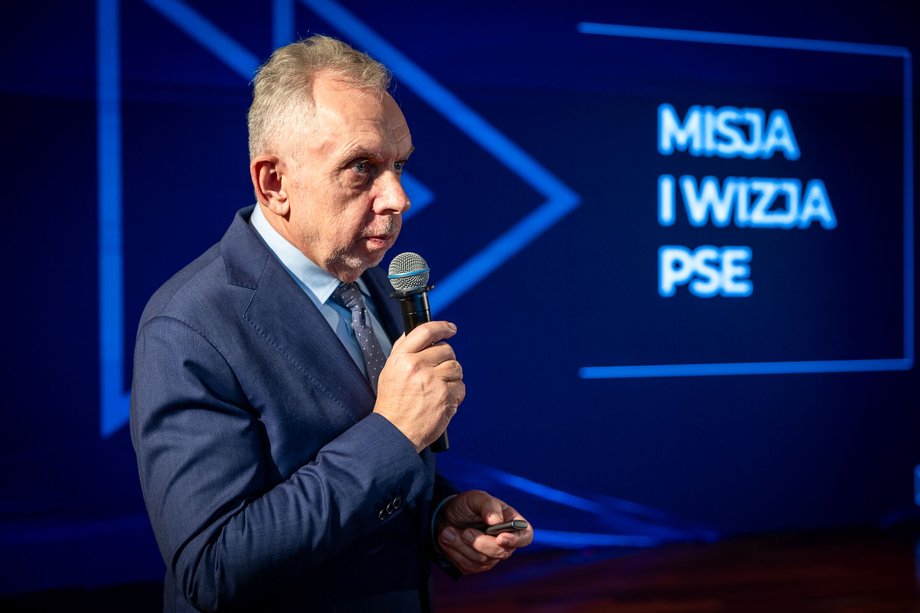
President of PSE, Grzegorz Onichimowski, PSE was the initiator of the change in the Energy Law
|
Press materials / Polish Power Grids
Read also: “A milestone in the implementation of the project.” The Polish nuclear power plant has gained a supplier
— The applicable advance payment rate (PLN 30/kW, with a limit of PLN 3 million) has not been changed since 2009. Since then, cumulative inflation has exceeded 70%. For comparison, the cost of building a 400 kV switchgear field increased from PLN 4 to 25 million during this time. The real value of the current advance payment is approximately 40%. what it was in 2009. Doubling the advance payment is not a drastic tightening – it is simply making up for 16 years of its lack of indexation – convinces Robert Tomaszewski.
— We do not want to demonize developers of renewable energy projects. They play an important role in the industry – they obtain permits, negotiate with landowners, and talk to municipalities. Without them, the industry would not develop so quickly. But the system that has operated so far has led to a speculative bubble and it needs to be fixed, he sums up.
He adds: – If the project is financed and will be implemented, the developer will easily find money to secure it. If there is none, it means that the project was speculative and should not block access to others.
As Robert Tomaszewski says, UC84 is intended to accelerate the development of renewable energy sources by enabling the connection of the best projects.
— This is bringing order to the chaos that today simply impedes the development of renewable energy sources. Because how can renewable energy be developed when real investors cannot get connection? This is absurd. If someone says that UC84 blocks renewable energy sources and storage, they simply have not read the project or are defending the status quo, which puts speculators who treat connection capacity as a commodity in a privileged position. Changes in the law will help unblock hundreds of projects that are currently stuck – he assures.