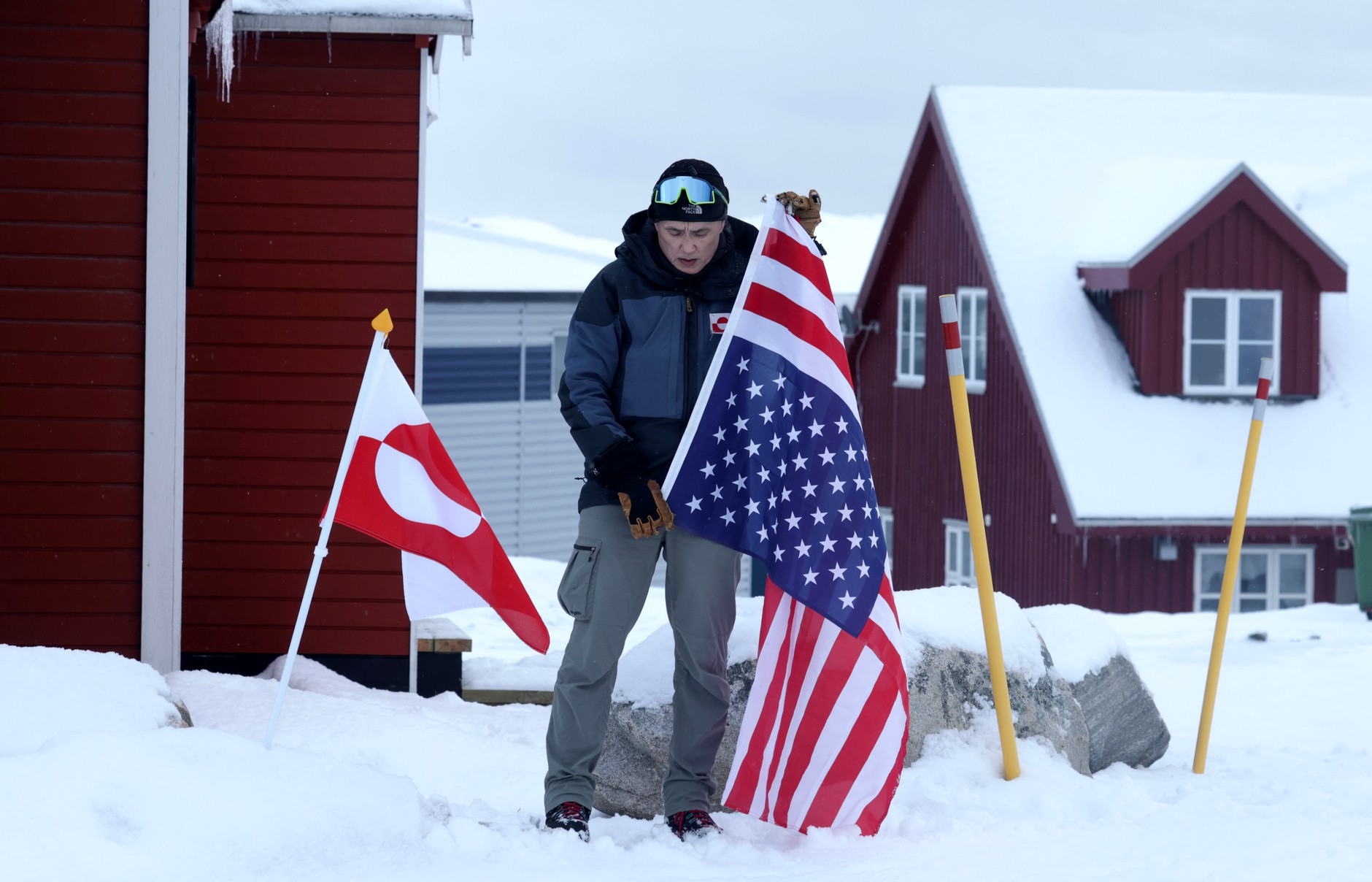
There is some irony in the fact that on Tuesday in Paris, European leaders were again discussing US security guarantees for Ukraine based on the clause contained in Article 5 of the NATO treaty, at a time when the United States is threatening a NATO ally to take over part of its territory by force. In recent days, senior Trump administration officials have repeatedly said that when in doubt, the United States will not hesitate to take over Denmark's Greenland by military force.
Taking control of the Arctic island is “the official position of the U.S. government,” said Stephen Miller, Trump's chief ideologist on migration issues and deputy chief of staff at the White House. He added that the United States could achieve an easy military victory there. — No one will fight militarily against the United States for the future of Greenland. It doesn't make sense, he said.
Karoline Leavitt, press secretary of the US president, spoke in a similar tone on Tuesday. — President Trump has made clear that taking Greenland is a priority for U.S. national security and critical to deterring its enemies in the Arctic. The president and his team are discussing a range of options to achieve this important foreign policy goal, and the use of armed forces, of course, is always an option for the commander in chief, she said.
Since Trump's first term, the topic of Greenland has become something of an obsession for him.
However, the arguments presented by his camp do not make much sense. Yes, the island is of great strategic importance for the defense of the United States against threats from the north. The North Atlantic would also be a major theater of war if Russia attacked NATO partners in Europe. The Russians would then try to break through the GIUK gap between Greenland, Iceland and Great Britain to prevent American ships from delivering supplies to Europe.
Expansion of presence even without annexation
However, the Americans already have their military base in Greenland, and Denmark has repeatedly expressed its readiness to increase the American military presence within NATO to protect the North Atlantic. “Because Denmark is a trustworthy, democratic ally, we can keep as many troops in Greenland as we want without having to annex it,” said Michael McFaul, a former U.S. ambassador to Moscow.
Trump's argument simply doesn't make sense – for example, the US 5th Fleet is stationed in Bahrain to protect the Middle East. However, the White House did not see the need to annex this territory. The same applies to the 7th Fleet stationed in Yokosuka, Japan to protect Asia. The Danes are also ready to talk about the exploitation of Greenland's natural resources by the Americans. So Trump's economic and strategic goals can be achieved without annexation – so why his obsession with taking over Greenland?
Trump clearly wants to go down in history as the president who expanded the territory of the United States, just like famous presidents before him. He already announced this in his inaugural speech. “The United States once again sees itself as a rising nation — a nation that increases its prosperity, expands its territory, builds cities, broadens expectations and carries the flag to beautiful new horizons,” Trump said at the time.
A Greenlander in front of the American consulate in protest against the “U.S. annexation threat”, Nuuk, March 14, 2025.Joe Raedle/Getty Images/Staff/Getty Images
One of these new horizons where you can plant the US flag is apparently Greenland. Because it belongs to the Western Hemisphere, which Trump's US wants to dominate. Because it has great strategic importance and rich natural resources. Because it would be easy to get it. Because Trump wants to make history with this. It is also important that, as Peter Baker and Susan Glasser described in their book “The Divider”, Trump was already impressed by the vastness of Greenland during his first term. However, on maps the island looks much larger than it actually is and consists mainly of an icy desert that is difficult to use.
Many foreign policy experts believe that Europe should take the Trump administration's new statements about Greenland very seriously. However, a significant number of them believe that the mention of the military option is currently only a means of political pressure. — Speculations about US military actions in Greenland after the events in Venezuela are understandable – but it is realistic that the United States will make an attractive offer to Greenland, at the same time putting a lot of pressure and focusing on organizing a referendum among Greenlanders – says security expert Nico Lange.
This is confirmed by the statements of US Secretary of State Marco Rubio, who informed congressmen about it behind closed doors. According to The Wall Street Journal, he tried to calm them down assuring that Washington is not planning a military intervention in the near future. He added that the US goal is to buy the island from Denmark.
Association Agreement and covert operations
In the past, Denmark has repeatedly declared that the island is not for sale. In fact, it appears to be just one of several options the Trump administration is considering. According to several media reports, it has been thinking about concluding an agreement with Greenland since May last year – the so-called Compact of Free Association (COFA), similar to those concluded by the United States with small Pacific states such as Micronesia, the Marshall Islands, and Palau.
COFA gives Americans exclusive military access to small countries in exchange for cash payments and social benefits that are intended to support the development of individual communities. So far, however, such agreements have been concluded only with independent countries, and not with territories such as Greenland, which is part of a larger country.
The article continues below the video
It's already becoming clear what it looks like plan implemented by the Trump administration for this territory. Its first phase has already begun involving the infiltration of a population of less than 60,000 people of Greenlandic society in order to strengthen separatist tendencies – just as the Russians did before 2014 in eastern Ukraine.
According to Danish media reports Americans linked to Trump have already launched covert influence operations. The Danish secret services also warn that the territory of Greenland has become the target of various such activities. According to polls, the majority of the island's inhabitants support independence from Denmark – but only if current living standards are maintained. Given the high financial transfers from Denmark to Greenland, this is very unlikely.
At the same time, however, the overwhelming majority of Greenland's inhabitants do not want to immediately become dependent on the United States. This is where the Americans come in – on the one hand they strengthen independence aspirations to separate Greenland from Denmarkon the other hand, they make an attractive offer to the inhabitants of Greenland that is difficult to refuse.
The Danish government would thus find itself in a difficult situation. On the one hand, he always emphasizes that it is the people of Greenland who decide about their future. But agreeing to a referendum and possible secession would mean giving up territory that has been inhabited by northern Europeans for more than 1,000 years — and losing an important strategic asset that has previously given Denmark a greater role in Washington than the small European country would otherwise have.
“Dismantling the alliance system”
However, the question remains – what will happen if the people of Greenland and Denmark stick to their “no” to joining the US? Will Trump's people actually choose the military option? As Miller pointed out to CNN, a brutal invasion would technically be largely risk-free for Americans because no one in Europe would be ready to enter into a bloody and hopeless conflict with the United States.
However, the political costs of such a move would be enormous for them. — Trump's threat to attack democratic Denmark and annex its territory would be the same as Putin attacking Ukraine and annexing parts of it, McFaul says. Eastern Europe expert Michael Casey in “Foreign Policy” adds that NATO would then be virtually finished — because one of its members would attack another.
And that would destroy all allies' trust in the US. — Which U.S. ally — given the numerous territories European nations still hold in the Western Hemisphere, from the Azores to French Guinea to the British Virgin Islands — could be sure would not be next? Casey asks. — For Trumpian unilateralists, this may not matter much. However, for those who, in times of growing geopolitical tensions, perceive US allies as their greatest strategic capital, dismantling this alliance system would be tantamount to a suicidal maneuver unparalleled in modern history, he adds.
Moreover, according to Casey, it can be safely assumed that the allies who were previously under the American nuclear umbrella would acquire an atomic bomb themselves. First of all, it would be done by Canada, which Trump also threatens to annex. It would then be in the deadly grip of the USA: to the south by its continental part, to the west by Alaska, and to the east by Greenland.
This would not be logical, considering the fact that Trump could achieve his military and economic goals without annexing Greenland at enormous political cost.. However, it would not be the first time in history that a ruler's personal vanity led to decisions that radically changed the course of world events.
I’m Ashley Davis as an editor, I’m committed to upholding the highest standards of integrity and accuracy in every piece we publish. My work is driven by curiosity, a passion for truth, and a belief that journalism plays a crucial role in shaping public discourse. I strive to tell stories that not only inform but also inspire action and conversation.