
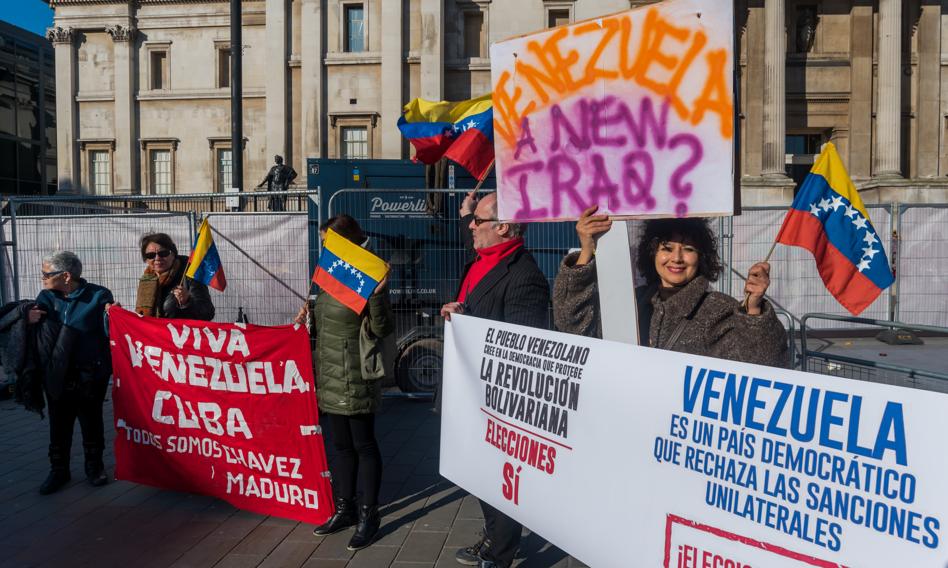
The specter of a “second Iraq” in Caracas. The US has no plan for the “day after” the dictator's arrest

2026-01-05 10:00
publication
2026-01-05 10:00
The US arrest of Venezuelan President Nicolás Maduro in Caracas as a result of a military operation was a spectacular show of military power. According to experts from the New York think-tank, the Council on Foreign Relations (CFR), however, this does not determine the future of this country.
Council on Foreign Relations analysts warn that the physical removal of the leader of the Venezuelan regime does not mean the automatic democratization of Venezuela. The lack of a clear political plan, the marginalization of the opposition and the focus on oil may deepen chaos and instability in the region.
According to experts, The arrest of Nicolás Maduro is a tactical success, but it does not guarantee lasting political change in Venezuela. Although the regime has lost its leader, real power remains in the hands of its loyalists, army and security apparatus, whose structures are weakened, corrupt and fragmented.
Shannon K. O'Neil emphasizes that Today, the state does not have a monopoly on violenceand comparisons to Panama in 1989 are misleading. In addition to the army, there are colectivos militias and guerrilla groups in Venezuela, which threatens a long period of fragmentation and uncertainty. As O'Neil points out, “this is not the end, but the beginning of new challenges for Venezuela and those who want to restore democracy.”
The fate of the democratic opposition remains a key problem. Although it enjoys the support of the majority of society, its leaders – president-elect Edmundo González and Nobel Peace Prize winner María Corina Machado – are outside the country. Experts point out that without clear US support and real control over the territory, even their return does not guarantee a takeover of power.
Elliott Abrams sharply criticizes the signals coming from Washington, especially the deprecation of the Nobel laureate and the readiness to talk with Vice President Delcy Rodríguez. In his opinion, only support for the legally elected leadership gives a chance for transformation.
– If the United States talks to the remnants of the regime, disaster is certain – he warns.
Max Boot, on the other hand, draws attention to no “next day” plan. Although the military operation was – in his opinion – exemplary, without a coherent political strategy the scenario known from Iraq and Libya may repeat itself. “Tactical success does not necessarily translate into strategic gains,” Boot admits.
Roxanna Vigil draws attention to the fact that The US administration is focusing on rebuilding the oil sector. He considers the lack of announcement of elections and the marginalization of Machada to be a departure from the democratic aspirations of Venezuelans. In her opinion, “without a clear road map for democracy, the United States is embarking on an open, long-term presence focused mainly on oil,” which could increase instability and migration pressure in the region.
CFR stipulates that the text represents only the views and opinions of the authors. The think-tank is the publisher of the bimonthly “Foreign Affairs”.
Andrzej Dobrowolski from New York (PAP)
ad/ san/


