Violence, rubbish, fear. Germany in a drug spiral. “Our city is a magnet for drug addicts”

In North Rhine-Westphalia there are three of the 10 “most criminal” German cities. Kolonia, Duesseldorf and Dortmund are cities with the highest percentage of thefts, in which the most densest network of open drugs in the whole country operates. In Dortmund there is the most dangerous main station in Germany, measuring the number of crimes per capita.
It is not surprising that security is one of the main topics of the ongoing election campaign to local authorities in North Rhine-Westphalia.
However, no commune has found a satisfactory response to this problem – despite the fact that open drugs, drugs related to drug use, aggressive addicted beggars and the atmosphere of falling have long taken over all the cities. This, in turn, raises the impression of collective powerlessness: everyone knows the problem – but no one solved it.
Before the local elections in North Rhine-Westphalia, the fight for internal security becomes one of the main topics in many cities. The center of remarks includes drug addicts. They are considered a source of many criminal phenomena.
Everyone, regardless of party affiliation, agree on one thing: surprisingly a lot (of course not all) phenomena of crime, especially in cities, can be reduced to one question: what to do with drug addicts in public space?
It is impossible not to notice that the increased presence of drug addicts negatively affects the sense of security of residents, because it causes several unpleasant consequences.
Similar reports come from the police from around the Dortmund railway station. The aggressive beggar of addicts causes fear – complain local media in many cities. Retail trade associations complain that customers avoid their stores because of the meeting places of drug addicts. In many places, the police observe an increase in the number of thefts, robberies and burglaries.
Politicians of all parties warn that (not only, but also) by addicted persons are increasing “fear zones”. This, in turn, “significantly worsens the quality of life,” says Julia Klewin, SPD candidate (Social Democratic Party of Germany) as the mayor of Essen. Many people have lost their sense of security.
– There are too many dark corners, unlit roads and neglected places. People avoid these fear zones – he adds.
“On the road to the loss of public space”
Indeed, according to research, at least every second German woman agrees to significant detours to bypass specific areas after dark. Also, the CDU (Christian-Democratic Union) candidate for the mayor of Hagen, Dennis Rehbein, warns that, among others, more and more frequent occurrence of addicts means that “many Hagen residents do not feel safe, especially in the evenings.” This is also confirmed by polls carried out by a local newspaper.
According to Rehbein, it doesn't matter if there is a significant increase in crime in these places. People feel anxious anyway. Scenes involving addicts arouse fear, even if there is no constant crime. That is why the CDU candidate for the mayor of Dortmund, Alexander Kalouti, warns that cities are “on the road to the loss of public space”. You have to do something.
A lot has already been done. For example, in Dortmund since March, as in other places, the square in front of the train station is monitored by cameras. Also in Essen, places where many crimes with drug violence and trafficking occur, have been monitored by cameras, for example the area around Porscheplatz.
Thanks to this, it was possible to significantly reduce the number of drug offenses. That is why now also in other municipalities, such as Hagen, the CDU opposition demands increased video monitoring.
In many cities, local politicians have long been working on solutions to the problem of drug addiction. They focus on the increased presence of the police and ordering services, removal of garbage, as well as for better lighting or reconstruction of poorly visible roads, underground passages and parks. In most municipalities, the government and the opposition are not argued about whether it should be followed this way, but how it should definitely be implemented.
An endless game of kitty and a mouse
This approach almost always ends with a success. However, success is usually limited to several streets or individual squares. 50 meters away, the situation looks completely different. Camera monitoring, patrols and illuminated rooms do not cause disappearance, but only denying drug addicts and criminals.
In Dortmund, the situation at the main station now looks slightly less dramatic, but on the neighboring Marien-Treppe stairs and at the Football Museum you can meet more drug addicts. In Essen, the situation at Rheinische Platz Square was calmed down thanks to visual monitoring and the presence of the police, but since then drug addicts moved several streets further.
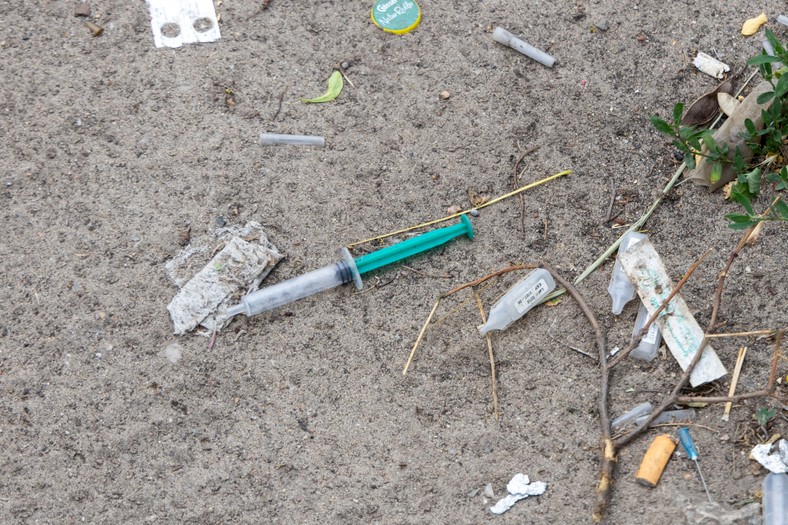
Used syringes at Goerlitzer Park in Berlin
Social democrat with Essen, Klewin, is afraid of “the effect of displacement. This game in kitty and mouse – today one place is cleansing, and tomorrow the problem appears two streets further – it is one of the biggest challenges.” This effect can also be observed throughout the districts.
In 2014, the police in Dortmund recognized the Nordstadt district as an area requiring special intervention and sent additional officers there – successfully. By 2022, the number of crimes fell by over 35 percent. in the Nordstadt district.
However, this number increased rapidly throughout the city. In 2024, the city recorded the highest number of crimes since 2016. What gives a decrease in the number of crimes in one district, since this number is growing throughout the city?
“Salon” for drug addicts
Nevertheless, cameras, the presence of the police and ordering services, lighting, garbage disposal and reconstruction are necessary at least for CDU, SPD and FDP (free democratic part), while the Greens have a slightly more difficulty with accepting more cameras and police. However, no party has the last word in the debate on the threats associated with the environment of drug addicts.
The Greens are in many places for more rooms where the use of crack, heroin or fentanyl is tolerated in small quantities. Under no circumstances do they want to put pressure on addicts to stay away from specific public places. Cologne Greens clearly found it. They explained that drug users should treat their city as a “salon”.
SPD is a slightly more diverse position. Her candidates are rather willing to drive out addicts from places where they are undesirable, provided they receive more help.
Thus, a representative of SPD Klewin demands, in parallel to other funds, “more social workers, counseling for addicts, or in cooperation with the union country, rooms for using drugs and programs from getting out of addiction.”
Apparently CDU (and AfD, an alternative to Germany) in many municipalities of North Rhine-Westphalia are in favor of combining repression and help to eliminate drug use areas as a source of problems. Whether in Cologne, Dortmund or Moenchengladbach – Christian Democrats are guided by the so -called Zuris model everywhere. Also in Zurich, the inhabitants suffered from the spreading drug use zones.
Then the city implemented a double strategy. On the one hand, all public drug use was consistently liquidated. If necessary, drug addicts were removed from the streets by force. On the other hand, rooms were created throughout the city where drug addicts could get help, take drugs and stay. This was an alternative to the street. However, this offer can be used only by addicted persons in the city, so as not to cause the effect of attraction of addicts.
The same position is represented by Kalouti, CDU candidate for the mayor of Dortmund.
– We need to restore safe public space, and addicted people need more social workers and better equipped rooms for taking drugs and staying there. However, they should be available only to the inhabitants of Dortmund. So far, our city is a magnet for drug addicts from all over the area. It must end – he said
Even the Zuryski model will not allow all addicts to reach.
– But if we manage to pull some of them out of the street, it will be a success. Our city should not be a “salon” for people addicted to drugs – he concludes.