SURVEY Romania, at the end of 2025: a dissatisfied and skeptical country. Justice, in the last place for trust


Romania ends 2025 with a depressing mood. Three out of four Romanians believe that the country is going in the wrong direction, according to a national survey conducted by CURS in December. It is one of the highest levels of social pessimism in recent years and a clear signal that, beyond macroeconomic indicators, public perception remains deeply negative
Direction of the country: almost unanimous verdict
To the question “Is Romania heading in a good or wrong direction?”, 75% of respondents say that the direction is wrong, while only 21% see a good direction. The difference is overwhelming and indicates a break between the official discourse and the everyday perception of the population.
Such an outcome suggests not just one-off discontents, but a systemic crisis of confidence: people are not convinced that things are moving in a controlled or predictable direction.
Trust in Politicians: Lots of Rejection, Little Enthusiasm
Nor does the political scene provide solid reliable benchmarks. For most of the political leaders tested, high trust scores are modest, and areas of distrust clearly dominate.
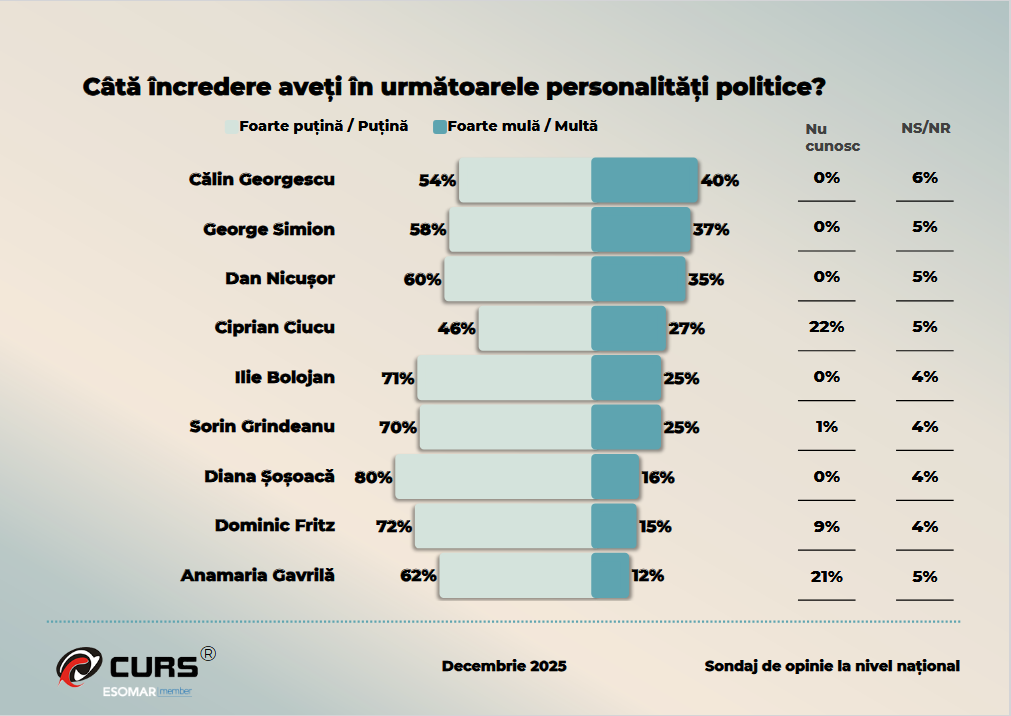
The best “very high / high trust” scores stop around the 35–40% threshold, while for some political actors the share of those declaring “very low / low trust” rises to 70–80%. The message is clear: the electorate no longer grants the presumption of competence or good faith to political leaders, regardless of camp
Institutions: who still has trust capital and who has lost it
The survey reveals a stark contrast between institutions perceived as “functional” and those associated with politics.
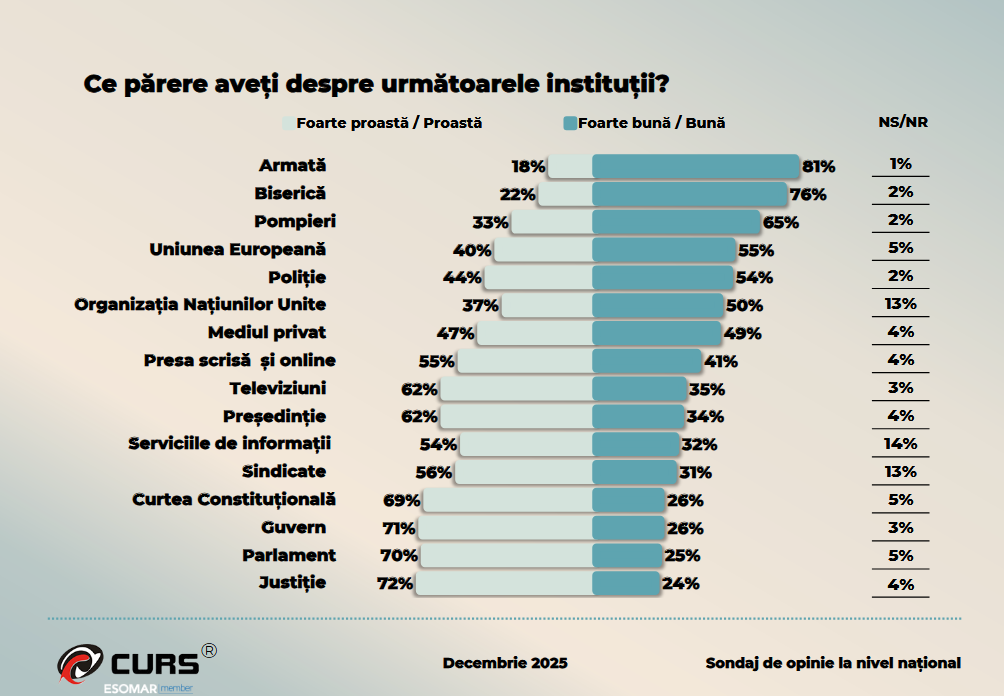
At the top of the list of trust are:
Army – 81% good opinions,
Church – 76%,
Firefighters – 65%.
At the opposite pole are the classic political institutions:
Justice, Parliament and the Government are evaluated negatively by approximately 70% of respondents,
The Constitutional Court and trade unions also have poor scores.
The overall picture is of a society that still trusts the institutions of “protection” or “order”, but has almost completely lost patience with those that govern and regulate public life
Voting intention: fragmentation and the rise of extremes
If parliamentary elections were to be held next Sunday, AUR would get 35% of the votes, becoming the first detached party. PSD would follow with 22%, PNL with 19%, and USR with only 9%.
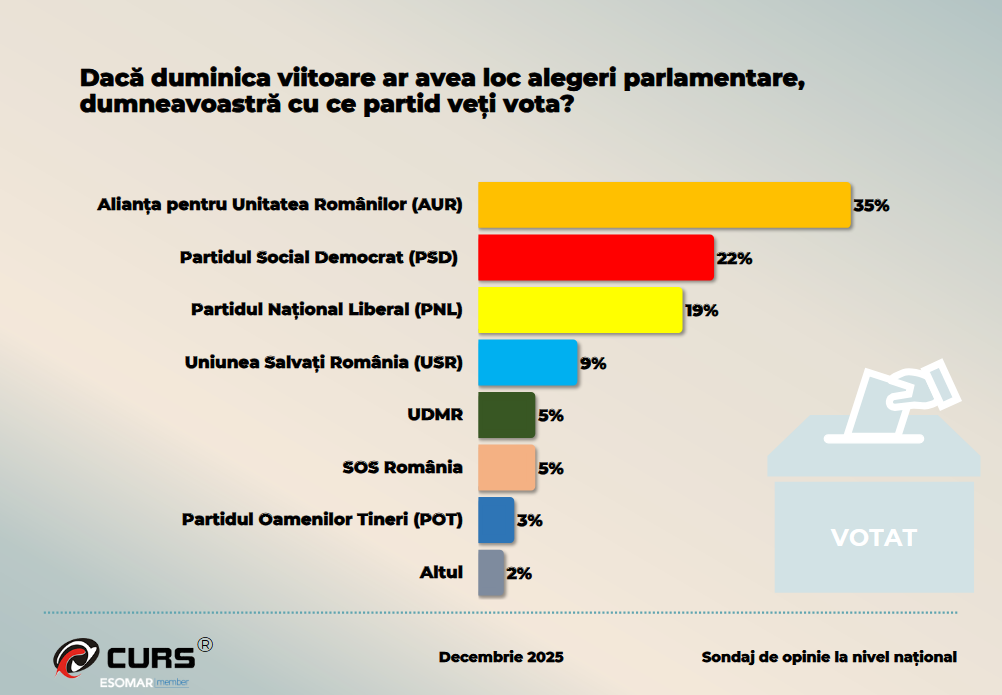
The data suggest a profound reconfiguration of the political scene, with an electorate penalizing traditional parties and seeking alternatives perceived as “anti-system”, regardless of cost or risk
Government measures: accepted but painful
The government led by Ilie Bolojan seems to benefit from a partial understanding, but not from enthusiastic support. Only 26% of respondents consider the economic measures “justified and necessary”, while 41% say some should have been taken and others not.
More importantly: 56% of Romanians say that the impact of these measures on their family is high or very high. In other words, even where there is rational acceptance, the personal cost is acutely felt
Pocket money: stagnation and decay
On a personal level, the financial picture is nuanced:
- over 58% of respondents say their financial situation has worsened in the past 12 months,
- only 6% say it has improved significantly.
This perception largely explains the general pessimism: for most people, the economy is not an abstract concept, but what remains or does not remain at the end of the month.
Price expectations: Inflation hasn't gone out of people's minds
Even though the official rate of inflation has slowed, 84% of Romanians expect prices to continue to rise in 2026, with half of them anticipating significant increases.
It is a sign that inflation has become a social trauma, not just a statistical indicator: people reflexively expect price increases, regardless of official messages.
See the full survey here
Methodology:
Sampling universe: adult population resident in Romania
Sample size: 1067 respondents, aged 18 and over
Sample type: probability, multistage, stratified
Maximum margin of error across the entire sample: +/-3% at a 95% confidence level
Data collection method: face-to-face, at respondents' homes
Validation of the sample: based on the latest INS data The data are weighted according to the age of the electorate Implementation period: December 10–19, 2025