After a series of sharp attacks from Washington — including Donald Trump's statement to POLITICO that European leaders are “weak” — the coming days will be a real a test of the character of Europeans. On Monday, leaders will try to build bridges and use their power of persuasion on a peace agreement during a meeting with Ukrainian President Volodymyr Zelensky and U.S. officials in Berlin. At the same time, EU foreign ministers and diplomats will fight in Brussels to convince more governments that oppose the loan plan.
“We are Russia's next target and we are already in danger,” Rutte said last week. “Russia has brought war back to Europe and we must be prepared for a war on the scale that our grandparents and great-grandparents experienced.”
It is therefore not surprising that European officials treat the coming days as… decisive for its future. In a last-minute attempt at diplomacy, the leaders of Britain, Germany and possibly France, potentially along with Trump's son-in-law Jared Kushner and his special envoy Steve Witkoff, will meet with Zelensky in Berlin.
As if to underscore the importance of the meeting, “several European heads of state and government, as well as EU and NATO leaders, will join the talks after preliminary talks,” said Stefan Kornelius, spokesman for German Chancellor Friedrich Merz. French President Emmanuel Macron did not confirm his participation, but he spoke with Zelensky by phone on Sunday.
“A disastrous signal for Ukraine”
The discussion will represent an attempt by Europe to influence a final agreement, weeks after a 28-point peace plan drafted by Witkoff – reportedly with the help of several Kremlin officials – sparked a violent reaction in both Kiev and European capitals. Since then, leaders have been trying to develop an alternative solution.
Further disunity in Europe this week would send a “disastrous signal to Ukraine,” says one EU official. Such an outcome would not only be a blow to the war-torn country, but “it's safe to say that Europe will also fail” – adds the source.
This time the focus will be on 20-point amendment to the plan developed by Kyiv and its European allies. It was sent to Washington for review last week.
The content of the amendment remains unclear and decisions have not yet been taken. However, the fate of Russia-occupied Ukrainian territories is a particularly sensitive issue. Trump proposed emptying the territories of Ukrainian and Russian soldiers and creating a demilitarized “free economic zone” in which American companies could operate.
Ukraine rejected this proposal, according to a French official who was granted anonymity due to the sensitive nature of the negotiations. The interlocutor adds that the United States insisted on territorial concessions despite strong objections from Europe, which caused friction with the Trump administration.
Money for Ukraine
European leaders say no progress can be made on the territorial issue until Ukraine is offered security guarantees.
In a signal that an agreement is getting closer, Zelensky said over the weekend that he is ready to go for it “compromise” and not demand Ukraine's membership in NATO. Instead, the country should be provided with an ad hoc collective defense agreement, he told reporters in a WhatsApp conversation.
“Bilateral security guarantees between Ukraine and the United States and security guarantees from our European colleagues, as well as from other countries such as Canada and Japan – these security guarantees give us a chance to preventing another outbreak of Russian aggression“- he said.
After Monday, Europe will have another chance to discuss further action. On Tuesday, EU affairs ministers will continue working in Brussels on plans for Thursday's summit. Meanwhile, on Wednesday, leaders of Europe's eastern flank – including representatives of the Baltic countries and Poland – will meet in Helsinki.
The EU has been trying for months to convince Belgian Prime Minister Bart De Wever to agree to a plan to use Russian state assets worth EUR 185 billion (PLN 781 billion), which are held in the Brussels depository Euroclear, to finance and arm Ukraine. The rest of the financial package, worth a total of EUR 210 billion (PLN 886 billion), would include EUR 25 billion (PLN 105 billion) of frozen Russian assets held throughout the EU.
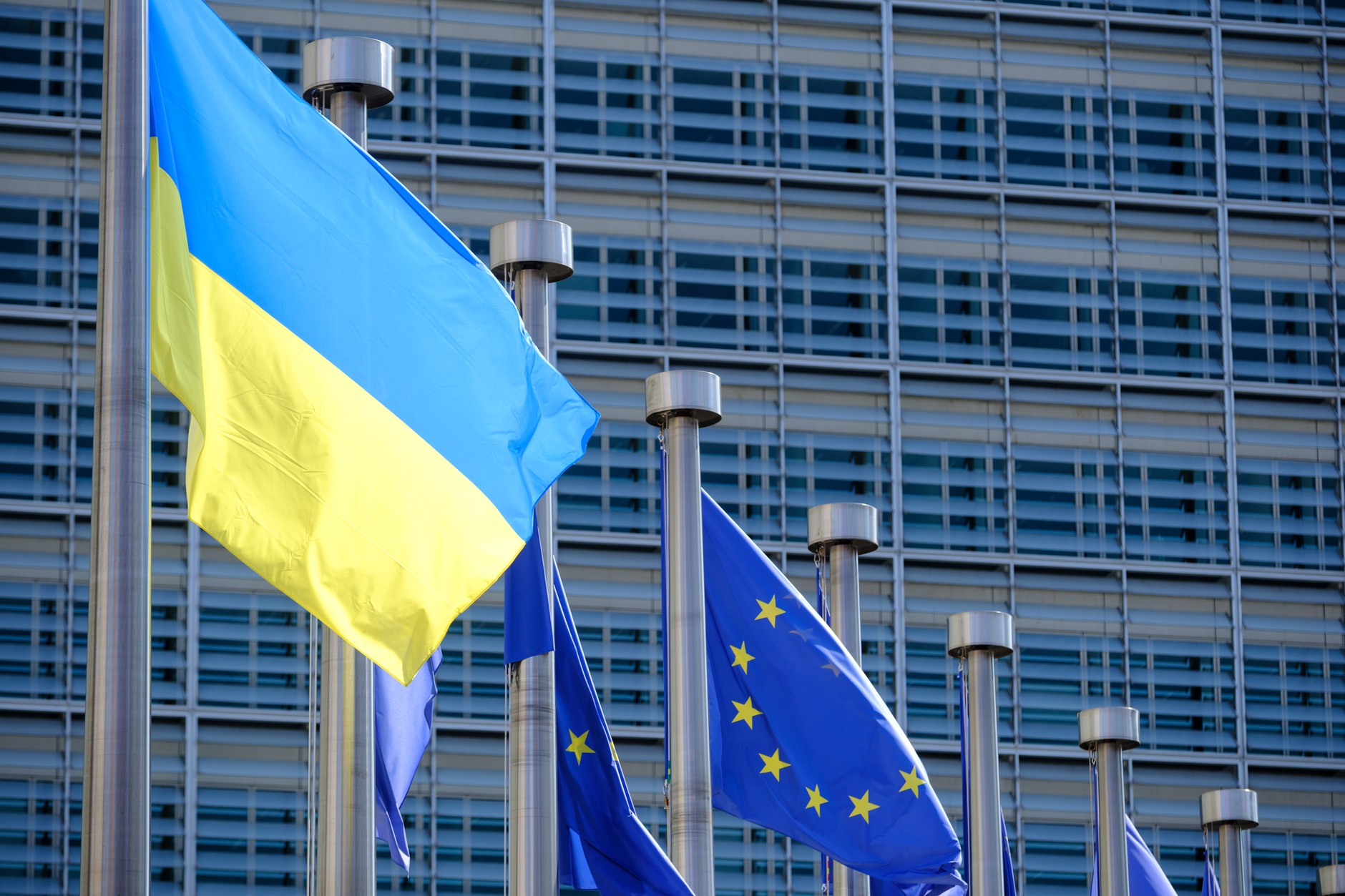
Flag of Ukraine in BrusselsTHIERRY MONASSE/Getty Images
Pointing out that the chances of an agreement at Thursday's summit are decreasing rather than increasing, Italy – the EU's third-largest country – supported Belgium's demands to seek alternative solutions regarding financing for Ukraine in a letter also signed by Malta and Bulgaria on Friday.
There is no plan B
New Czech Prime Minister Andrej Babis also rejected the plan on Sunday. “The more cases like this, the more likely it is that we will have to find other solutions,” said an EU diplomat.
The five countries — even if they were joined by pro-Russian Hungary and Slovakia — would not be able to form a blocking minority. However, their public criticism undermines the Commission's hopes for reaching an agreement political this week.
The meeting of EU ambassadors, originally scheduled for Sunday evening, was postponed to Monday.
Recent diplomatic efforts have many concerned that the funding may not be approved before the end of the year – at a time when Ukraine urgently needs cash. However, the three diplomats emphasize that they are sticking to the plan and are not yet considering any alternative solutions.
Belgium is constructively engaged in work on the draft measures, actively submitting suggestions and changes to the document, which will be considered during Monday's meeting of ambassadors, says one of the diplomats and an EU official.
The decision on Russian assets is “a decision on the future of Europe and will determine whether the EU will continue to play an important role,” explains a German official. “There is no plan B,” he adds.
The Onet editorial team presents various points of view regarding the possible development of the situation in Ukraine and Russia's aggressive actions towards NATO countries. The above material is one of them.
We would like to point out that it cannot be predicted that there will be a military attack by Russia on Poland or another NATO country. The war in Ukraine is a challenge for the Russian army and economy. It is unlikely that while fighting the Ukrainians, Vladimir Putin would also decide to confront NATO, which would be incomparably more costly for Moscow – militarily, financially and politically. It should also be remembered that neither Russia nor the Soviet Union ever directly attacked a NATO country.
Below are some analytical texts by our expert Witold Jurasz, devoted to Poland's security:


