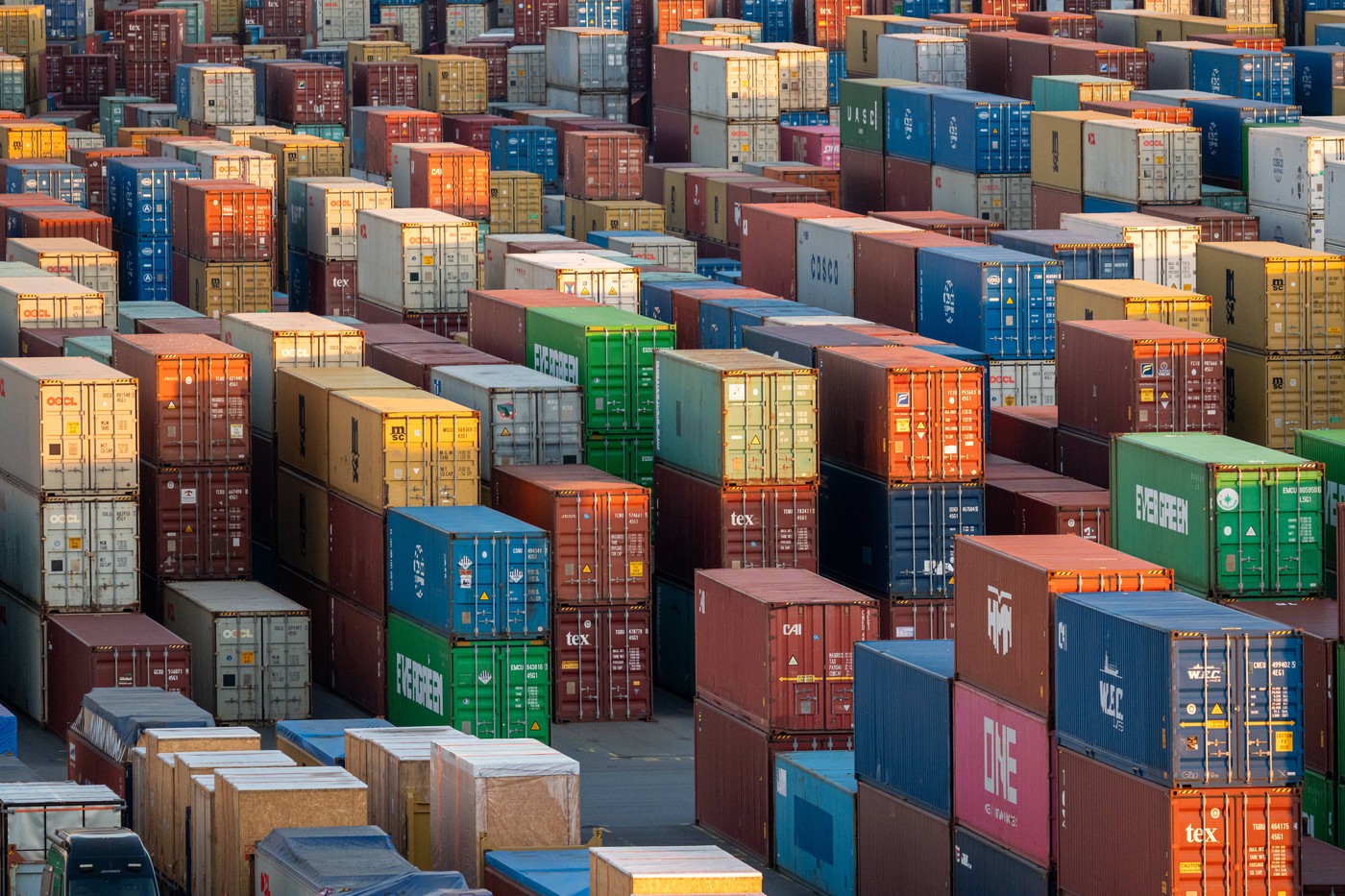
On an autumn morning in Port Constanța, a crane lifts a 40ft container from the deck of a ship coming from Asia. Inside are electronics, clothes, toys, cables, appliances. Compact, easy-to-sell, high-value merchandise. Destination: warehouses, malls or online stores.
It is just one of the thousands of containers that enter Romania every month. Together, they make up the visible part of a reality that is harder to explain to the general public: the trade deficit.
In October 2025, imports exceeded exports by 3 billion euros, and the cumulative trade deficit for the first ten months of the year reached 27.5 billion euros, the National Institute of Statistics reported on Wednesday.
The road of the container: from full to empty
After it is unloaded, the container starts for Bucharest. Merchandise spreads quickly through the economy: full shelves, quick sales, turnover. Consumption. Money collected at the cash register, which is then exchanged into Euros and returned to the countries of origin.
After a few days, the same container is sent back to the port for export. Only this time it's almost empty. At best, they carry raw materials, a few industrial components, and semi-finished products.
This image – the container that goes in full and comes out almost empty – is, in fact, the true picture of the trade deficit.
An economy that imports value and exports volume
The structure of exchanges shows the underlying imbalance.
Over 46% of Romania's exports are machinery and transport equipment, but these are dominated by assembly production, integrated in multinational chains. In parallel, Romania imports massively: chemical products (almost 15% of total imports), fuels, high-value manufactured goods.
In other words, Romania exports a lot in terms of volume, but imports more expensively in terms of value.
The deficit as an effect of consumption-based growth
At the macroeconomic level, this dynamic is supported by the growth model of recent years: higher wages, strong consumption, accelerated imports.
Exports are also growing, but more slowly. In the first ten months of 2025, exports totaled 81 billion euros, and imports totaled 108.5 billion euros, the INS also says.
The deficit is not just a statistical problem. It is transmitted further in pressure on the exchange rate, imported inflation, higher interest rates, higher financing costs for the state.
Romania, caught between the full shelves and the empty balance sheet
The paradox is visible with the naked eye: shopping centers are full, the offer is rich, the Romanian consumer has more options than ever. But behind this abundance is a growing dependence on the outside.
Almost 72% of Romania's trade is with the European Union, both export and import, which makes the economy vulnerable to any slowdown in the euro zone
The deficit means permanent demand for euros → pressure on the exchange rate
In the first 10 months of 2025, Romania imported goods worth 108.5 billion euros, but exported only 81.0 billion euros. The difference of 27.5 billion euros means, very concretely, that monthly, the Romanian economy needs more than 2.7 billion euros “from outside” just to pay the difference.
These euros come from: external loans, European funds, foreign investments or from BNR reserves.
When these inputs are not enough, the pressure automatically switches to course.
What this means in your wallet:
A leu that depreciates by only 5% in a year means:
- a loan rate in euros of 2,500 lei → 2,625 lei
- a laptop of 5,000 lei → 5,250–5,300 lei
- a holiday of 1,000 euros → 500–600 lei more expensive
The trade deficit is basically a pressure plant per course.
The deficit can be seen directly in the loan rates
Romania massively imports exactly what is essential for the economy: chemical products (15.8 billion euros imports), fuels and energy (8.8 billion euros), machines and equipment: almost 40 billion euros.
All these imports are paid for in foreign currency. When the deficit remains high, the exchange rate is under pressure, the NBR must be cautious, and interest rates remain high for longer.
Translation into installments:
- Mortgage loan 350,000 lei:
- at 7.5% interest → rate ≈ 2,450 lei
- at 9% interest → rate ≈ 2,800 lei
Difference: +350 lei/month, interest only.
The trade deficit, even if it doesn't appear in your contract with the bank, is visible in installments.
The deficit goes into the shopping cart
Romania is a net importer of food, energy and chemicals:
- Food imports: 9.4 billion euros
- Food exports: 6.1 billion euros.
An average basket of 2,000 lei/month at the supermarket:
- if prices rise by only 6–7% due to course and energy → means an addition of 120–140 lei/month
- in a year they gather 1,500–1,700 lei lost
The trade deficit is literally an invisible fee on each receipt homemade.