Most Hungarian minority organizations in Hungary's neighboring countries have become affiliates of Fidesz, Viktor Orban's party. Peter Magyar promises to reform the entire system of politics towards minorities.
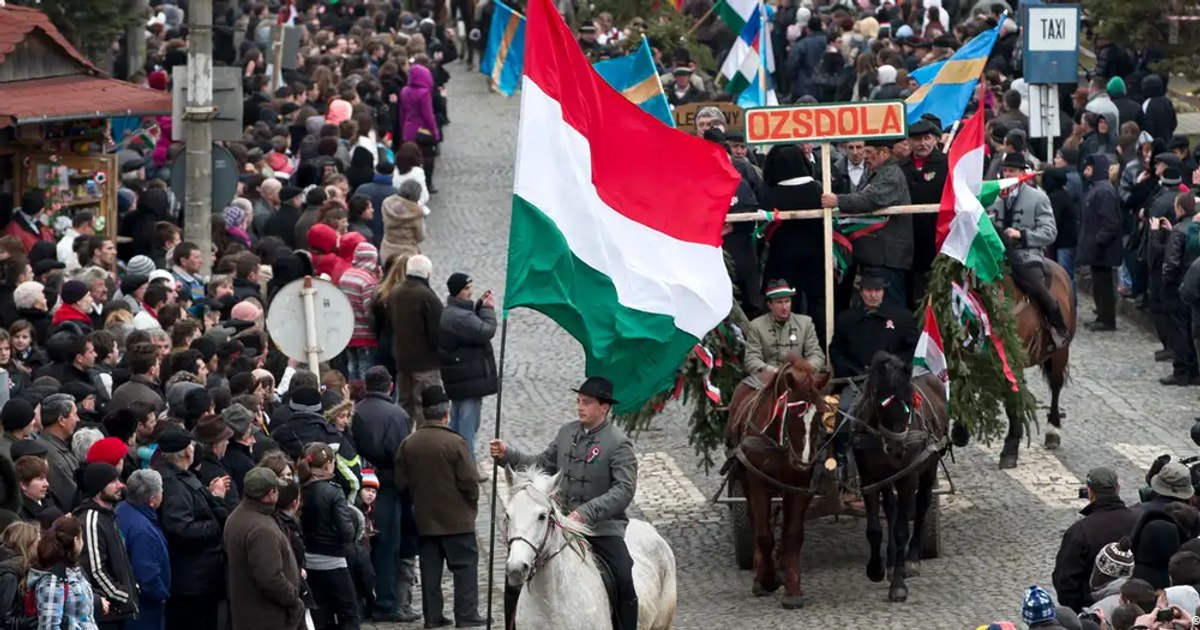
A parade organized on the occasion of a celebration of the Hungarian minority in Târgu Secuiesc
No prime minister of Hungary could avoid, after 1990, the unwritten obligation to declare himself responsible for Hungarians outside the borders. This stems from the “trauma of Trianon”, still alive in the country's collective consciousness, given that, after the First World War, through the Trianon Treaty of 1920, Hungary lost over 70 percent of its territory to neighboring states. Millions of Hungarians thus found themselves, overnight, citizens of other countries, where they were often treated as second-class people.
During the communist dictatorship, which dominated Hungary between 1945 and 1989, discussions about compatriots from neighboring states were a taboo subject. Hungary's first post-communist prime minister, the conservative Jozsef Antall, caused a stir in 1990 when, upon taking office, he declared that he wanted to be “in spirit” the prime minister of all 15 million Hungarians.
Budapest, April 12, 2026: Viktor Orban greets supporters of his Fidesz party
Antall mainly referred to the approximately three and a half million Hungarians living in Romania, Serbia, Slovakia and Ukraine at the time, out of the approximately five million Hungarians outside the borders. Since then, the situation of Hungarian minorities has remained a permanent theme of the country's domestic politics, even if their numbers are decreasing. Today, only about two million Hungarians still live in the neighboring countries.
But no other Hungarian political leader has exploited “Hungarians outside the homeland”, as they are called in Hungarian political parlance, to the extent that Viktor Orban has. This is especially true for the approximately 1.1 million Hungarians in Transylvania, the largest Hungarian minority in Europe. Their representative organization, the Hungarian Democratic Union of Romania (UDMR/RMDSZ), has become an appendage of the Fidesz party for many years.
The end of an “ethnic autocracy”
Sociologist Tamas Kiss, originally from Cluj, talks about the existence of an “ethnic autocracy”. A similar dependence on Orban and Fidesz exists in the case of the Union of Hungarians in Vojvodina (VMSZ) in Serbia, but also, to a lesser extent, in relation to the Hungarian parties in Slovakia and Ukraine.
But it has now become clear that, with the change of power in Budapest, for all politicians loyal to Orban in these four states, a new era has begun. Future Prime Minister Peter Magyar asked them to adopt a position of political neutrality in the future. At the same time, he intends to reform the corrupt system of financing intended for Hungarian minorities.
A change for minority politicians
It should be noted that this is by no means a marginal issue, but a problem with European implications, given that the Hungarian parties in Romania and Serbia have, in some respects, an important influence on government policy in their countries, especially in Romania.
Budapest, 20.04.2026. The future Prime Minister of Hungary, Peter Magyar, gives a speech
Both formations are members of the European People's Party, from which Fidesz withdrew in 2021. They are also part of the Federalist Union of European Nationalities (FUEN), the largest European minority organization, currently led by a UDMR politician. In 2013, FUEN also started the “Minority SafePack” initiative, aimed at strengthening the protection of minorities in Europe, an initiative that Orban's government later instrumentalized for the benefit of its anti-EU discourse.
In addition, the financial support provided by the Hungarian state to the institutional network of minorities has turned into a sensitive cross-border issue. In the last 16 years, the total amount has exceeded, according to some conservative estimates, three billion euros, most of the money being directed to Romania. Exact figures do not exist, as the financing of Hungarians outside the borders was carried out through an opaque system of foundations and companies.
Everything was done for votes
Behind this extensive instrumentalization of Hungarian minorities by Orban is an electoral calculation. Many Hungarians abroad hold Hungarian citizenship and, since 2014, have the right to vote on lists in Hungarian parliamentary elections. The most important are the more than 500,000 Hungarians in Transylvania who have Hungarian citizenship and who vote, overwhelmingly, for Fidesz.
In order to link them ideologically to his party, Orban constructed a deeply revisionist historical discourse. According to this narrative, Hungarians are the European nation that was most dramatically torn apart in the 20th century and continues to suffer from it today, but remains united across borders under the leadership of Viktor Orban.
Excellent relations with nationalists
This speech, however, did not prevent the Budapest leader from maintaining excellent relations with nationalist politicians such as Serbian President Aleksandar Vucic or Slovak Prime Minister Robert Fico. Last year, on the occasion of the presidential elections in Romania, Orban went so far as to grant electoral support to the extremist George Simion, who in the past had participated in the organization of anti-Hungarian demonstrations in a military cemetery in Transylvania.
Viktor Orban and Slovak Prime Minister Robert Fico at the EU summit in Brussels on 26 June 2025
The policy of attraction exerted on the Hungarian minorities cost billions. In the neighboring states, especially in Romania, Budapest financed minority institutions, Hungarian churches, the Hungarian language education system and even an extensive economic support mechanism for ethnic Hungarian entrepreneurs.
“Orban bought the politics of the Hungarians in Romania and, to a large extent, even the minority itself,” says Peter Eckstein-Kovacs, lawyer, liberal politician of the Hungarian community in Romania and former minister for minorities, in a dialogue with DW. “A large part of the UDMR leadership has thus completely become a mouthpiece of Fidesz.”
Magyar calls for neutrality
The future Hungarian Prime Minister Peter Magyar has already met with the political representatives of Hungarians in Romania, Serbia and Slovakia — Kelemen Hunor, Balint Pasztor and Laszlo Gubik — asking them to maintain political neutrality in the future. In reality, Kelemen and Pasztor in particular had actively intervened in Hungary's 2026 election campaign, suggesting that only Orban and Fidesz were capable of defending the interests of Hungarian minorities.
Peter Magyar said he still wants to support Hungarian communities outside the borders and that his government has no intention of curtailing the rights already won. But he also announced the retroactive verification of all payments made to minorities since 2010, to analyze their legality, as well as the transparent reorganization of the entire financing system.
Peter Eckstein-Kovacs hopes that the political change in Hungary will give new impetus to Hungarian communities. “We must return to the original idea of minority representation, the one in which all non-extremist currents could coexist in the same organization,” says the liberal lawyer and politician. He expects a radical change of perspective in the minority policy of the new government in Budapest.
“There are very dangerous historical precedents – let's think of Germany for example – where a motherland used its minorities outside its borders in troubled times. It is important to create the conditions so that Hungary can never again do with its minorities what it did under Viktor Orban.”
Keno Verseck – DW