The energy sector is waiting for the verdict from the Energy Regulatory Office. The electricity to the stock exchange has already been cut off


For a month now, the energy sector on the Polish stock exchange has been depreciated by over 20%. from the historic peak. WIG-Energy, taking into account all industry indices on the WSE, is the worst performing benchmark on the trading floor in this period. Before the wave of decline, he was the best. Mid-December is the deadline for the Energy Regulatory Office (URE) to approve new tariffs for 2026, including the distribution tariff, which is the main reason for the discount on the part of investors.
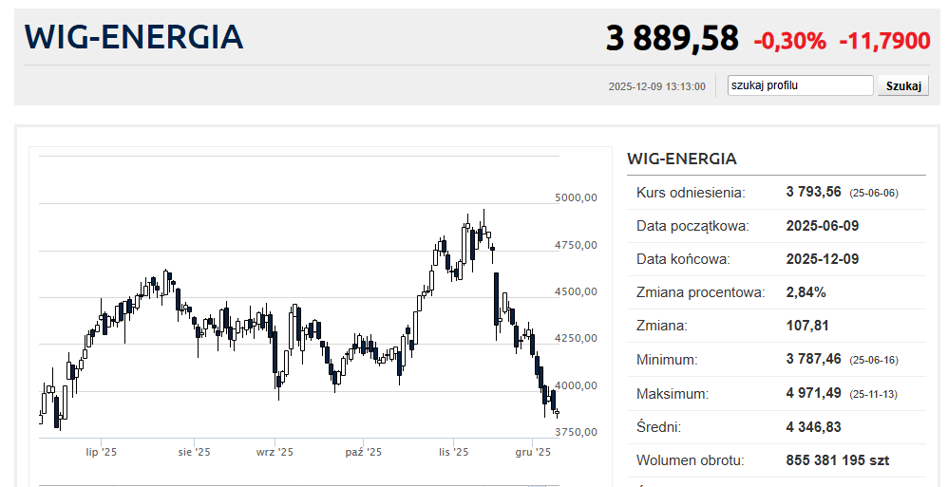
On November 13, WIG-Energy was quoted at a historic peak, reaching 4,971.49 points. Already on December 9, the index recorded 3,851 points and was at its lowest level since mid-June this year, losing 22% in less than a month. from the top. The index has fallen in 11 of the 17 sessions since November 13. On Tuesday, after setting a periodic bottom, the index rebounded to around 3,923 points. However, the sentiment towards the sector remains dismal.
Energy: from stock market heaven to hell
During the period of 1 month, WIG-Energia recorded the worst rate of return of all industry indices listed on the WSE. A retreat from companies such as PGE, Tauron, Enea, which constitute nearly 90 percent. index weight, is significant because before the price reduction it was the best-performing sector benchmark on the WSE, consisting of several companies, recording a rate of return of almost 100 percent.
The shock was caused by growing concerns about the future of their profits, after first the president signaled their willingness to change distribution tariffs in a draft bill, and then the government, by taking specific actions (establishing an appropriate working team). The presidential bill was submitted to the Sejm on November 12. On November 14, the Ministry of Energy established a team to develop a more effective method of calculating the distribution tariff.
An important date for the energy sector
Everyone investing in the energy sector certainly has one more important date in mind – December 17. Until this date, the Energy Regulatory Office (URE) has time to approve electricity tariffs for households and distribution tariffs for 2026. The government promises that electricity prices will not be higher than in 2025, when they were frozen.
In 2026, there will be no more price freezing. The guaranteed return on investment of Distribution Network Operators may also be changed, which in 2025 is 8.5%. The presidential project assumes 7 percent. The team appointed by the ministry did not present its recommendations. As reported by Bloomberg, analysts expect that this level may drop to 7-8%. from the current 11-13% that energy companies actually currently achieve, taking into account guarantees and the bonus generated.
On Tuesday, “Parkiet” reported, citing information from energy companies, that their distribution companies are preparing to reduce the WACC (weighted average cost of capital) indicator used to calculate the distribution tariff below 10%. According to the daily, “PGE”, the largest energy company in the country, may suffer the most from his change.
Analyst: Worsening prospects
A potential revision of distribution tariffs, which were the main driver of earnings growth this year, is now the main reason for the sell-off in energy stocks. “In addition (…) reports about the resignation of the president of PGE suggest that the political pressure for deep tariff reductions may be greater than the management boards are willing to accept, which is interpreted as a signal of lack of stability and worsening prospects for the entire sector,” Michał Kozak from DM Trigon commented for Bloomberg.
A recent report by DM BOŚm indicated that reducing WACC combined with increasing investment outlays is expected to lead to a decline in EBITDA in the distribution segment in 2026, despite the high value of the regulatory asset base. Analysts warn that even if the tariff for 2026 turns out to be higher, the regulatory outlook will probably deteriorate in the next year, including: due to the political risk associated with the 2027 elections. Therefore, they recommend taking profits on energy companies listed on the WSE and have recently significantly lowered the target prices for their shares.
The market is anxiously awaiting the decision of the Energy Regulatory Office, which should be made by December 17 and which will determine the financial balances of energy companies for the coming year. Analysts indicate that the key problem is the potential “erosion of profits” related to tariff changes. Investors, expecting a drastic change, are selling shares en masse, pushing the WIG-Energy index to the lowest level since June and perhaps thus ending the strong bull market for companies in the sector.
Michal Kubicki