Romania, abandoned by most of the Saxons, Swabians and Jews. How the demographic structure has transformed in a century


Over a century after the Great Union of 1918, Romania's demographic structure has undergone major changes in terms of ethnic diversity, with Germanic and Slavic populations, Jews and Hungarians among the most affected minorities.
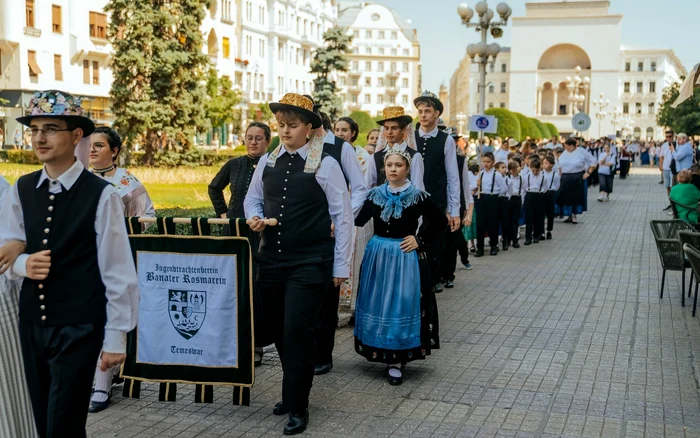
Germans in Timișoara, formerly called the “capital” of the Swabians. Photo: Timisoara City Hall
Two censuses carried out at an interval of almost a century reveal the demographic “chasm” formed in Romania, and part of the explanations of this phenomenon can be found in the major events of the middle of the 20th century, in the policies of the communist regime and in the years of “balance” after 1990.
Some minorities almost disappeared from Romania
In December 1930, the first census of the Romanian population took place after December 1, 1918, the day of the proclamation of the Union of Transylvania, Banat, Crișana and Maramureș with the Kingdom of Romania. It was, moreover, the only census of Greater Romania, the ones that followed it being carried out for the current territory of the country. The results of the census 95 years ago showed a completely different situation of the demographic structure, even if the total number of inhabitants in the 1930s was close to that of today.
The whole of Romania then had over 18 million inhabitants, of which almost 13 million declared themselves Romanian. The Hungarian population exceeded 1.4 million, and that of the Germans (Saxons and Swabians) numbered almost 750,000 people. The Jews represented the third minority in the country, their number being estimated at over 720,000 people, many of them in Bessarabia and Bucovina.
The Slavic populations (Ruthenians, Ukrainians, Russians, Bulgarians, Serbs, Croats, Czechs, Slovaks, Slovenes, and Poles) totaled more than 1.5 million people, and the Turks, Tatars, and Gagauz nearly 300,000. Greater Romania had over 260,000 Roma and over 26,000 Greeks in 1930.
According to the results of the 2021 Census, Romania had just over 19 million inhabitants. Of these, 16.6 million declared their ethnicity. Among the minorities, the more than one million Hungarians represented six percent of the total population. Almost 570,000 people declared themselves Roma, 46,000 declared Ukrainian, 23,000 Germans, 21,000 Turks, and the number of Jews in Romania reached just over 2,000 people.
The decline of the great Saxon and Swabian communities
In interwar Romania, the German population reached over 700,000 people. Almost half was represented by Danube Swabians from the historical region of Banat, whose ancestors settled in the 18th century in today's western Romania and, to a lesser extent, in the area of Sătmar (Satu Mare, Carei). The other half were Saxons from Transylvania, descendants of settlers brought here in the Middle Ages by the Kingdom of Hungary.
The Second World War marked the beginning of the end for numerous German settlements in Romania. Many members of these communities fell victim to the war, and more than 100,000 are said to have left the country during the withdrawal of Nazi German forces in 1944.
As early as the autumn of 1944, Joseph Stalin, the leader of the Soviet Union, asked Romania, Hungary and Yugoslavia, in the territories where the Soviet army had arrived, to provide German workers for the reconstruction of the Russian areas destroyed during the war.
In January 1945, more than 70,000 Saxons and Swabians were sent to Soviet labor camps for several years. Several thousand never returned, either because they died in the USSR or because they managed to reach Germany. Other repressive policies awaited those who returned to the country. In 1951, shortly after the end of the wave of deportations in the USSR, over 40,000 people from Timiș, Caraș-Severin and Mehedinți counties, located on the border with Yugoslavia, were forced to leave their homes to start a new life from scratch in the Bărăganului Plain. The measures led to the disappearance of some settlements dominated by Swabian families.
In the following decades, the demographic decline of the German minority continued, as the Saxons and Swabians left for the West, at first with great difficulty, due to the regime trying to stop the exodus. In the 70s, when around 360,000 Germans still lived in Romania, former communist president Nicolae Ceaușescu decided to “sell” them to Federal Germany.
“Concerned about the fate of the large number of ethnic Germans who wanted to leave Romania, West German Chancellor Helmut Schmidt traveled to Bucharest and negotiated a program to purchase emigration documents for them. Between 1978 and 1988, Federal Germany 'repatriated' approximately 11,000 people annually, paying the equivalent of several thousand US dollars for each exit visa”. researchers from the US Library of Congress informed in the volume “Romania, a study of the country” (1991).
Some Germans, in turn, paid for their exit from the country, without knowing that they had been “sold” by Ceaușescu.
In 1990, some statistics showed that around 120,000 Germans, Saxons and Swabians still lived in Romania, but in the first years after the Revolution, the community was drastically reduced, with almost 90,000 people leaving for Germany without much formality. Few of them returned.
The war, terrible for the Jewish community
In Romania, most of the Jewish population settled in Moldova, originally arriving from Poland and the Austro-Hungarian Empire in the 19th century. Hundreds of thousands of Jews suffered in the early 1940s, during the dictatorship of Marshal Ion Antonescu and during the war years, according to historians.
“During the war, Antonescu's regime subjected the Jews of Romania and the conquered territories to severe oppression. The troops drove at least 200,000 Jews from Bucovina and Bessarabia, considered Soviet traitors, across the Dniester to squalid concentration camps, where many died of hunger, disease, or brutality. Despite rampant anti-Semitism, the majority of Romanian Jews survived the wari”, pointed out the authors of the country study.
After World War II, the Stalinist regime in Romania restricted Jewish religious practices and harassed, arrested, and imprisoned Jews who wanted to immigrate to Israel. Despite all these pressures, a third of Romania's Jews had already emigrated by 1951, and the decline of the community was accentuated in the following years as a result of large-scale emigration.
“Suffering from state-encouraged anti-Semitism and financially ruined by expropriations during nationalization, a large part of the Jewish population applied for permission to leave in 1948. Between 1948 and 1951, 117,950 Jews immigrated to Israel, and between 1958 and 1964 another 90,000 followed, the Jewish population reaching just 43,000 people in 1966” Ronald D. Bachman pointed out.
Jews were easily given permission to emigrate, and by 1988 their population had dwindled to 20,000–25,000, half of whom were over sixty-five. Moreover, over a third of the Jews still in the country held exit visas.
Currently, in many cities in Romania, only the buildings of the former synagogues and their old cemeteries remain.
Hungarians, more reluctant to leave communist Romania
The policies of the Ceaușescu regime also deeply affected the Hungarian minority in communist Romania, forcing many Hungarians to leave the country. Most, however, remained reluctant to consider emigration.
Among the measures complained about by the minorities was, according to the authors of the country study, the “systematization” program of the villages.
“Conceived in the early 1970s, ostensibly to obtain productive agricultural land by eliminating villages deemed 'unviable', the systematization threatened to destroy half of the country's 13,000 villages, including many old settlements of ethnic Hungarians and Germans”notes Ronald D. Bachman, author of the volume.
The systematization was harshly criticized by the Western community. The Germans and Hungarians claimed it as an attempt at forced assimilation of national minorities.