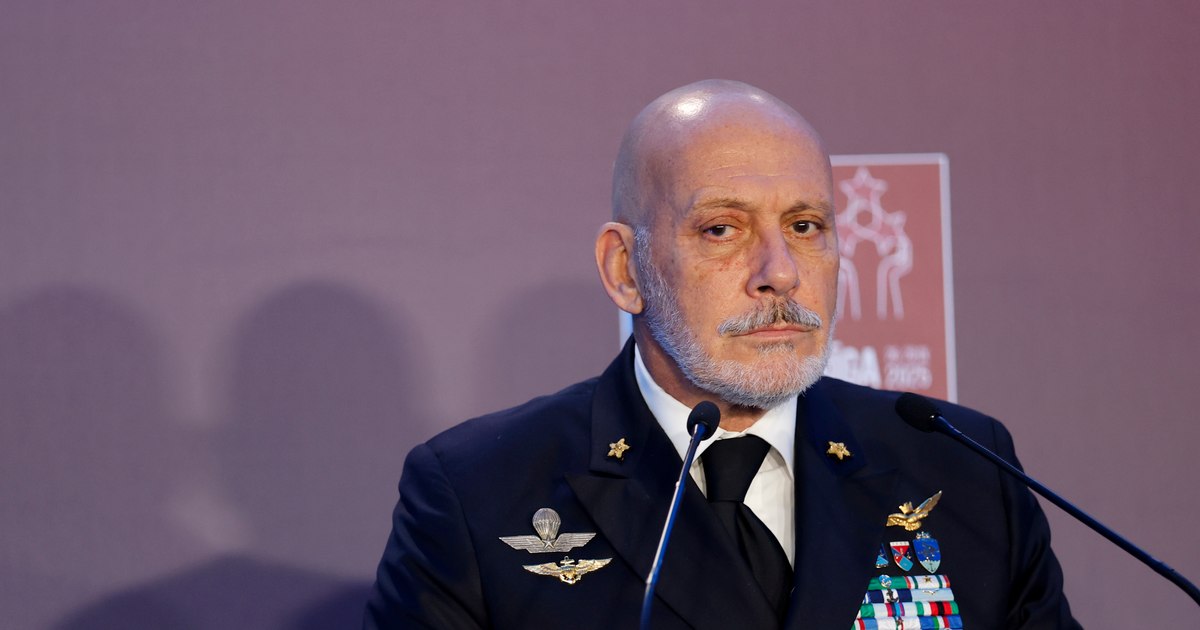
NATO is considering a “more aggressive” approach in response to Russian cyber attacks, sabotage and airspace violations, Admiral Giuseppe Cavo Dragone, chairman of NATO's Military Committee, told the Financial Times (FT).
PHOTO EPA-EFE
The alliance is reassessing its traditional reactive posture as Europe faces an increase in hybrid incidents linked to Russia. Recent cases include cutting submarine cables in the Baltic Sea, large-scale cyber intrusions across the continent and drone activity near allied borders.
“We're studying everything … In cyber, we're kind of reactive. We're thinking about being more aggressive or proactive instead of being reactive,” he said.
Dragone pointed out that while offensive cyber responses would be the simplest option – given that many member states possess such capabilities – retaliation for physical sabotage or drone raids would be more complex.
For example, “preemptive strike” could, under certain circumstances, be classified as a defensive action. “It goes beyond our normal way of thinking and behaving.”
“One option could be to be more aggressive than our opponent. (The problems are) the legal framework, the jurisdictional framework, who will do this?”, he argued.
NATO has had success with the Baltic Sentinel mission, in which ships, aircraft and naval drones patrolled the Baltic Sea, preventing a repeat of incidents such as cable cutting in 2023 and 2024 by ships linked to Russia's ghost fleet, formed to evade Western sanctions.
“Since the beginning of the Baltic Sentinel mission, nothing has happened. This means that this deterrent is working,” Dragone emphasized.
“If all we do is keep reacting, we're only inviting Russia to keep trying, to hurt us. Especially when the hybrid war is asymmetric – the costs are low for them, but high for us. We have to try to be more inventive,” pleaded a Baltic diplomat.
Despite the success of NATO's Operation Baltic Sentinel, there are still concerns within the alliance after a Finnish court dismissed a lawsuit against the crew of the Eagle S, a ghost fleet ship that cut several underwater electricity and data cables. The court reasoned that the ship was in international waters when the alleged sabotage took place, according to news.ro.
Asked whether such an approach gave Russian ships a “carte carte blanche” to operate in international waters, Finland's foreign minister, Elina Valtonen, told the FT: “Yes, and that is a problem.” She confirmed that taking a “more assertive” stance is being considered.
“Until now, I don't think there was a need for such a thing. We should also take a step back and analyze what the aggressor is really after. Then, perhaps, we shouldn't be hysterical anymore. We would have our own plan of action and we should trust it because it is robust,” explained Valtonen.
Admiral Dragone admits that one of the problems is that NATO and its members have “much more limits than their (Russian) counterparts, because of ethics, law, jurisdiction. It's a problem. I don't want to say it's a losing position, but it's a more difficult position than our counterparts,” he told the FT.
The head of the NATO Military Committee stated that the crucial test is the deterrence of future aggressions. “The way in which deterrence is achieved – through retaliation, through pre-emptive strikes – is something that we need to analyze in depth, because in the future there could be even more pressure in this regard,” Dragone added.
Europe is preparing for war
Last week, Emmanuel Macron announced that France was resuming voluntary military service in the face of the growing threat posed by Russia, just under three decades after the country abolished conscription.
The head of the French armed forces, General Fabien Mandon, sparked outrage last week by warning that France must be prepared to “lose its children”, adding that Russia was “preparing for a confrontation by 2030 with our countries”.
At the same time, Sweden is considering the purchase of long-range ballistic and cruise missiles as Moscow's military threat is expected to increase over the next five years, the Swedish Armed Forces warned in a government memo.
The proposed missiles could reach targets up to 2,000 kilometers away, giving Sweden the ability to strike deep into Russian territory.
Chief of the Defense Staff, Carl-Johan Edström, said they would only be used if Russia attacked NATO and Article 5 on collective defense was invoked.