Romania buries textiles, although recycling has become mandatory in the EU. Manufacturers have to absorb the costs, but the system is lagging


A study recently published by the Joint Research Center (JRC), the scientific service of the European Commission, confirms the fact that Romania manages textile waste ineffectively, and most clothes taken out of use end up in the landfill or are incinerated.
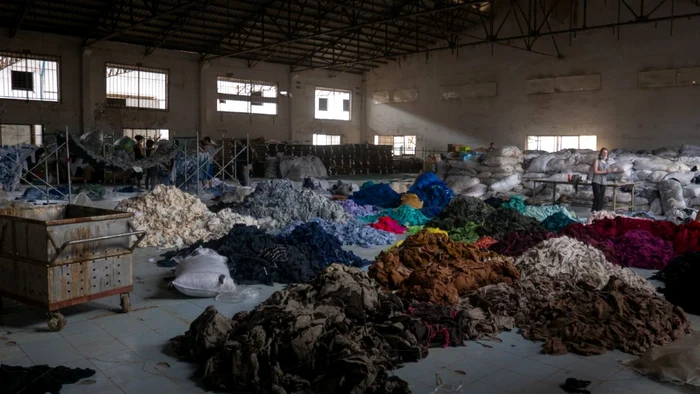
A lot of textile waste is incinerated. Photo ecosynergy
The situation was also highlighted by the Romanian Association for Textile Reuse and Recycling (ARETEX), through a report that showed that approximately 160,000 tons of textile waste are thrown away in Romania annually.
The European analysis, carried out in collaboration with the Foundation for the Circular Economy and with the support of Humana People to People Italy, INCIEN (Czech Republic) and INCDTP (Romania), compared textile flows in Italy, the Czech Republic and Romania. In our country, JRC shows, only 8-16% of textiles are collected separately, and the rest end up mixed with household waste, become contaminated and are impossible to reuse, thus compromising the economic value of reusable textile goods.
The JRC report emphasizes the importance of correct sorting and pre-processing for reuse and recycling, with an emphasis on prioritizing reuse as the main solution for the transition to a circular economy. The lack of these processes leads to contamination and decreased value of materials, especially when textiles are collected together with mixed municipal waste.
Although the study concludes that most textile waste can be recycled, ARETEX representatives claim that the practical reality does not confirm this because it depends, among other things, on an efficient collection and sorting system, both at the level of households and specialized centers. Thus, textiles from users after initial consumption have a much lower recycling value, on the other hand post-consumer industrial waste, when sorted according to material composition, color or stitch type, has a much higher recycling potential.
ARETEX recommendations for efficient management of textile waste
Data provided in 2024 by ARETEX indicated a reuse and recycling rate of only 6–8% in Romania, as well as an extremely low volume of separate collection, between 0.5 and 0.7 kilograms of textiles per inhabitant, annually.
In the European comparative study, Italy reported the highest domestic reuse rate of around 25%, while the Czech Republic recorded the lowest percentage (around 2%), with most of the textiles collected being exported either as second-hand clothes or for industrial recycling. Romania lies between the two, with indicators showing that purchases of second-hand clothes are becoming more popular, but the infrastructure for domestic collection and reuse remains very limited. According to ARETEX estimates, in Romania, the combined reuse and recycling rate is below 10%.
“The two sets of data – the JRC study and the ARETEX figures – tell the same story: Romania massively transforms textiles into household waste. It is important to understand that the circular economy in textiles will not happen by itself. It must be designed, financed and supported by smart policies and public trust. We need as quickly as possible a clear system for reporting and monitoring the route of textiles: what is collected, what is reused, what is recycled, what ends up in incineration or in landfills. Only in this way can we measure the real impact and build effective policies”, declares Zoltán Gündisch, president of ARETEX.
Urgent measures are needed
To avoid the risk of non-compliance with the new EU Waste Directive, ARETEX formulates a series of recommendations and requests the adoption of urgent measures. First of all, in the case of textile waste, collection should have the purpose of reuse as a priority, a fact that requires a distinct approach compared to the other waste streams, since the degradation of their quality causes a significant decrease in the reuse potential. As a concrete measure, the collection of textiles should be delegated to specialized operators and not to operators who manage household waste, as is currently done.
In addition, there is a pressing need to invest in collection container infrastructure as well as advanced sorting and recycling technologies. In this sense, it is essential to introduce the Extended Producer Responsibility (REP) scheme as soon as possible, whereby the money collected from producers is directed to the sorters, for reuse, and to the recyclers. ARETEX also calls for the removal of the 150 euro ceiling for duty-free online imports, a mechanism that favors the ultra-fast fashion market and unsustainable consumption. In parallel, easy market access for reusable products should be ensured and strong measures taken against illegal imports of textiles.
Second-hand products are under double economic pressure: on the one hand, due to the market of ultra-fast fashion imported online at very low prices, often duty-free, and, on the other hand, the lack of subsidies or incentives for sorting centers for reuse and recycling.
Implementation of the EU Waste Directive
The publication of the JRC study comes at an important time: on 9 September 2025, the European Parliament adopted the new Waste Framework Directive, which, for the first time, treats textiles as a distinct category, setting out clear obligations for member states.
Separate collection of textiles became mandatory in the EU from 1 January 2025, and within 30 months each state must implement Extended Producer Responsibility (EPR) schemes, a mechanism whereby textile manufacturers and retailers will cover the costs of collecting, sorting and recycling textile waste.
The new directive covers a wide range of products: from clothing and footwear to bedding, curtains and blankets. At the same time, it introduces criteria for clearly establishing the moment when a clothing product ceases to be reusable and becomes waste. Member countries can adjust the financial contributions of producers depending on the degree of sustainability of the products and their belonging to the fast or ultra-fast fashion segment.
However, in the absence of a national system of transparent reporting, the transposition of the directive risks remaining only “on paper”. ARETEX emphasizes the importance of the clear centralization of data and their transparent publication in order to be able to build a coherent and measurable legislative framework capable of effectively reducing the amount of textiles removed from the reuse circuit.