Sonia Sobczyk-Grygiel, Business Insider Polska: At the request of the government, you analyzed the impact of the agreement with Mercosur on the Polish economy, what results from this analysis?
Marek Wąsiński, head of the World Economy Team at the Polish Economic Institute: A number of analyzes carried out at the level of the European Union, but also in Poland, show that, generally speaking, the EU-Mercosur agreement will bring neither significantly positive nor significantly negative economic effects, both for Poland and for the entire Union. As for total exports, its positive impact will not be very significant either. This is due to the fact that the Mercosur countries, i.e. Argentina, Brazil, Paraguay and Uruguay, although they have a very large population, have limited economic importance for the EU. Moreover, they account for only about 2%. EU exports and about 2 percent imports into the Union.
The rest of the interview below the photo
This is the case today, but a free trade agreement increases this potential.
The agreement will not cause Mercosur's importance for EU exports to suddenly increase dramatically. The latest study by the European Commission, which analyzed its expected effects, indicates that thanks to it the EU's annual GDP will increase by EUR 77 billion. This translates to 0.1 percent. EU GDP. Other analyzes estimate that this effect will be even lower. Overall, this agreement will not change much. It is similar in the case of Poland. From the analysis of prof. Jan Hagemejer and an international team, carried out at the request of the European Parliament, shows that in the case of Poland, the effect of the agreement will be slightly positive, but almost zero. Although, of course, from the perspective of individual sectors, this impact will vary.
In a moment I will ask about the effects on individual sectors, but I would like to return to PIE's analyses, what do they result from?
Our analyzes come to the same conclusions – the EU-Mercosur agreement will be neutral for both Poland and the European Union. The reason is the mentioned limited economic potential of the Mercosur countries. The fact that the overall effect on the economy as a whole is not significant does not mean that the consequences of the agreement for individual sectors cannot be more significant.
Read also: No more illusions about Mercosur. Italy says yes
If the effect of the agreement on the EU economy in general is neutral, why do the European Commission and many EU countries care about it so much?
In the current geopolitical situation, in a dynamic world, developing the network of connections between the EU and other countries is important. An important circumstance is that from this year the EU has limited access to the US market. The agreement with Mercosur, if it comes into force, may partially compensate us for this – if there is no free trade agreement with Mercosur, our situation will be worse than before.
Another important factor is that China is intensively developing cooperation with Mercosur countries. Therefore, if we do not strengthen our relations with them and strengthen our position in this market, we will be increasingly pushed out of it.
The last point I would like to draw attention to is that the Mercosur countries may be our potential partner when it comes to critical raw materials, including rare earth metals. For example, in Brazil there are quite important deposits of lithium. The agreement with Mercosur limits the possibility of possible restrictions on the export of these raw materials or its taxation. The European Union is therefore trying to secure potential new directions for the supply of these raw materials. This is of great importance in the face of China's policy, which takes advantage of the fact that we are currently fully dependent on their supplies of some critical raw materials.
Read also: Why are farmers afraid of the agreement with Mercosur? “The devil is in the details”
The impact of the EU-Mercosur agreement on the Polish economy
This means that PIE's analyzes show that signing this agreement will have no significant impact on the economy makes sense. But let's get back to the risks, the concerns of agricultural communities are the loudest, how justified are they?
There are two issues here. Firstly, the export structure of the Mercosur countries indicates that they are very competitive in agriculture and have significant advantages here. Their agricultural exports to the EU may therefore increase. Moreover, so far the EU has had the highest trade barriers, in the form of customs duties, in the agri-food area. Therefore, once the agreement is fully implemented, losses may occur among European producers. Secondly, however, for this reason it contains transitional periods extending the time of access to the common market, as well as quantitative quotas that limit the possible export of especially so-called sensitive goods to the EU. It also introduces safeguards that help limit liberalization when there is an excessive increase in exports that threatens the internal market. Additionally, the European Commission has provided a compensation system in the event of high losses.
From the Polish perspective, what matters is not so much that Mercosur products will appear on our market, but that our exporters will have increased competition on the European market.
Poland is a large food exporter. Last year, the value of these exports amounted to nearly EUR 54 billion. This is a considerable amount.
That's why this topic is so prominent in the debate. The restrictions and compensations introduced will reduce these potential losses. Moreover, instruments such as the promotion of European goods among consumers are available. Moreover, the appearance of cheaper competition gives an opportunity to increase the volume of consumption of a given product category. In such a situation, exports from Poland do not necessarily have to decline. It's not zero-sum at all.
The rest of the interview below the photo
Impacts of the EU-Mercosur agreement on agriculture
Which sectors of the agricultural sector will suffer the most and which may benefit from this agreement and what may be the scale of these changes?
Changes in agricultural production across the EU are estimated at less than 0.5%. at the end of the full implementation period of the agreement, sugar, rice, beef and other meats are most at risk. The poultry sector may also be relatively more important for Poland than for other EU countries. Potential very small gains, however, may be seen in oils and fats, dairy products, beverages and tobacco.
How would you respond to such arguments that once this agreement comes into force, our agriculture is finished, due to the size of farms, labor and energy costs, lack of requirements regarding the use of pesticides or animal welfare in the Mercosur countries?
There will be no crash. Analyzes indicate that this agreement will be neutral for the economy and moderately negative for agriculture. The changes will be spread over time thanks to transition periods, quantitative quotas will apply to the most sensitive products, and in the event of imbalances, protective mechanisms will be able to be activated. It is worth adding that the EU can also be competitive in this area, and consumers are also attached to local production. There is no reason for defeatism.
Moreover, when it comes to food standards, products exported to the EU must meet our food standards. In terms of labor and energy costs, we actually have dramatic differences, but this applies to all sectors that do not have such significant customs barriers now.
Moreover, when it comes to labor standards or deforestation of the Amazon Forest, the agreement allows for control of the supply chain. Enforcing these mechanisms will be a challenge, but the EU's opening up to other markets makes it possible to disseminate our standards, for example in the area of personal data protection. This phenomenon has even been labeled the “Brussels effect”.
It is also worth asking the question whether, as the European Union, we want to close ourselves completely and become an autarkic entity? Taking this path would bring huge economic losses for the entire Union. In the context of security, you may even need to think the opposite. In the face of climate change and increasingly frequent extreme weather phenomena, food security may be defined by the availability of various sources of food supplies. This agreement may allow for such slight diversification.
Read also: Poland is taking the last stand in the Mercosur case [ANALIZA]
The EU-Mercosur agreement in the context of the geopolitical situation
And what will be the consequences of the agreement with Mercosur for other sectors, and who will benefit from this agreement?
The deal could pay off for industrial sectors. The three most important sectors in current exports to Mercosur countries are the machinery and equipment sector, the chemical sector and various means of transport, including the automotive sector. Together, they account for over 65 percent. EU exports to Mercosur. They will also benefit most from liberalization, especially the automotive industry, which faced higher customs barriers and will be able to count on greater benefits during a long transitional period. For the entire EU, we are talking about production increases of approximately 0.3-0.4 percent. From a Polish perspective, greater access to the sale of pharmaceutical products and furniture may also be interesting.
The rest of the interview below the photo
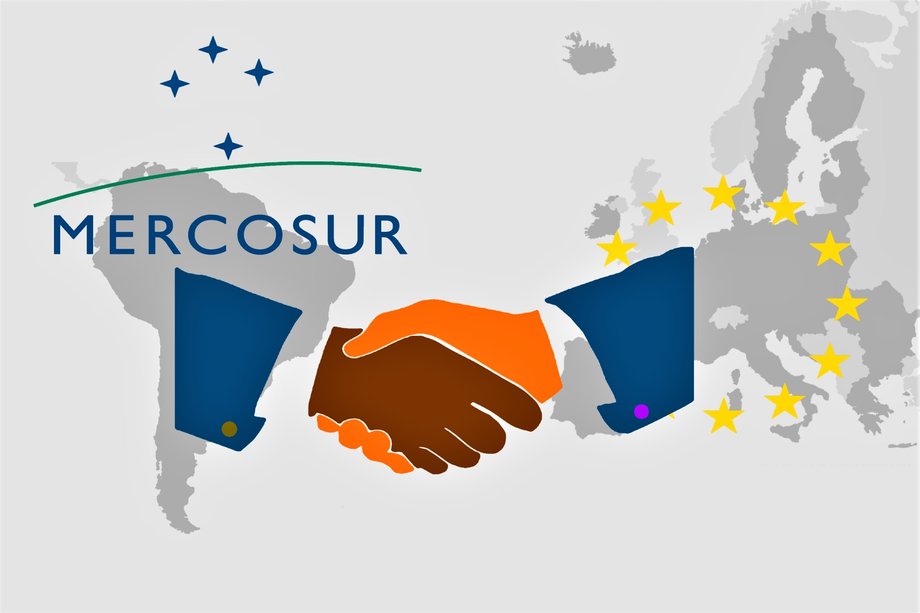
EU-Mercosur Agreement
|
John Kehly / Shutterstock
I will also ask about consumers. What will this deal mean for them?
The effects for consumers will also be close to neutral, as for the entire economy. Although some agri-food products may actually become more available, because goods that previously faced high customs barriers will be able to be partially offered on the European market over time.
So, weighing all these reasons, do you think that this agreement is beneficial for Poland as part of the European Union?
It is reasonable to ask whether Poland, as part of the European Union, can afford not to have this agreement? It is difficult in this current world, in which the rivalry between superpowers is growing and barriers, e.g. access to critical raw materials, are growing, to look at it with indifference and allow for this agreement not to exist.
I would add one more thing here. We focus our conversation on the EU-Mercosur agreement. I mentioned in this context that the EU cannot close itself off to the world. At the same time, I would like to emphasize that the EU, for its security and development stability, must actually focus more on itself and less on exports, which was emphasized by Christine Lagarde, head of the European Central Bank, on November 21 (and also six years ago). Cooperation in the single market should be deepened and its importance in the EU's GDP increased. This will be much more important for the EU's resilience and development than the agreement with the Mercosur countries.