Poles assessed the government's reaction to the act of sabotage. A surprising opinion from Braun voters


Read also: A meeting between the president and the prime minister? The deputy head of the KPRP explains the reasons for the delay
The prosecutor's office began an investigation into acts of terrorist sabotage directed against the railway network and committed for the benefit of foreign intelligence. The State Commission for the Investigation of Railway Accidents also dealt with the matter. A suspect was arrested in this case and an act of sabotage was committed on the tracks.
On Friday, the spokesman of the Belarusian Ministry of Foreign Affairs, Ruslan Barankou, announced that Belarus has joined the search for people suspected of sabotage in Poland. He assured that if their stay on the territory of Belarus is confirmed, they will be detained and the application for their transfer to Poland will be considered in accordance with the procedures and taking into account all circumstances. He added that so far only the entry of these people into Belarus has been confirmed, where intensive searches are being carried out.
Poles about the government's reaction to the act of sabotage in the latest survey
Gives negative marks 46.2 percent respondents, while 41.9 percent assesses the authorities' reaction positively. As much as 12 percent those asked have no opinion. These data show the growing polarization of public opinion regarding internal security and the effectiveness of state institutions.
Read also: The government is divided over labor inspection. Dziemianowicz-Bąk versus PSL
The rest of the text below the video
The response was dominated by positive opinions “rather good” – this was indicated by 33.3 percent. respondents, while 8.6% expressed strong appreciation for the authorities' actions. In turn, 31.6 percent respondents assessed the state's reaction as “definitely bad”, and 14.6 percent — “rather bad.” It can be seen that extremely negative opinions appear much more often than extremely positive ones.
Political colors of assessments of the government's reaction to the act of sabotage. Electorates divided like never before
The survey revealed clear correlations between opinions about the state's actions and political preferences. The authorities' reaction is assessed very positively by supporters of the ruling camp – as many as 82%. of them gave positive ratings. 74% are of the opposite opinion. respondents identifying with the opposition. Criticism also dominates among non-voters: 49 percent. of them evaluate the state's actions negatively.
Even more visible differences are visible when comparing the answers with the last parliamentary elections. As much as 80 percent PiS voters and 62 percent Confederation voters assess the state's reaction negatively — this is one of the most surprising conclusions of the study, showing the growing dissatisfaction of part of the right with the actions of state institutions. On the other hand electorates of the Civic Coalition (79%), New Left (73%) and Third Way (72%) are more likely to declare satisfaction with the state's actions.
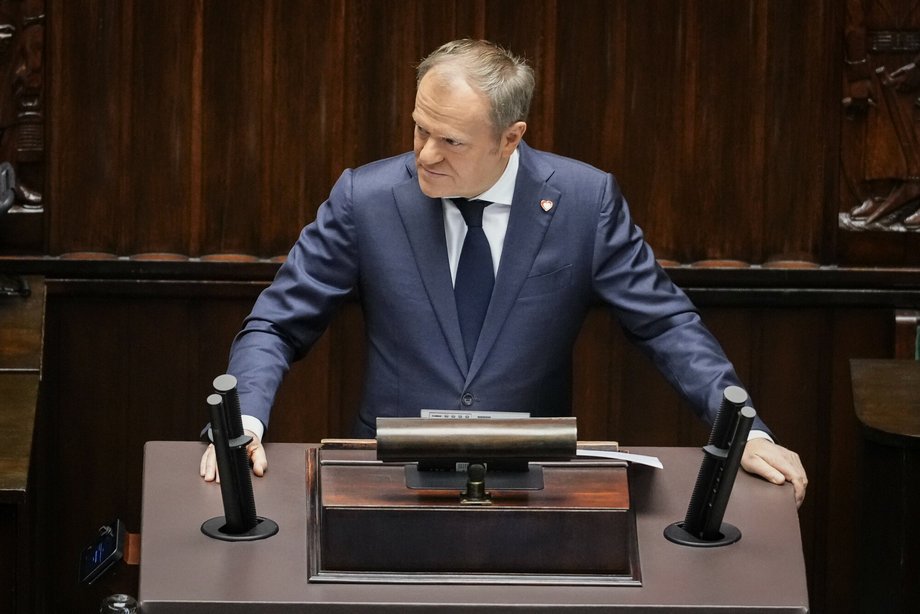
Donald Tusk
|
Marysia Zawada/REPORTER / East News
Equally strong cracks can be seen when analyzing presidential preferences. As many as 87% of respondents assess the state's reaction as negative. Karol Nawrocki's voters, as well as 55 percent supporters of Sławomir Mentzen and Adrian Zandberg. On the other side are the voters Rafał Trzaskowski (85 percent positive ratings), Szymon Hołownia (82 percent), Magdalena Biejat (66 percent) and – interestingly – also Grzegorz Braun (54 percent).
Social divisions: critical villages, moderately satisfied cities
Demographics from the survey also show a wide diversity of opinions. Women more often than men evaluate the state's actions positively (47% compared to 48% of negative opinions), while as many as 52% men have a critical opinion. The greatest satisfaction occurs in age groups 50 plus – 59% of 50-year-olds have a positive opinion, and as many as 60% of 70-year-olds. The most 30-year-olds are dissatisfied, of whom as many as 63 percent criticizes the actions of the state.
Significant differences were also noted due to place of residence. Rural residents assess the authorities' response extremely harshly – 67%. gives negative marks. Positive assessments predominate in medium-sized cities (61%).which may reflect different sources of information and a different sense of security.
The study also draws attention to the connection between opinions and the level of education. People with primary and vocational education are more likely to be critical (59%), while respondents with higher education have more balanced opinions – 49%. evaluates the state's actions well.
An interesting thread is media preferences. The state's actions are assessed positively mainly by people who use TVN news channels (77%), while viewers of Telewizja Republika more often declare a negative opinion (66%).. This result confirms how strongly public debate remains dependent on information sources.
The survey was conducted by IBRiS using the CATI method on a representative sample of 1,075 adult Poles on November 21-22, 2025.