You will notice it in the crowd thanks to its round shape. However, you will remember this sausage forever because of its taste. It has a thicker and juicier consistency than other sausages and an amazing flavor thanks to the large amount of spices.
Cumberland sausages are loved in the UK. However, there are only 12 butchers in the country producing the original, traditional sausage, which has received protection status. We are located in Barrow-in-Furness, Cumbria, England. This county has been the home of Cumberland sausage for hundreds of years. Today we will learn more about the traditional method of making Cumberland sausages – a method that will take us back to the times of the British Empire. I invite.
Read more: We were in a kitchen that feeds two million children a day. This is what it looks like from the inside
How is a traditional sausage made in Great Britain?
To produce traditional Cumberland sausages, butchers once used a local breed, the Cumberland pig, which is now extinct. That's why they now use rare breeds, outdoor-raised pigs such as the British Lop.
— Because these pigs live longer, their meat is more flavorful, and a bit of spices and herbs make for a fantastic sausage. We have half a pig here. This is the shoulder blade, middle and belly. Here we have pork loin, from which we obtain cutlets and pork belly. And here we have the leg. We connect the leg and shoulder together. This is because the leg is lean. If you're just using the leg, you'll need some fat. So we need to combine both of these parts. You will see that this combination is the best. You need to know how to use a knife. When removing the meat from the bones, be sure to separate any tendons and skin. Believe it or not, a commercial machine turns each of these skins into a paste that can end up in sausages. We don't want this and we don't have such a machine. Therefore, it is important that every bit of tendon, bone and cartilage is removed so that we are left with only really good meat. To make money, we need to get as much meat as possible. If you get little of it, you are a bad butcher explains Peter Gott, owner of Sillfield Farm Food.
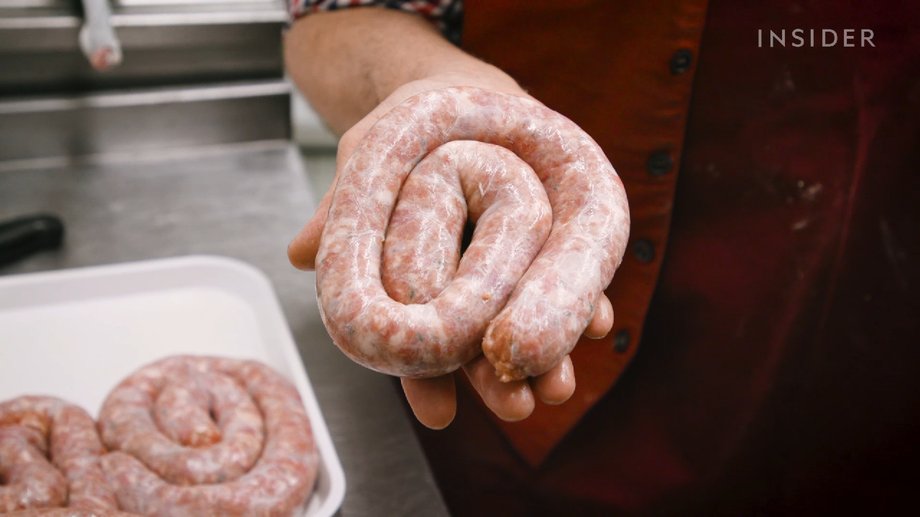
This British sausage has a spiral shape and a taste that is hard to forget
|
Business Insider
Once the meat is stripped of its bones and cartilage, we obtain cutlets that will later be transformed into Cumberland sausages. Instead of going through a more commercial grinder and emulsification process, the meat is ground coarsely to retain large pieces.
– These are nice thick pieces of ground meat that would taste really good in your mouth. 80 percent all of it is red meat, and 20 percent it's white fat. However, if we add too much fat, it will fill the pan while frying, and this is not good. Additionally, the sausage will shrink. In this case, the sausage will remain the same, explains Peter.
This may seem obvious, but the high meat content of a sausage is never obvious. More commercial butchers use bread or cereal, something Peter is strongly against. Bread or cereal absorbs some of the extra fat, which in turn changes the texture and flavor of the sausage.
We want to make sausage with a high meat content. We want real Cumberland sausage to be recognized because it is different. So we submitted an application to the European Union for protection of our regional sausage
– explains Peter.
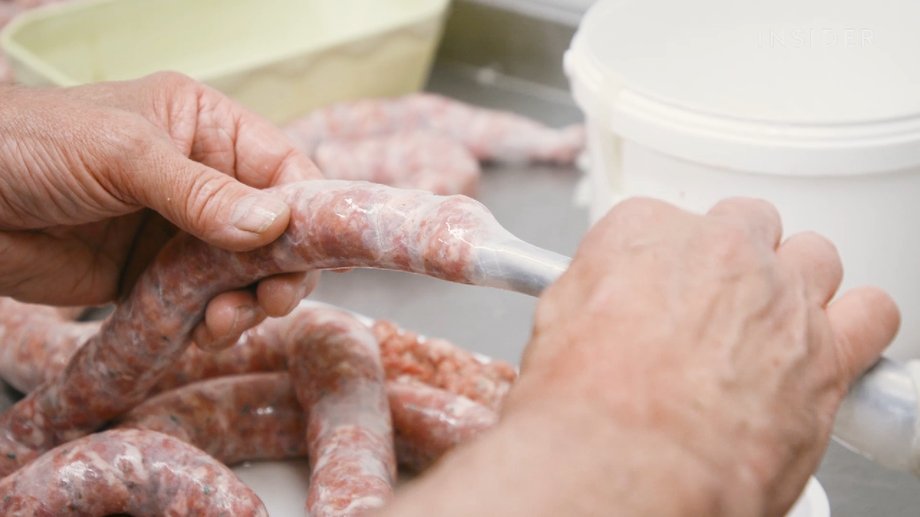
The British have been eating this sausage for generations
|
Business Insider
Read more: 170 million poultry have been slaughtered, and egg prices in the US are still rising. Experts are sounding the alarm
Cumberland sausage is not just meat
Now that we know how important the meat is, we're ready to learn more about Cumberland sausage's other signature feature – the spices. These are added by hand before the entire mixture is enclosed in the pig's natural intestine. What types of spices are included in Cumberland sausage? What do we have here?
— Here we have salt and pepper, some sage and nutmeg, which are finely ground, we have potato starch and rice flour. This mixture is meat and spices. Then we add some herbs, specifically sage. Fresh sage can be used, but dried sage increases shelf life. Then add pea starch. The mixture has dried out a bit, so we need to add some water. Everything has to go through this nozzle, explains Peter.
This particular spice blend is not accidental. According to Peter, in the 19th century, German miners moved to Cumbria in search of work and brought the sausage recipe with them. Instead of the spices they were used to, they used spices they could get locally, even though they were not local. Spices were imported to Cumbria from the Caribbean through the port of Whitehaven, the second largest port in the country at the time.
Spices have always been used. Sometimes even ginger. However, the main ingredients used were nutmeg, mace and pepper. It was these spices that made Cumberland sausage completely different. If you worked hard in a slate mine and wanted a good, strong sausage, local spices were fantastic. However, the most important ingredient was meat
says Peter.
Everything together creates something completely unique.
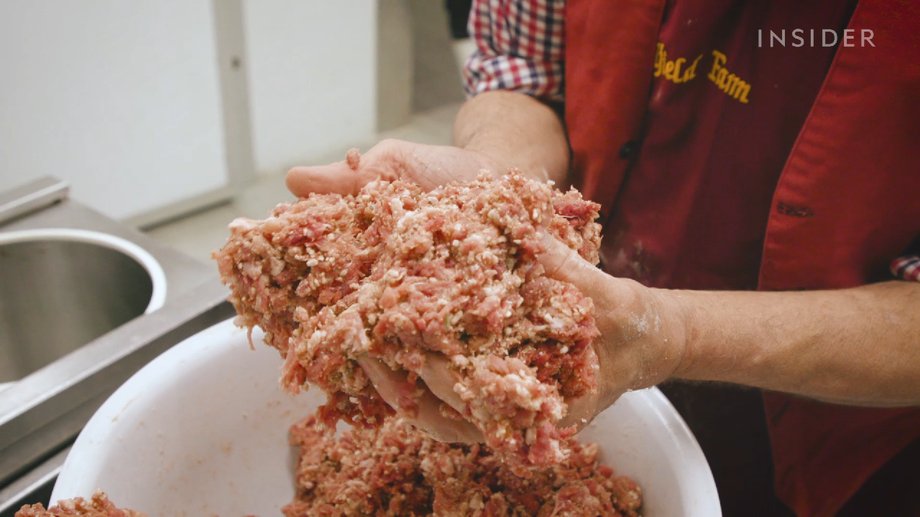
Cumberland sausage is not just meat
|
Business Insider
— Now I take cleaned pig intestine. We put them into the nozzle of the sausage machine. It is very important that we use a natural casing, i.e. a natural intestine. Commercial manufacturers currently use synthetic cowhide. When cooked, this natural texture is not stringy, rubbery or plasticky, which is sometimes the case with some sausages, explains Peter.
– How long is this intestine? That's one intestine from one pig, right? I ask because it is continuous, I say.
— In Victorian times it was 19 yards (approx. 17.5 m). Now he is 21 m. It is interesting because as the vitality of our pigs has improved, the intestine has become longer and is able to absorb more food. That's just the way it is. The intestine is 21 meters long, he explains.
— You also see sausages like this in Italy, right? – Peter asks.
— Yes, in my region we have a sausage that is served this way and is called zampina. It means “little paw”. It is served in a similar spiral shape. And it's a grilled sausage, I say.
Read also: Five tons of rice a day are cooked in this cauldron. Nobody leaves here hungry
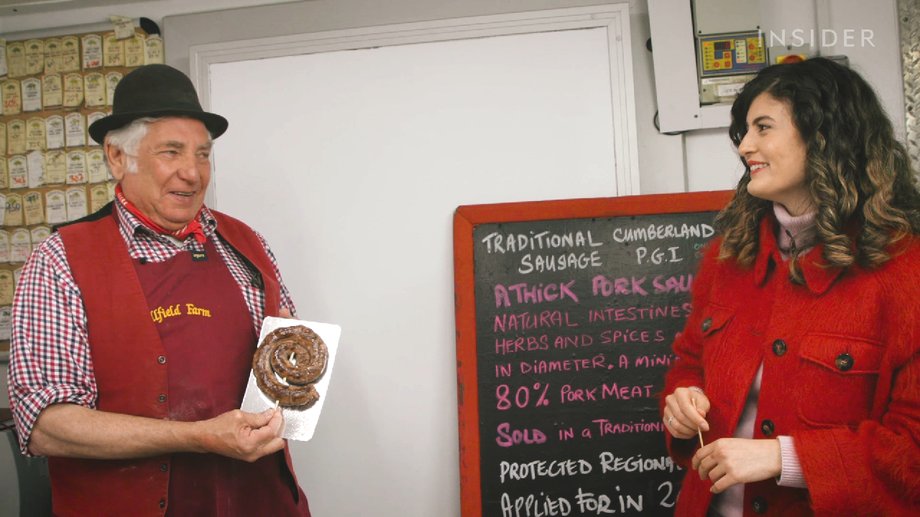
Cumberland sausages are loved in the UK. However, there are only 12 butchers in the country producing the original, traditional sausage, which has been granted protection status.
|
Business Insider
Cumberland is the Rolls-Royce of sausages
Real Cumberland sausage must be left overnight to allow the spices and herbs to mix with the meat. Peter grilled some sausages for us from yesterday's production.
— The thickness and consistency of the sausage are important. But what matters most is the taste, says Peter.
“I can feel the natural casing cracking when I bite into it,” I praise.
— It's a natural casing, a natural intestine. The flavor of the meat is distinct and the spices influence it a bit, explains Peter.
— First of all, you can smell the pepper.
– That's true. And nutmeg. Can you taste it?
– I feel. The taste is very good. You can definitely taste the meat. The sausage is quite meaty, I reply.
– Claudia, if you owned a Rolls-Royce… You wouldn't put cheap engine oil in it. Don't put bad food in your mouth, Peter pleads.
— How do you recommend eating sausage? Apart from this way, i.e. on a skewer? – I ask at the end.
– Traditionally. That is, in the shape of a spiral. This is what a real Cumberland sausage looks like. It's a good meal. Nowadays, it's a meal for two, says Peter.
-I'll eat it myself! – I laugh.
Author: Claudia Romeo, journalist, Insider