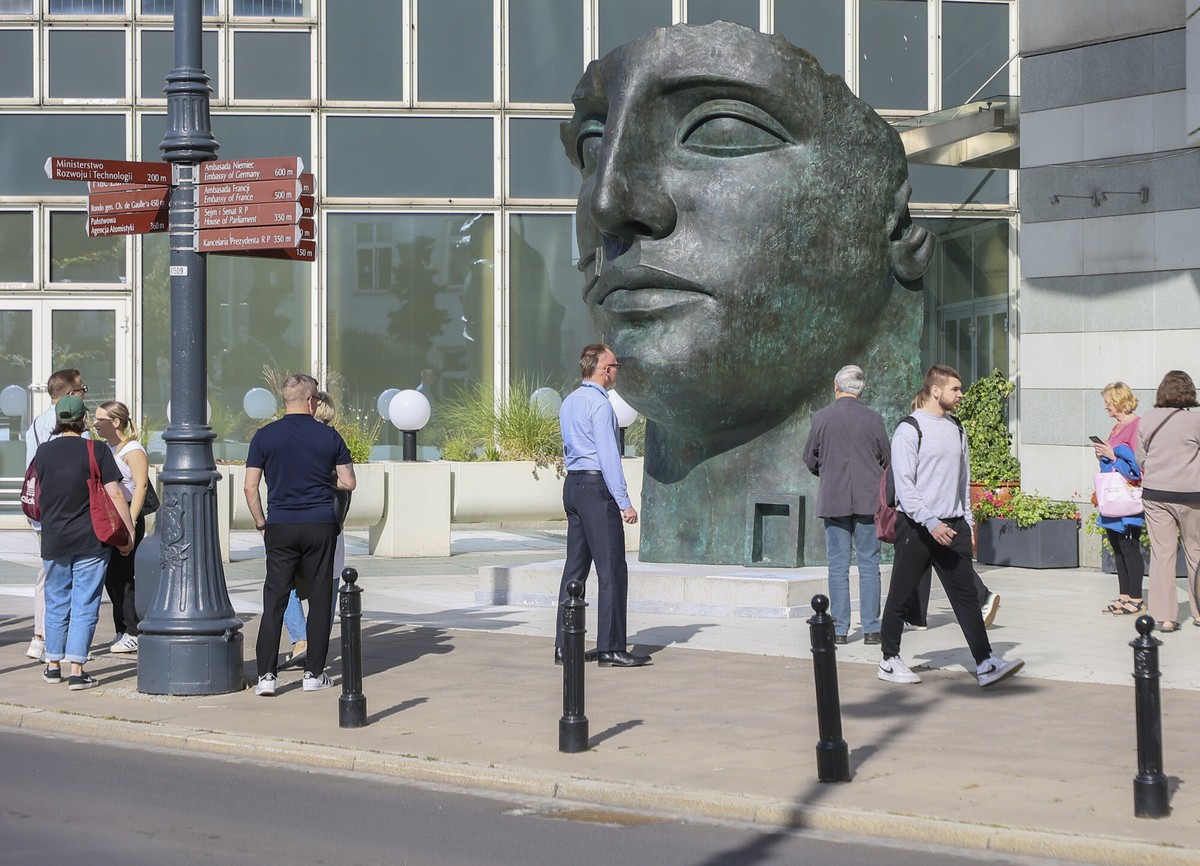
The sculpture came from France, where she has decorated the La Défense district in Paris for years. The four -meter “Tindaro” from patinated bronze weighs 2.6 tonnes and was created in 1997 on the order of the international company KPM.
“Tindaro” presents the head of a young man inspired by Tyndareos – King of Sparta and the father of Helena Trojan. Mitoraj created a “sculpture”, using reliefs and mascaron in which he quoted his own work. “Ancient art was and is an ideal for me, and it is also associated with nostalgia behind the lost paradise,” said the artist.
A distinctive element is the rear part of the sculpture: two pillars with reliefs and a central mascaron reminiscent of a jellyic motif.
Fragmentation as a metaphor
Mitoraj was famous for monumental, “damaged” forms that were not defective to him, but were a metaphor for human condition and transience. “Mitoraj models every fragment – hand, leg, eye, mouth – but this fragmentation reflects the state of man and society,” wrote Constantinin in interviews with the artist.
The sculptor also emphasized that he did not like when his works were given “mutilated” or “defective” labels: “I do not like the sculpture that looks at, everything can be seen immediately; you have to discover it yourself and reach the heart for a long time. I think that art should intrigue the viewer. It can be a secret. He can even keep your secret forever.”
Mitoraj – an artist with an international reputation
Igor Mitoraj (1944–2014), actually Jerzy Makina, created mainly in Italy, France and Germany. His works can be found, among others in Pietrasant, Lukka, Florence or Paris. Monumental realizations include fountains, monuments and cariats in public space, and the works combine classic beauty with drama and reflection on passing.