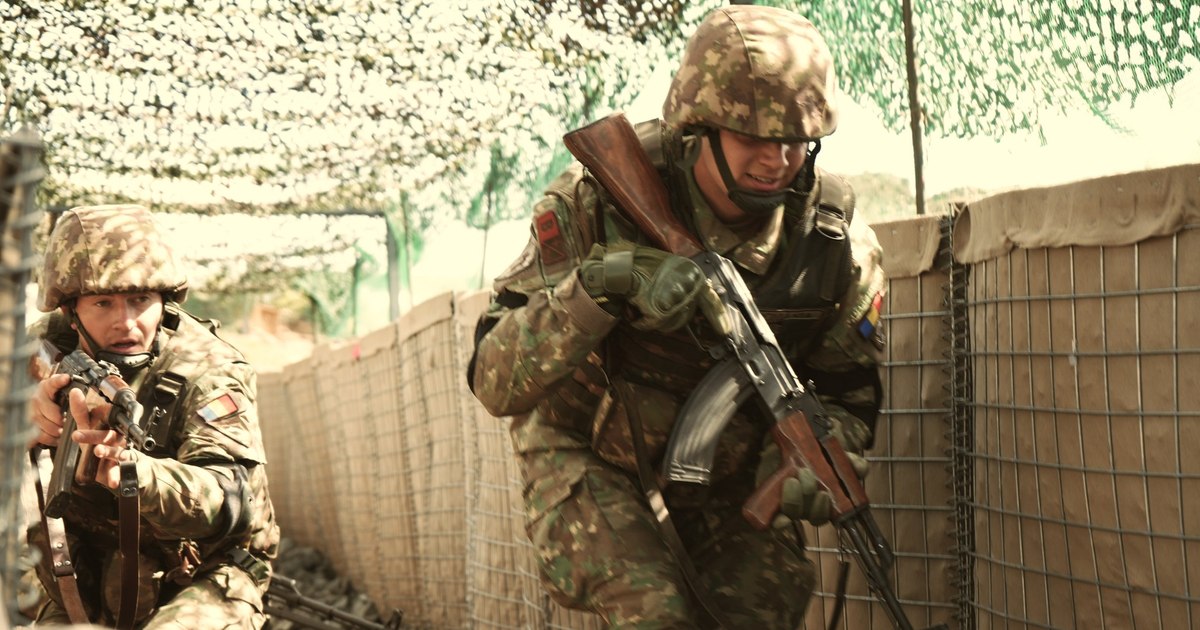
A European Commission report estimates that Romania must defend itself for 45 days, until the arrival of NATO troops.
Romania should defend itself for 45 days until the arrival of NATO troops. PHOTO: MApN
Romania should be able to hold out for about 45 days in the event of a major armed conflict with Russia, until NATO troops could arrive on its territory, according to estimates by European Union officials in a report on military mobility.
Currently, the movement of an army from strategic ports in the west to countries near Russia or Ukraine would take about 45 days, writes the Financial Times after analyzing the latest European report on the adoption of measures to reduce border blockages and create common rules for military transport.
Experts have identified several obstacles that hinder military mobility: weak bridges, too narrow tunnels, differences in railway gauges and excessive bureaucracy, so projects like Rail Baltica aim to remove these blockages, integrating the Baltic states into the European network and facilitating the rapid transport of heavy equipment.
NATO plans call for, in unofficial scenarios, the move of around 200,000 troops, 1,500 tanks and thousands of armored vehicles from the US, Canada and Britain to eastern Europe. For this to be possible, every logistical element must work “like a Swiss watch”, explained Alexander Sollfrank, an expert on the German military, quoted by the Financial Times.
But before any move, a quick political decision is needed at the moment of crisis, and recent experiences, such as the concentration of Russian troops on the Ukrainian border ahead of the February 2022 invasion, have shown that Western leaders can be reluctant to anticipate military action by their adversaries.
Complicated procedures and bureaucracy
Logistics are also complicated by the fact that troops must cross neutral states, complying with customs rules, different legislation and varying procedures for the same convoy.
To that end, European officials are working on a “military Schengen” to standardize travel rules, although issues such as cyber security will remain major challenges.
A concrete example is the delivery of the French Leclerc tanks to Romania in 2022, which took several weeks, but was expected to take place in a few days, after the German customs initially rejected them on the grounds that they were too heavy for the roads. Finally, the equipment was transported by rail through Greece to Romania.
According to the same source, throughout the European Union, experts have identified approximately 2,800 critical points in the transport infrastructure, of which 500 have been prioritized for modernization.
The preparation of Romania
In this context, the question of whether Romania could face an attack from Russia for 46 days is a topical one. We remind you that, towards the end of October, when asked directly how prepared the Romanian army is, on a scale from 1 to 10, to defend itself in the event of a Russian attack, the Minister of Defense, Ionuț Moșteanu, declared that the Romanian army was “prepared and continues to prepare”, but did not offer a clear answer regarding the country's ability to resist until the arrival of NATO troops, nor
“It would be arbitrary for me to give a grade now, how prepared the Romanian Army is. I want to see the length of my nose. I am not in a position to evaluate, after four months, the performance of the Romanian Army as a whole. There are things that can be done better, they will be done better, there are things that the army is constantly changing together with our allies”. he said then.
“It's a discussion that doesn't make sense, mathematically, in days. Who is attacking you and how hard? The Russians, who barely bother to move the front with Ukraine? Did Putin come for, as he says, a special 3-day operation, and he's been on the same front line for three and a half years? With Ukraine, who will attack us? NATO is the biggest military firepower at the moment. Who has the courage to attack NATO at this moment?”, the same minister declared at the beginning of November.
Romania's situation is now even more unclear, in the context of the reduction in the number of American troops deployed in Romania, including at the Mihail Kogălniceanu Base, while the Russian-Ukrainian conflict approaches the country's borders.