The massive decline in energy companies pushed the main indexes of the Warsaw Stock Exchange down. The strength of the declines was the largest in almost three months and caused the WIG to fall with a bang from the double peaks of October and November.
WIG20 decreased by 1.79%, ending Tuesday's session at 2,903.10 points. WIG returned 1.97% with a turnover of PLN 1.8 billion. This was the largest daily decline in this index since August 22, so for almost three months. The same applies to WIG 20.
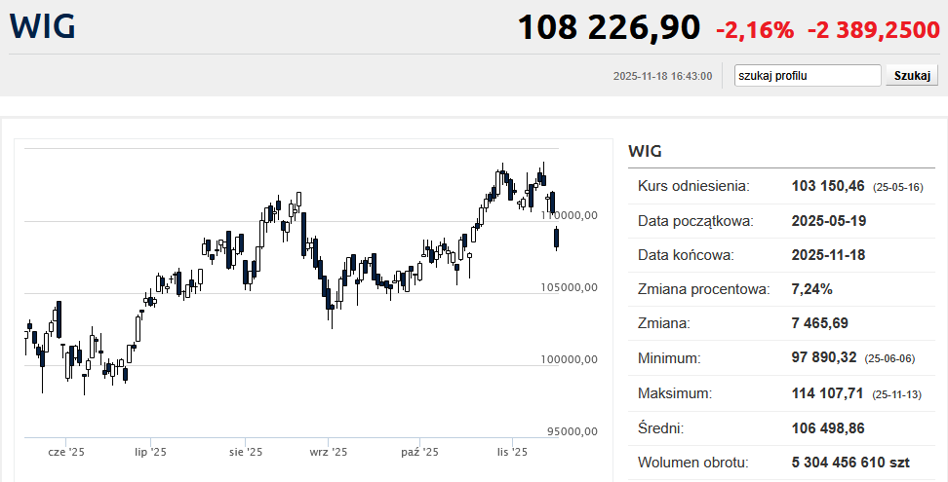
In this way, a double top formation, not very pleasing to the eye (and statistically also to the wallet), was created on the daily chart, from which the Warsaw Stock Exchange has dynamically fallen away today. Based on technical analysis, this portends further declines, and the potential support for WIG 20 is only the zone of 2,750-2,800 points.
The cause of Tuesday's declines were strongly declining shares of energy companies. PGE's share price will decline by 6.5%, Tauron's share price has fallen by 9.7%, and Enea's share price has fallen by over 11%. This was most likely the result of the fact that information about the changes proposed by President Nawrocki in calculating rates for the electricity distribution service reached institutional investors.
Although the project has been publicly known since November 7, it was only today that the Bloomberg agency wrote about it, spreading the news to foreign investors. The result was the strongest decline in the WIG-Energy index since March 2020, which ended the day more than 8% below the mark. It is worth remembering that energy companies are the runners-up in this year's increase on the WSE, and WIG-Energia has been up by over 70% since the beginning of the year.
However, it was not only the shares of energy companies that fell on Tuesday. The decline affected all market sectors and all industry indices. In WIG 20, quotations for 18 of its 20 components were lit in red. Only CCC shares (+2.2%), which were intensively sold out over the previous two months and have been reduced by one third since July, and Orange Polska (unchanged) survived the decline.
– Today we have a clearly red sessionwhich is consistent with the weakness of European banks. The largest contributor to this decline is Orlen, followed by PKO BP, PZU, Pekao SA and KGHM. PGE drops the most in percentage terms, this is due to the proposal to reduce the distribution tariff, which worsens the sentiment towards energy companies, which were previously one of the driving forces when it comes to WIG – Sobiesław Kozłowski, director of the Analysis and Consulting Department at Noble Securities, told PAP Biznes.
Kozłowski also noted that almost exactly a year ago (i.e. November 19, 2024) there was also a crash on the WSE, which later resulted in a very dynamic rebound, pushing the WIG20 up by over 50%. – For some investors, this approach is important. Tomorrow marks a year since that day, and since the scale of year-on-year growth was large, the question is whether this will not be an argument for some inflection point – added the Noble Securities analyst. According to Sobiesław Kozłowski, the current level of 2,834 points is the closest support for WIG20.
The sharp decline on the Warsaw Stock Exchange – although driven by the local context (see the energy sector) – is part of a broader global context. In Europe, the main indexes in Paris, Frankfurt, Milan and Madrid also fell by more than 2%. The session on Wall Street also started with significant declines – exceeding 1%.
In the background is the issue of the dynamic increase in the yield of 10-year Japanese bonds, which reduces the profitability of carry trade transactions, i.e. the strategy of buying more risky (or higher interest) securities for loans taken out in the Japanese currency. – We have an anti-carry trade effect, in the sense that Japanese investors, seeing the rising yields of Japanese bonds, reduce their investments abroad and return to the motherland – explained Sobiesław Kozłowski.
It is also worth adding that shares on the WSE were most likely also sold by domestic investors. This is evidenced by an almost 2% decline in sWIG 80 (on which foreign investors almost do not operate) and a 2.7% reduction in mWIG. As well as the “width” of Tuesday's sell-off, which covered over ¾ of the securities on the main market, and only every seventh security managed to increase in price. In turn, 11 issuers recorded at least a one-year quota low today.