Maia Sandu, consultations with the formations for the nomination of the candidate for the head of the Government. A pro-Russian party refuses to participate


The President of the Republic of Moldova, Maia Sandu, started the consultations with the parliamentary parties regarding the nomination of the candidate for the position of Prime Minister, starting the very second day after the first session of the Parliament.
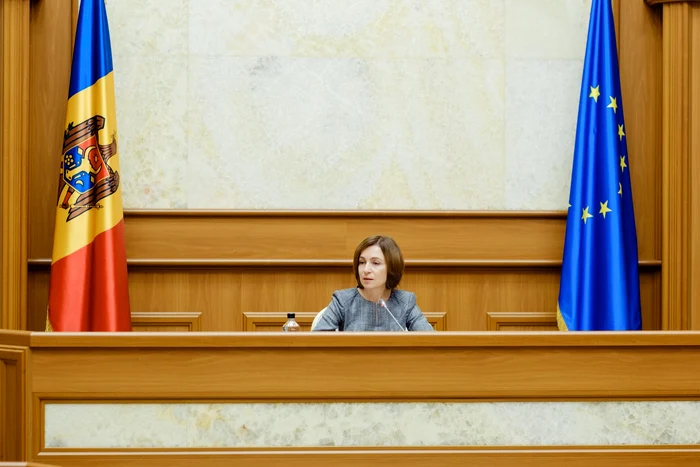
Maia Sandu started the consultations with the parliamentary parties. PHOTO: President.md
The consultations take place on Thursdays and Fridays, and on the first day, the representatives of the Home Democracy Political Party (PPDA), the Partidul Nostru formation, the Alternative Bloc, as well as the Communist Party of the Republic of Moldova (PCRM) and the Socialist Party of the Republic of Moldova (PSRM) were invited.
The refusal of the communists
However, not all of them accepted the invitation, it is about the communists, who claim that the talks are “formal and useless”.
“First of all, the proposed candidacy for the position of prime minister, contrary to the Constitution and common sense, was made public and widely publicized, including by Sandu herself, long before the official approval of the new Parliament and long before the formation of the parliamentary factions with which the president is obliged to consult. This means that the decision regarding the candidacy of Mrs. Sandu, or rather her protectors, had already been taken then, and further consultations became merely formal and unnecessary,” it is stated in a press release issued by PCRM managers.
The representatives of the other invited formations presented themselves at the Presidency in the center of Chisinau, among them being the PSRM leader, Igor Dodon, who emphasized that the formation he leads will not support the new Executive.
“The reason is simple. We do not trust that the new government can be better than the previous one. In such conditions, the socialists remain in the opposition and we will take care of our political agenda, in accordance with the national interest of the Republic of Moldova”pro-Russian Igor Dodon mentioned.
The representatives of the Alternative Bloc state that they will make a decision on whether or not to offer support to the Executive after they learn details about the program and its composition.
“The Alternative bloc will make decisions about the Government after consultations with who will be appointed prime minister tomorrow or the day after tomorrow, after we get to know the governing program and the nominal composition of the Government”, the chairman of the Alternativa parliamentary faction, Gaik Vartanian, told the Chisinau press.
Asked what he thinks about Alexandru Munteanu, the candidate put forward by the Action and Solidarity Party (PAS), which has a parliamentary majority, Gaik Vartanian answered that: “he seems to be a professional, a very smart man, an economist with a very good background”, concluded the representative of the Alternative Bloc who came for consultations, which, however, its leaders did not do: the mayor of Chisinau, Ion Ceban, the leader of the PDCM, Ion Chicu, the president of the Civic Congress party, Mark Tcaciuk, and the former candidate for the presidential elections, Alexandr Stoianoglo.
The leader of Our Party, Renato Usatîi, claims that “it is clear to us who will be the future prime minister”, emphasizing that “the only joy I have, because your (no-Alexandru Munteanu) comes from the business environment”.
And the PPDA leader, Vasile Costiuc, is of the opinion that “they have a majority and they have a candidate that they believe the Moldovans deserve”.
The discussions will continue tomorrow, October 24, with PAS representatives expected, the party that has a parliamentary majority for the second time.
Candidate proposed by the pro-European power
On October 14, the Action and Solidarity Party announced that it will propose Alexandru Munteanu for the position of prime minister.
After the consultations between the parliamentary factions and the leader from Chisinau, Maia Sandu will appoint a prime minister who, in a maximum of 15 days, will have to present the list of ministers and the government program.
Afterwards, the investiture of the Government will follow. In no more than 14 days after the vote of the parliamentarians, the head of state will sign the decree, and the members of the Cabinet of Ministers will take the oath.