Google announces major leap in quantum computing race, an algorithm 13,000 times faster than any analogue on a supercomputer


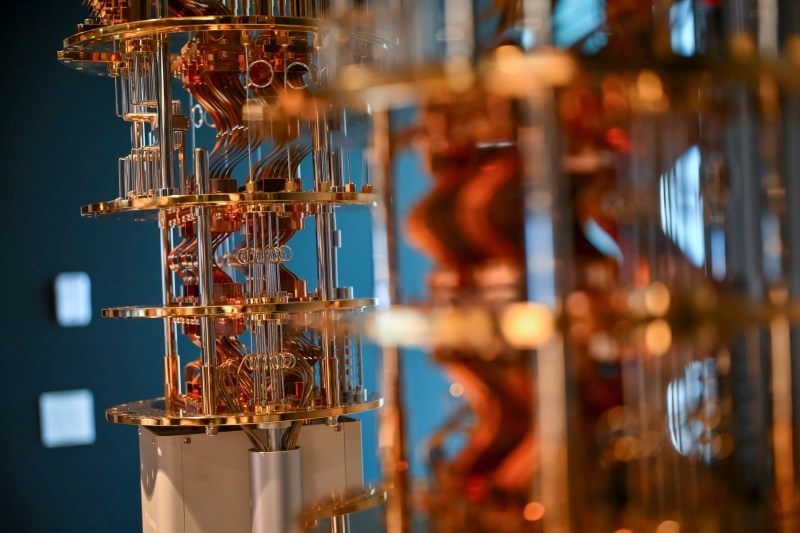
Components of a quantum computer (illustrative image), PHOTO: Angela Weiss / AFP / Profimedia Images
Google has announced that it has developed a computer algorithm that paves the way for practical applications for quantum computing and will be able to generate unique data for use in artificial intelligence, reports Reuters.
The American tech giant says the new algorithm, called Quantum Echoes, runs on the company's quantum chip and is 13,000 times faster than the most sophisticated classical computing algorithm used on supercomputers.
The announcement comes less than a year after Google unveiled its quantum chip, Willow, which the company said can overcome a crucial problem of “qubits,” the fundamental building blocks of quantum computing.
Company executives have now said that the development of the algorithm is roughly equivalent in importance to that of the chip.
In the future, the Quantum Echoes algorithm could help measure the molecular structure of various molecules, which could facilitate the discovery of new drugs and contribute to materials science by identifying new types of materials, company executives said in a press conference.
What Google says about its new discovery
“Imagine you're trying to find a lost ship on the ocean floor. Sonar technology can give you a fuzzy shape and tell you, 'That's a wreck down there.' But what if you could not only find the ship, but also read the nameplate on its hull? That's the kind of unprecedented precision we've just achieved with our Willow quantum chip,” Google said in a published statement wednesday
“Quantum Echoes can be useful in studying the structure of systems in nature – from molecules to magnets to black holes – and we have demonstrated that it runs 13,000 times faster on the Willow chip than the best-performing classical algorithm run on one of the world's fastest supercomputers,” the company added.
In terms of artificial intelligence, Google engineers hope to be able to use the algorithm to create new data sets for areas such as life sciences, where there is not enough quality data to train AI models.
Google, a company that is part of the American Alphabet group, is among the tech giants investing in quantum computing, a field that promises to accelerate processing speed and solve problems inaccessible to current computers.
The Quantum Echos algorithm is also testable on other quantum computers or through experiments. Verifiable data means it can lead to practical applications.
“A new step towards full-scale quantum computing”
Michel Devoret, chief researcher in Google's quantum artificial intelligence division, said the announcement represents a new milestone in the field. “This marks a new step toward full-scale quantum computing,” said Devoret, who just this month won the Nobel Prize in Physics for his work on quantum technology.
However, one expert cautioned that Google's achievement, while impressive, focuses on a narrow scientific problem without significant real-world impact. Winfried Hensinger, professor of quantum technologies at the University of Sussex, told The Guardian that Google had demonstrated the “quantum advantage” – meaning that researchers were able to perform a task using a quantum computer that was impossible to do with a classical computer.
However, fully fault-tolerant quantum computers capable of performing some of the tasks that most excite the scientific community are still a long way off, as they would require systems capable of hosting hundreds of thousands of qubits, the basic unit of information in a quantum computer.
“It's important to understand that Google's work is not nearly as revolutionary as some of the applications that are expected to change the world of quantum computing,” Hensinger said. “However, it is still compelling evidence that quantum computers are gradually becoming more and more powerful,” he said.
Google published details of the Quantum Echoes algorithm in the scientific journal Nature on Wednesday.