According to preliminary findings, the action began at 9.30: the perpetrators entered the museum on Sunday morning using a freight elevator. French Culture Minister Rachida Dati told TF1 that the action lasted only “four minutes.” Two perpetrators disguised themselves as employees – they put on reflective vests. Blick talked to an expert about this theft, who points out that one thing seems clear in this case.
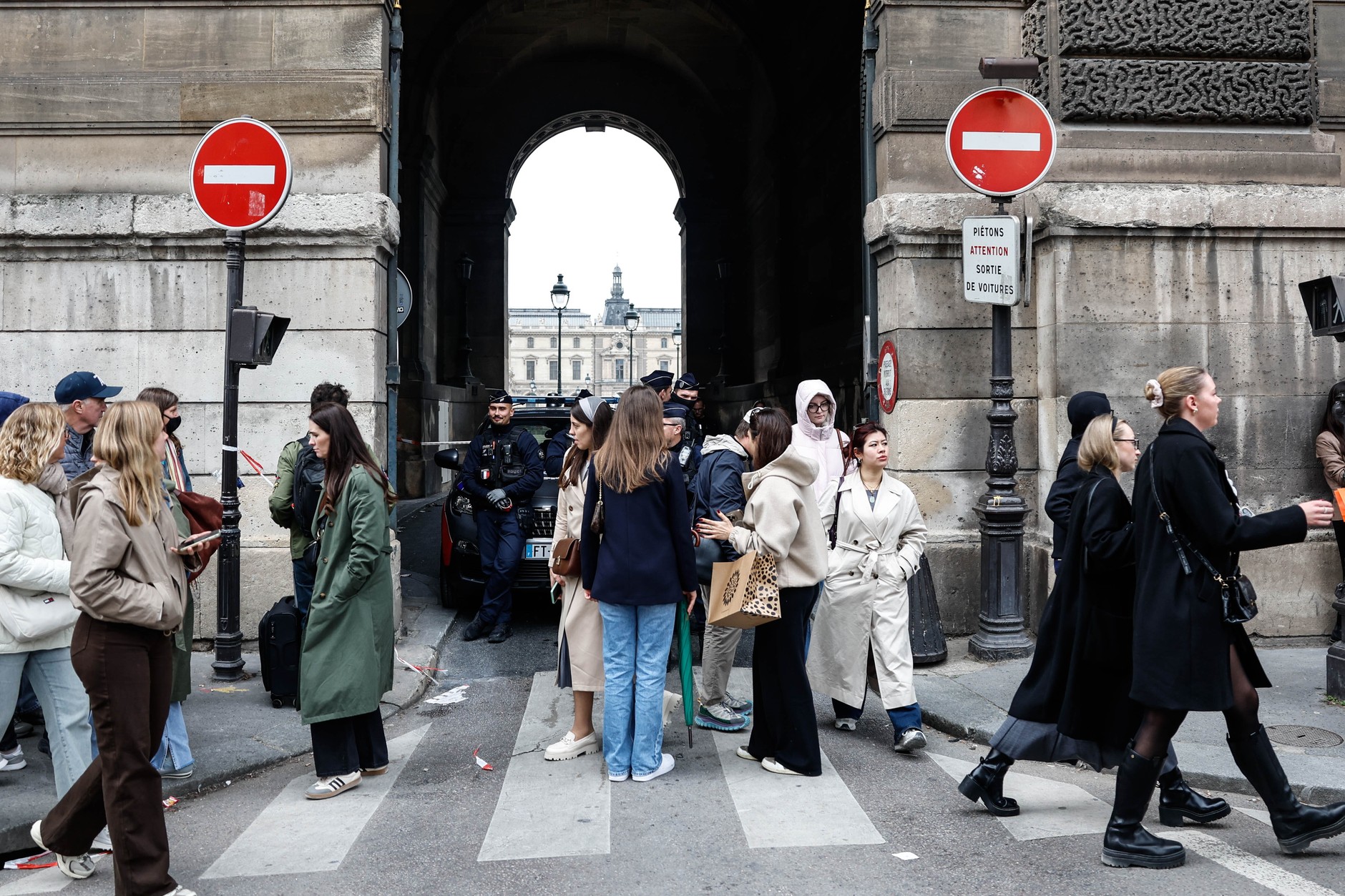
Police officers close the Place du Carrousel next to the Louvre after a robbery at the Louvre museum in Paris, France, October 19, 2025.PAP/EPA/MOHAMMED BADRA / PAP
According to Swiss art law expert Andrea Rascher, it is certain that this is the work of well-organized professionals. – Anyone who wants to carry out such an action needs good timing, very good logistics and perfect organization – he says in an interview with Blick.
Ordinary thieves would not be able to carry out such a robbery.
These include, for example, former members of the military secret services or members of multi-generational families involved in organized crime
– says Rascher.
The expert recalls the case of the theft of jewels in Dresden in 2019. Then, burglars broke into the historic treasury of Augustus II the Strong and stole precious jewels within a few minutes. The damage amounted to approximately EUR 113 million [prawie 480 mln zł według obecnego kursu].
Ultimately, five members of Berlin's extended Remmo family — which numbers around 500 members and is among Germany's most criminal clans — were later convicted in the case, and one defendant was acquitted. Most of the loot reappeared in 2022, partially damaged.
What will happen to the loot?
So far, the perpetrators have not been arrested [napadu w Luwrze]so the fate of the precious loot remains unclear. An art law expert sees two possibilities, one bad and one slightly better, of what will happen now to the stolen jewels.
Bad option:- It would be bad if thieves only wanted money says Rascher. Then the jewelry would be destroyed, the gems would be recut, and the precious metals would be melted down and sold.. – Whoever is able to carry out such a theft often already has a buyer – adds Rascher.
Second possibility:- The theft was probably a commission. In such cases, the principals are people who only care about having these items, even if they can only show them to a few people, explains the expert. — Owning something so unique gives such collectors a sense of power and superiority.
If this were the case, there is a possibility that the works will one day reappear [w obiegu na czarnym rynku lub oficjalnie]. — For example, when a collector dies and his heirs return the stolen items [do muzeum] – adds Rascher. Even though it may take years, it would still be better than having the works irreversibly destroyed.
Every group has a weak link
Even if carrying out a theft within a few minutes proves the thieves' great professionalism, all is not lost: – The decisive factor is always the human being. There is a weak link in every group, and if they make a mistake, it can lead to arrest, explains the expert. “But for that you need Inspector Chance [postać z serii niemieckojęzycznych publikacji opisujących prawdziwe sprawy kryminalne, w których rozwiązaniu kluczową rolę odegrał przypadek]”.
The human factor also plays a key role in another field. — It was most likely the work of an insider — there is an expert. According to the results of the investigation, the thieves entered the Louvre through the construction site. “This clearly indicates that they had helpers,” Rascher says. “Perhaps someone from the museum or from the construction companies involved in the work,” he adds.
No museum is safe
No museum can ensure 100% security of its exhibits. “That's why it would be wrong to point the finger at the Louvre,” says an art law expert. — Every museum faces a dilemma between ensuring security and making exhibits available [zwiedzającym] – he adds.
Nevertheless, one must ask whether the security measures in Paris were really sufficient. – One thing is certain: there is no 100% safety, emphasizes Rascher.
Countless examples from the past prove this. In 1911, the Italian craftsman Vincenzo Peruggia stole the “Mona Lisa” [“La Giocondę” autorstwa Leonarda da Vinci] from the Louvre and hid it for two years before it “resurfaced” again in Florence. In 2004, two armed men broke into the Edward Munch Museum in Oslo and stole the famous paintings “The Scream” and “Madonna”. Their value was approximately EUR 75 million [ponad 318 mln zł według obecnego kursu]. When the paintings appeared two years later, they were in very poor condition.
In Switzerland, in 2008, a theft at the Buehrle Museum in Zurich caused a sensation: the perpetrators stole four paintings worth tens of millions of Swiss francs [w tym “Chłopca w czerwonej kamizelce” Paula Cezanne’a]. Two of them were found later.
I’m Ashley Davis as an editor, I’m committed to upholding the highest standards of integrity and accuracy in every piece we publish. My work is driven by curiosity, a passion for truth, and a belief that journalism plays a crucial role in shaping public discourse. I strive to tell stories that not only inform but also inspire action and conversation.