What is known about the Córdoba train accident that left at least 39 dead. Authorities describe the circumstances of the collision as 'highly unusual'


At least 39 people died and more than 150 were injured after a serious train accident in the Spanish province of Córdoba on Sunday evening. Authorities are describing the circumstances of the collision as “extremely unusual” while the investigation is just beginning.
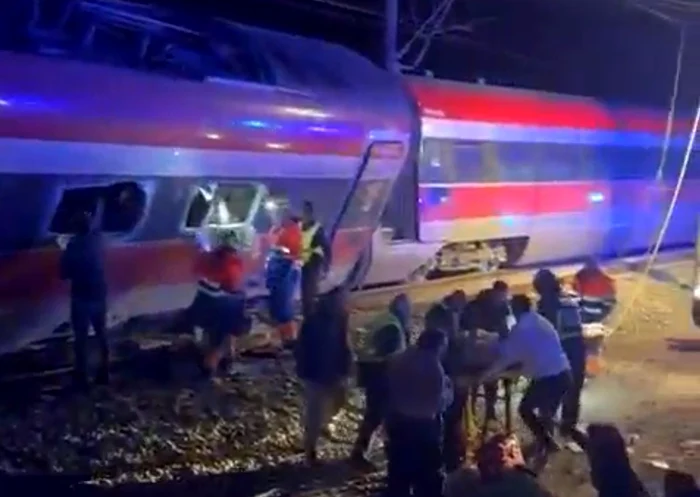
First aid after the railway accident/PHOTO:X
How the accident happened
The accident took place on Sunday, around 19:45, near the town of Adamuz, with approximately 4,200 inhabitants. Train Iryo 6189, traveling on the route Málaga–Madrid (Puerta de Atocha) and carrying 317 passengers, derailed and entered the adjacent track.
At that moment, Alvia train 2384 was coming from the opposite direction, connecting Madrid-Huelva and having about 100 passengers on board. The two trains collided, and according to the authorities, the Alvia train was traveling at approximately 200 km/h at the time of the impact.
Transport Minister Óscar Puente said the first two carriages of the Alvia train, carrying 53 people, were “thrown off the line” and fell down an embankment of around four metres.
The balance of victims
Authorities confirm at least 39 dead and 152 injured. Of these, 48 remain hospitalized in Andalusia and 12 are in intensive care units in Córdoba.
Among the injured are five children, all admitted to the Reina Sofía hospital in Córdoba, one of them being in critical condition. Among the deceased victims is the train driver Alvia, aged 27.
Rescue teams described an extremely difficult intervention. Firefighters spoke of serious injuries — cuts, contusions and open fractures — and of a “heap of beasts” that made it difficult to access passengers in the worst-hit carriages. The mayor of the town of Adamuz said that the rescuers faced “a Dantesque landscape”.
What is known about the causes – and what is not
For now, the causes of the derailment remain unknown. The investigation is being coordinated by the Commission for the Investigation of Railway Accidents (CIAF), an independent body.
The Minister of Transport emphasized that the accident was “extremely strange”: it happened on a straight section, the train that derailed was less than four years old, and the infrastructure had been completely modernized. Work on that segment ended in May, with an investment of approximately 700 million euros. Operator Iryo said the train was last checked on January 15.
Renfe president Álvaro Fernández Heredia explained that about 20 seconds passed between the derailment of the first train and the collision — too short an interval for the automatic safety system to trigger emergency braking.
He warned that it was too early for conclusions and that “the worst thing now is to speculate.” According to him, it cannot yet be established whether the Alvia train hit the derailed carriages or an element of the infrastructure, and some components, including wheels of the train, have not yet been located.
Testimonies of survivors
Passengers described moments of panic. Some have reported strong vibrations and repeated noises followed by a sudden stop. Others said they felt “like an earthquake” before the lights went out.
Several survivors reported seeing twisted wagons and seriously injured people, and that it took nearly an hour for emergency services to arrive before first responders arrived.
Resources mobilized and impact on traffic
National, regional and local resources were mobilized on site. Military emergency units, hundreds of Civil Guard agents, helicopters, drones and medical examiners are participating in the operations. Information and psychological support points for families have been set up in several cities, including Madrid, Córdoba and Seville.
Rail traffic between Madrid and Andalusia is suspended indefinitely. Renfe announced that affected passengers can benefit from free ticket changes or cancellations. Resumption of traffic on the high-speed line could take several days, possibly more than four, due to severe damage.
Authorities warn the investigation could take weeks, perhaps even a month, before a clear explanation is established. Investigators will look inch by inch at the crash site in a complex investigation described by officials as a veritable “railroad CSI.”
Until then, more questions than answers remain about one of Spain's worst rail accidents in recent years.