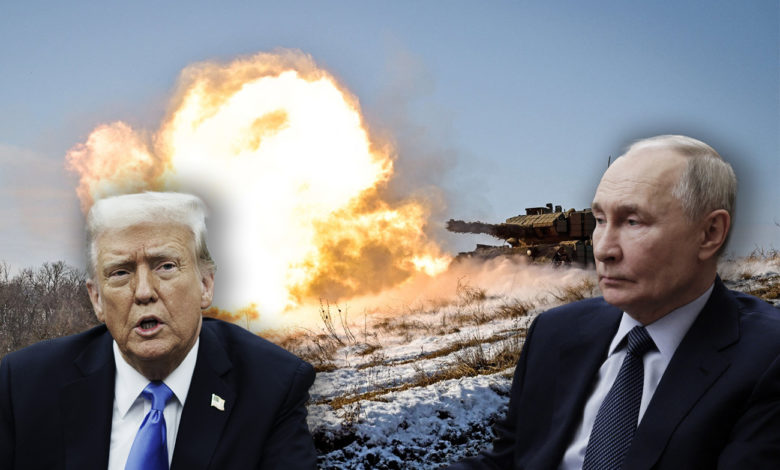
The United States has stepped up intelligence sharing with Ukraine to include intelligence on targets deeper inside Russian territory, as part of a strategic shift that both countries hope will relaunch negotiations with Moscow that stalled after a summit between US President Donald Trump and Russian leader Vladimir Putin in Alaska this summer failed to produce a peace deal, two sources familiar with the matter, according to CNN.
Ukrainian President Volodymyr Zelensky is expected to press Trump for additional long-range weapons capable of striking targets deep inside Russian territory, such as US Tomahawk missiles, when he meets Trump at the White House in Washington on Friday.
Trump signaled he was open to the idea in the days leading up to Zelenskiy's visit, indicating how the US leader's view of the war in Ukraine has changed since the Alaska summit ended.
The shift in stance, to begin providing information focused on energy-related sites and facilities that the Trump administration had previously denied to Kiev, came after Trump met with Putin at the US military base in Anchorage, Alaska, this summer, both sources said. Trump then failed to strike a deal with Putin that would end the war.
In the wake of the summit, the US has sought to increase pressure on Putin, including by changing the way it shares information, which the administration in Washington hopes will change the Russian leader's calculations about whether to continue the war.
The Financial Times was the first to report on US support for Ukraine's ongoing campaign, which sees Kiev's forces targeting Russian energy infrastructure.
The Trump administration urged Ukraine to avoid attacking Russia's oil, gas and energy infrastructure ahead of the summit as officials pursued a peace deal with Moscow. But the US gave Ukraine the green light to resume attacks against those targets after both leaders left Alaska without an agreement, one of the sources cited by the US television channel said.
With US approval, Ukraine has now adopted a deliberate strategy to target Russia's energy infrastructure, this source added.
With front lines effectively frozen and more than a million casualties in total during the conflict, Ukraine sees attacking Russian energy infrastructure as one of the few remaining ways to produce strategic effects, the source added.
The White House did not respond to CNN's request for comment on the report.
Putin and Trump had what Trump described in a post on Truth Social as a “long conversation” on Thursday, the day before Zelenski arrived at the White House.
Immediately after the discussion, the head of the White House made a surprising announcement: he will meet with the Russian president in an “agreed” place – in Budapest, Hungary – “to see if we can put an end to this “shameful” war between Russia and Ukraine” and stated that “important progress has been made following the conversation” by phone with the Kremlin leader. Trump also announced that, at the end of the conversation with Putin, he agreed to hold a meeting of high-level American and Russian advisers next week. This meeting is to be chaired by the head of American diplomacy, Marco Rubio (from the US), and the meeting place is to be determined.
It remains unclear how many energy-related targets remain untouched, and whether Ukraine will be able to maintain its long-range strike capability to successfully destroy facilities located deep inside Russia—data that would help demonstrate that the current strategy could ultimately succeed. Ukrainian President Zelensky has hinted that his military needs additional help from the US to do so, repeatedly calling for American-made long-range weapons in the weeks since the Alaska summit.
Trump, about Zelenski's visit: “I know what he has to say. He wants weapons”
Trump has indicated he is open to the idea, recently suggesting the possibility of supplying Ukraine with Tomahawk cruise missiles unless Russia radically changes its position in the negotiations. Ahead of Friday's planned meeting with Trump at the White House, Zelensky told a group of journalists in Kiev that the main topics of his conversation would include “air defense and our possibilities to put pressure on Russia with long-range missiles.”
On Sunday, the Ukrainian leader wanted to signal that the use of Tomahawk missiles could be closer. “We see and hear that Russia is afraid that the Americans might supply us with Tomahawk missiles, which is a signal that exactly such pressure could contribute to peace,” Zelenskiy said.
Trump said on Tuesday that Zelenskiy would come to the White House on Friday to ask the United States to supply him with long-range Tomahawk missiles that would allow Ukrainian forces to strike deep into Russian territory.
“I know what he has to say. He wants guns. He would like to have Tomahawk missiles,” Trump told reporters during a meeting with his Argentine counterpart Javier Milei at the White House.
When asked on Sunday if he would send Tomahawk missiles, Trump said: “We'll see… Maybe,” adding: “I might tell them if the war doesn't end, we very well might, we might not, but we might. Do they (the Russians, no) want Tomahawks pointed at them? I don't think so.”
A US official stressed that no matter what happens, the most important thing is that the delivery of Tomahawk missiles to Ukraine is a serious option on the table.
Trump himself has repeatedly expressed astonishment at the prospect of Ukraine having the ability to strike Moscow or St. Petersburg, including in recent conversations with Zelensky, according to another source familiar with the discussions. During a phone call after the Alaska summit, Trump asked Zelenskiy if his military had the capability to strike Moscow or St. Petersburg.
The Ukrainian leader replied that he could if he had the right weapons, sources told CNN.
What weapons has the US approved for Ukraine in the meantime
Meanwhile, the US has stepped up intelligence sharing and approved the sale of 3,350 Extended Range Attack Munition (ERAM) missiles – in what appears to be Trump's first concrete step to bolster Ukraine's long-range capabilities since his summit with Putin.
The Trump administration has placed no explicit restrictions on how Ukraine can use the long-range missiles, which are part of a recently approved $825 million arms sale, according to two U.S. officials familiar with the matter.
Similarly, the Biden administration has not set any limits on how Ukraine can use weapons it has supplied that are technically capable of striking Russian targets, specifically the Army's tactical missile systems (ATACMS), according to a source familiar with the matter.
But ATACMS missiles have a shorter range than Tomahawk or ERAM missiles, forcing Ukrainian forces to move quickly and hide the launchers to get them closer to enemy lines, the source said. Air missiles approved by the Trump administration offer more flexibility.
However, it may still be difficult for aircraft using ERAM missiles to approach the border because of Russian MiG fighter patrols, the source added, limitations that have fueled Ukraine's demand for Tomahawk missiles and other long-range weapons.
The 1,500-mile range and speed of Tomahawk missiles mean they are only useful for evading air defenses and hitting valuable infrastructure inside Russia.
The Kremlin has suggested that US personnel should operate such sophisticated weapons and that Tomahawk missiles may be capable of carrying nuclear weapons – a threat that fuels fears of an escalation of the conflict.
Ultimatum delivered by the head of the Pentagon
On Wednesday, US Defense Secretary Pete Hegseth warned Moscow that the Americans and their allies would “impose costs” for continued aggression against Ukraine.
“If we have to take this step, the US Department of War (the official name of the Pentagon recommended by President Donald Trump instead of the Department of Defense, no) is ready to play its role as only the United States can,” the head of the Pentagon said at a meeting of the Contact Group on the Defense of Ukraine at NATO headquarters in Brussels.
Hegseth did not give details, but the Reuters news agency mentions that his statements came precisely in the context in which Trump is considering the request of the Ukrainians to receive Tomahawk missiles.
“Now is the time to end this tragic war, stop the unnecessary bloodshed and come to the table of peace. It is not a war started in President Trump's time, but it will end in his time,” said Hegseth, quoted by Agerpres.
Pentagon chief asks NATO allies to buy more US weaponry for Ukraine; a report from the Kiel Institute for World Economics showed on Tuesday that Western military support for the Russian-invaded country fell by 43 percent in July and August.
And the Secretary General of the Alliance, Mark Rutte, said that he expects new investment announcements in the PURL (Prioritized Ukraine Requirements List), the program that replaced the arms donations from the US and through which two billion dollars have already been committed.
Ukrainian President Volodymyr Zelensky, however, hoped to reach $3.5 billion by the end of October.
 Harsh attack from Kiev on Viktor Orban: “Flirting with Russia” / What Romania has done in return since the first hours of the war