The oldest railway in Transylvania is reborn after a century and a half. What her former railway knot now looks like


At 160 years after the construction of Arad – Alba Iulia, the oldest railway in Transylvania has completely changed its appearance. After almost seven years of site, the works are not yet completed, but its “jewel”, Simeria Station, receives its guests with a new appearance.
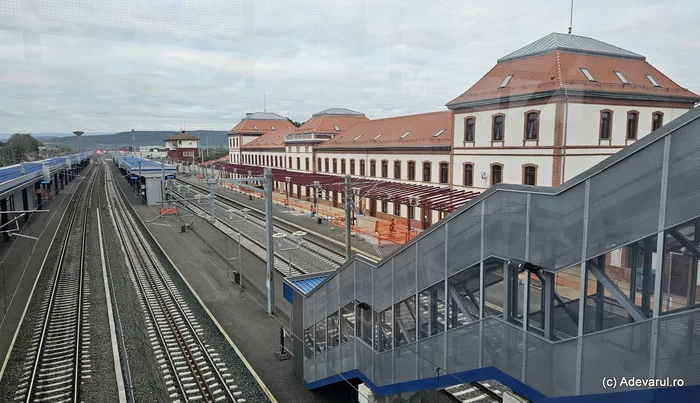
CFR Simeria station. Photo: Daniel Guță. TRUTH
Since 2018, over 140 kilometers of the Simeria – Arad railway, important segment of the first railway bus in Transylvania (Arad – Alba Iulia, 210 kilometers), are in the site, the transport infrastructure and the stations being modernized with European funds.
Work in railway node, near the end
The works on the four railway sections in which the project was divided will have to be completed until 2026, on some sections the traffic of the train being moved in the meantime on the new route.
In other places, the constructions are delayed and there are little chance that they will be inaugurated next year. Such a place is the area of the tunnels on the Mureș Valley, built in Zam (Hunedoara county).
Also, the new station of Deva municipality has no chance of being inaugurated in 2026, given that the old passenger building was demolished in June 2024, and in its place remained a viran land, over which the vegetation increased.
The CFR Simeria station, the largest on the route, entered the yard since 2018, and his railway station two years later. The works at the CFR station are approaching the end, and the old railway node welcomes their guests with a new appearance, completely changed to that of the “old man” of CFR stations and his monument building, in a state of advanced degradation before the modernization, over a century from its construction.
The passenger building remained in the yard, but the works could be completed in 2025. A modern lift was built inside the 1900 train station. The installation is connected to the underground passage that connects with the platforms.
“The Simeria passenger building – historical monument – will have modern spaces for the traveling public – car parking, waiting room, ticket offices, bathrooms, luggage space and information office; spaces for people with disabilities – special access areas, ticket house and toilets; Inform CFR Infrastructure.
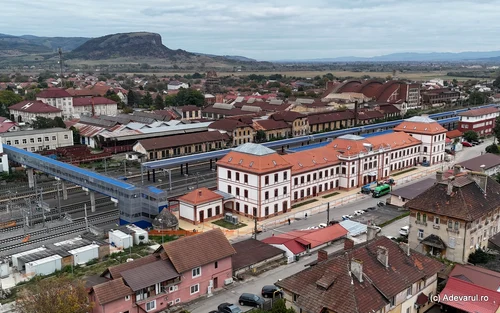
Image 1/21:
CFR Station Simeria Photo Daniel Guță Adevărul (35) JPG
Above the CFR station, located for four years in the site, the new pedestrian walkway built over the railway lines, to connect, over the railway area, the Simeriei neighborhoods, was partially opened, only between platforms 1 and 3. This year the completion of the works is expected. Otherwise, the works on the transport infrastructure (platforms, installations, railway lines) are also the final execution stage.
From 2026 the inaugurations on the Simeria – Arad railway are beginning
The new railway bus Simeria -Rad (kilometer 614), in western Romania, is in the yard since 2018, after the works contracts were signed in 2017. The 141 kilometers of the railway in the Mureș Valley, in Hunedoara and Arad counties, were divided into four sections.
According to CFR, the stage of works on each segment is: on subtronson 2A, km 614 – Bârzava (41.91 km) – 97 percent, on subtronson 2B, Bârzava -Iilteu (36.04 km) – 96 percent, on subtronson 2C, Ilteu -Gurasada (22.34 km) – 79 percent) – 79) 3, Gurasada – Simeria (40.88 km) – 88 percent.
The project aimed at modernizing the railway infrastructure and reconfiguring the route, so that the speed of trains can increase to 160 km/h.
It imposed the construction of about 60 kilometers of completely new route between Simeria and Arad, some tunnels and the lifting of nine bridges over Mureș; The old bridge over Mureș from Brănișca will no longer be used, on the new route. With the completion of the works at the bus, the duration of a trip between Simeria and Arad will be reduced to less than an hour and a half.
From Simeria, the modernized route continues through Alba Iulia (Coșlariu -Teiuș – Llaj), then through Mediaș, Copșa Mică, Atel -Micăsasa, to Sighișoara, on the section where works were performed to increase the speed of circulation and the installation of ERTMS/ETCS Level 2 (European unitary European system).
This axis continues to Brașov-București-Constanța (Constanța Port) and is part of the Central Corridor Ten-T “Rhine-Dunăre”, which connects the western and center of Europe to the Black Sea on the Strasbourg-Budapest-Rad-Brașov-București-Constanța relationship.
Arad – Alba Iulia railway, a 160 -year -old history
The first Transylvanian railway, as it was called in the past the Arad – Alba Iulia bus, after the name of the company that started its construction, was one of the oldest railway infrastructure projects in Romania.
The plans for its realization were started in the middle of the 19th century, in an era in which the railways in the region represented a novelty, and the infrastructure projects, intensely debated by the officials of the Austro-Hungarian state, targeted several routes between the cities of Transylvania (Alba Iulia, Arad, Sibiu, Oradea).
The works on the route on Valea Mureșului began in 1867, being run by the mining and metallurgical society in Brasov, the one who had founded the “first Transylvanian railway”. In order to support the constructions of the first railways, almost all the cities and many private owners offered the necessary land for free, and the communities committed to contribute with days of work, transports and large quantities of wood, stone, lime and brick for construction.
The first railways in Transylvania built in five years
On Christmas day in 1868, the first train to start from Arad arrived in Alba Iulia. The 211 -kilometer line thus linked the old capital of Transylvania to Arad, Pesta and Vienna. In the next five years, the new railway network exceeded 600 kilometers. In the summer of 1870, the “railway of coal” was inaugurated, Simeria -Petroșani.
On September 7, 1870, the section Oradea – Cluj was opened, which continued in 1871 to Teiuș and Târgu Mureș, and the following year to Mediaș, Sighișoara and Sibiu. In the middle of 1873, the trains also arrived in Brasov. Over 20,000 people worked in the railways that would then connect the important cities in Transylvania, attractive for the former Austro-Hungarian Empire due to the wheat resources in the Transylvania Plain, the salt from Turda, Ocna Mureș and Praid and the coal from the Jiu Valley.
In the second half of the 1880s, the railway bus were complemented by numerous secondary ramifications, such as the railway on the Someș Valley, which connected the cities of Gherla, Dej, Zalău, Bistrița and Cluj, the railway of Sălaj, or the Simeria -Hunedoara line, which connects the Magistrala to the Magistral. At the outbreak of the First World War, the railway network of Transylvania has numbered 2,384 kilometers, historians show.
Simeriei station, rebuilt at 1900
At the end of the 19th century, Simeria became one of the great railway nodes in Transylvania.
“The importance of the Simeria (Piski) station was shown, besides the branch line to the important coal warehouses in the Jiu Valley, and the main workshop built here”, The researchers Horváth Ferenc and Kubinszky Mihály showed, in the study “The civil construction works of the first Transylvanian railway”.
A colony of the families of railway workers was established here, and the extension of the railway traffic to Hunedoara and Petroșani imposed the construction of a new station.
In the first years after the change of century, Máv (Hungarian railways) rebuilt the Simeria station building based on the plans of the architect Ferenc Pfaff and its collaborators. Simeriei station was one of the largest Máv passenger buildings. To the east of the new building was kept a building with plane in H, with a pronounced roof, intended for housing or operating functions.
In the decades of communism, the railway node Simeria worked at maximum capacity; However, after 1990, the decline of mining, of the metallurgical industry, the reduction of the transport of passengers on the railway and the lack of investments in the railway infrastructure reduced the importance of the CFR Simeria station.
Currently, it is facing a paradox: the inhabitants of the railway city can be proud of a modernized station, but the number of those who climb and descend from trains passing through the CFR station has reduced considerably, while most lines remain deserted most of the time.