2025-10-13 22:06
publication
2025-10-13 22:06
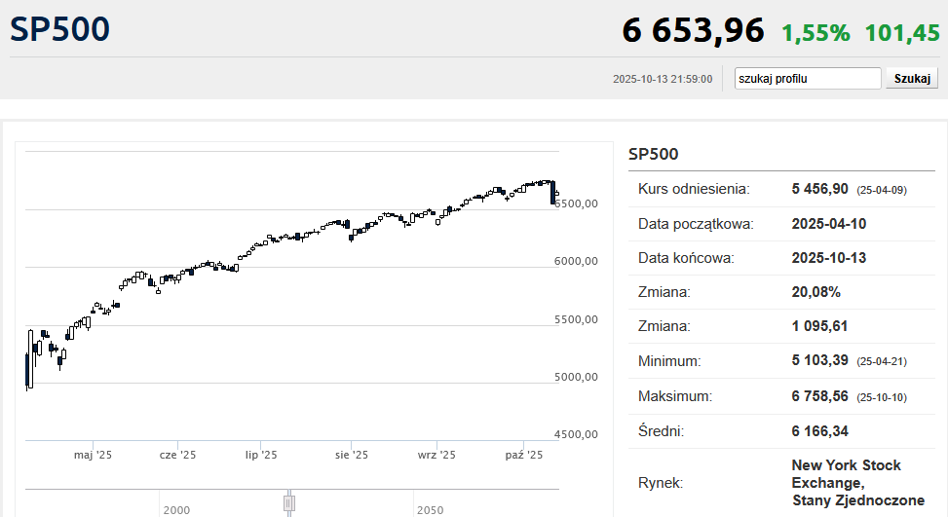
After the weekend, the mood on Wall Street changed 180 degrees. Panic selling of stocks turned into equally panic buying. Investor FOMO was fueled by President Trump's Sunday statements, who quickly withdrew what he had said on Friday.
The S&P500 ended Monday's session with an increase of 1.56% and the level of 6,654.72 points. The Nasdaq Composite gained 2.21% and climbed to 22,694.61 points. The Dow Jones strengthened by 1.29% and closed at 46,067.58 points.
The increase in stock indices was driven by the shares of the most popular big tech companies. Broadcom shares gained nearly 10%, Oracle's stock increased by almost 6%, and Tesla's by almost 5%. In addition, the prices of Nvidia and Alphabet shares increased by 2.7% (+3.1%). The former company was helped by a deal with OpenAI, which announced an agreement to collaborate with Broadcom to design chips for AI training. This is another agreement of this type by OpenAI, which is building a network of mutual connections in the technology industry.
And on Friday, investors were selling the same securities in panic, predicting the strongest declines in the New York stock indexes since April. The spark for Friday's sell-off was President Donald Trump's harsh statements against China. The host of the White House even announced the introduction of punitive, 100-percent tariffs on China in retaliation for Beijing's regulation of the export of rare earth metals.
But on Sunday, President Trump, in his own style, withdrew from aggressive rhetoric. Once again it turned out that his words were only aggressive, but not his actions. – Don't worry about China, everything will be fine! – wrote the US president in a Sunday entry on the Truth Social website. Well, investors actually stopped worrying and started buying back the discounted shares in a hurry.
Classic FOMO (fear of missing out) is now visible on the American stock market. That is, the fear of missing an investment opportunity, which for several years has been considered to be even the smallest discount on Wall Street. Now no one asks why and for how much, they just buy PKC.
– AI remains a driving factor and I am not surprised that investors have bought into this low, commented Sam Stovall, chief investment strategist at CFRA Research, quoted by Reuters.
Meanwhile, investors' attention may soon shift to the quarterly results of American companies. On Tuesday, reports will be released by large banks: JP Morgan Chase, Goldman Sachs, Citigroup and Wells Fargo. This will be the conventional beginning of the earnings season, after which analysts expect a nearly 9% increase in companies' profits attributable to the S&P500 index (i.e. EPS).
K.K