The last hour Donald Trump puts the cannons again on Europe: Spain “should be released” from NATO – Video


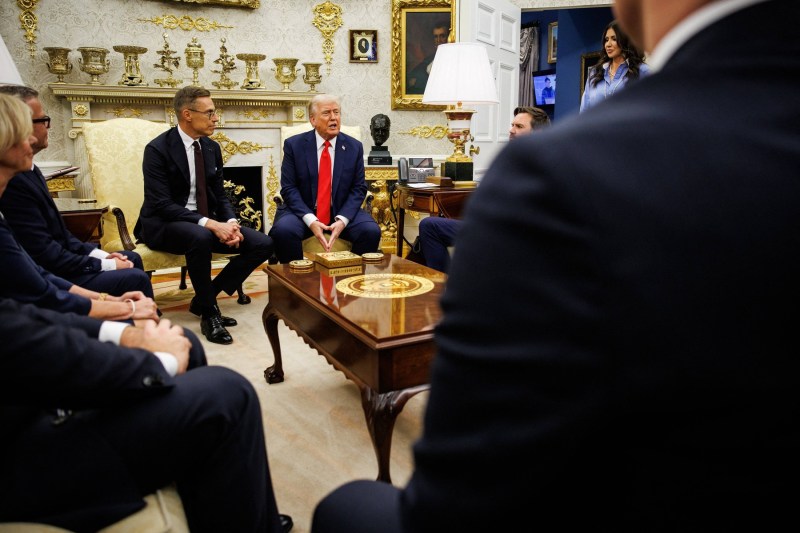
US President Donald J. Trump meets President of Finland, Alexander Stubb, in the White House Oval Office in Washington, DC, on October 9, 2025. Photo: Samuel Corum – Pool Via CNP / Mega / The Mega Agency / Profimedia
US President Donald Trump suggested on Thursday that the North Atlantic Alliance (NATO) should take into account the exclusion of Spain from its ranks, against a dispute on insufficient military expenses of this country in Western Europe, writes Reuters.
The members of the US Security Alliance agreed in June to significantly increase their military expenses to 5% of the Gross Domestic Product (GDP), in order to fulfill a major priority for Trump, who wants Europeans to spend more for their own defense.
But the Spanish Prime Minister Pedro Sanchez announced at the time that he will not hire to reach the target of 5% of GDP, qualifying it as “incompatible with our social state and our vision of the world.”
During a meeting in the Oval Office with Alexander Stubb, the President of Finland, the second newest member of NATO, Trump said that European leaders must convince Spain to intensify their commitments to the military alliance.
“You will have to start talking to Spain,” Trump said. “You have to call them and find out why they are behind,” said the White House leader.
He then added: “((Spaniards) they have no excuse not to do this, but nothing. Maybe you should get them out of NATO, honestly.”
Trump on Spain: Maybe You Should Throw Them Out of NATO pic.twitter.com/kiitmatjeb
– Acyn (@cyn) October 9, 2025
Spain joined the organization of the Northern Atlantic Treaty in 1982.
The collective defense alliance with 32 members was the center of attention after Russia invaded Ukraine, in 2022, and triggered the bloodiest terrestrial war in Europe since the end of World War II and until now.
After signing the Washington Agreement, no member country was excluded, nor left the organization of the North Atlantic Treaty, since its establishment, in 1949. Over the decades, NATO belonging has increased, with the addition of several European countries, of former Soviet republics and, in the new Soviet (Finland).
However, the founding treaty of NATO includes an exit clause, which means that a country could theoretically leave the international organization if it wants it, although this procedure is subject to a number of legal and political conditions.
This clause is found in Article 13 of the treaty signed in Washington, DC, on April 4, 1949. This article establishes that for any of the parties to be a member of the Atlantic Alliance, it must have passed “twenty years of validity of the treaty”.
Moreover, the withdrawal would officially materialize “one year after notifying its denunciation of the United States Government, which will inform the governments of the other parties about submitting each withdrawal notification”.
Trump's threats
In the summer, Spain led by the left government of Prime Minister Pedro Sanchez was noted as the only NATO country that opposes the defense expenses at 5% of GDP per year.
Prime Minister Sanchez explained that Madrid will allocate 2.1% of GDP, “no more, no less”, explaining that otherwise, Spain will have problems with financing other priorities, such as social expenses.
At the NATO Summit in The Hague, Trump has threatened to negotiate with Madrid a commercial agreement and oblige Spain to pay twice as much.
However, as a member of the European Union, Spain does not negotiate directly with the US in terms of trade – the European Commission has dealt with these negotiations for the entire block of 27 countries.
Recently, the Fitch rating agency noted that the economy of Spain retains its resilience, helped among others by “the exposure limited to US customs duties”.