Experts remind you that Poland's housing problems are still reaching pre -war times, when overpopulation belonged to the highest in Europe. However, the modern stage of development began in the 90s, at the beginning of the Third Polish Republic.
According to UN data from 1998, there were less than 300 premises per 1,000 Poles – only Albania was worse. In the Czech Republic and Estonia, the indicator reached 400. It was only at the beginning of the current decade that Poland exceeded this level.
– In terms of the area per person and the number of households for the premises/house, our country was worse 30 years ago than even Slovakia – not even mentioning the Czechs and Hungary, i.e. countries with a much better starting position after 1989 – notes Andrzej Prajsnar, expert on the portal RynekPierwotny.pl.
The housing market in pursuit of the West
At the beginning of the 21st century, high unemployment slowed down the arrears – in the years 2002–2004 20 percent reached. However, accession to the EU turned out to be a breakthrough.
Housing problems
|
Primary market
In the years 2005-2024 a total of 327.6 million sq m of new houses and apartments-slightly more than the area of Krakow, was commissioned. The year 2022 was recorded with a result of 22 million sq m, more than in the best year of the Gierek decade.
– It is worth checking how construction activity from the last twenty years has influenced other indicators of the housing situation than previously analyzed – comments Andrzej Prajsnar.
Housing conditions as a problem
– When in 2004 Poland entered the EU, we were at the gray end in the statistics regarding housing. However, since then a lot has changed with us. Of course, there are statistics that we can be proud of, but there are also those that do not bring pride to our country – says Marek Wielgo, an expert of the RynekPierwotny.pl portal.
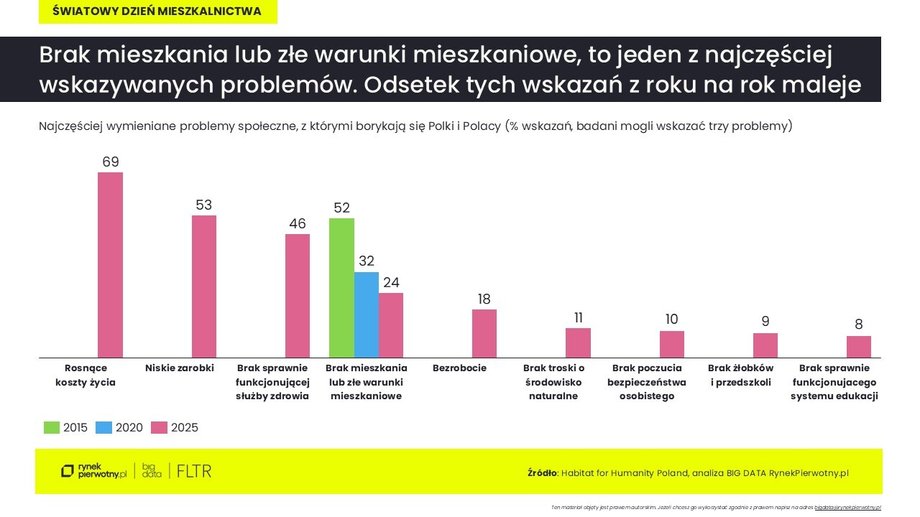
According to Habitat for Humanity Poland research, the lack of a flat or bad living conditions still belong to the main problems of Poles – giving way only with the growing costs of life and healthcare. In 2015, more than half of the respondents indicated the housing problem, today less than a quarter. This is proof of improving the situation.
Standard of apartments
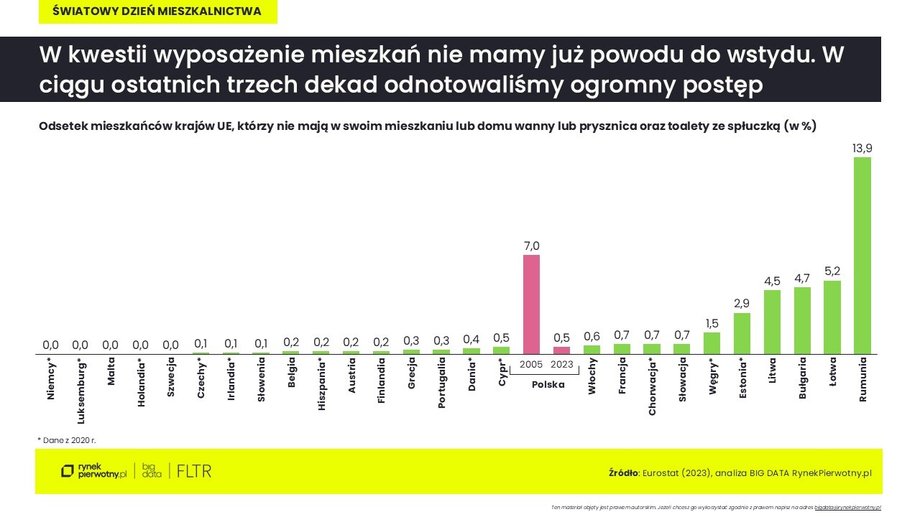
The greatest progress can be seen in the standard of apartments, especially in the countryside – thanks to EU subsidies on water and sewage networks.
In 2005, 7 percent Poles (about 2.7 million people) did not have a bathroom or toilet. In 2023, there were only 0.5 percent such people. (approx. 190 thousand), which puts us in a row with Western Europe.
– It is worth appreciating this progress. According to CSO data, about 12.7 million Polish women and Poles lived in the end of the Polish People's Republic. They occupied 3.5 million apartments (premises and houses), i.e. every third apartment existing at the time. In many villages, a common phenomenon, and even “standard” were the so -called Sławojki – reminds Marek Wielgo.
Housing equipment
|
Primary market
We invest in our premises and houses
Poles are investing more and more in their real estate, which can be seen, among others in statistics regarding the technical condition of buildings.
In 2005, over 40 percent complained about moisture in the apartments. Poles – most in the EU. Today, this percentage has dropped to 6 percent, and only Croatia, Finland and Sweden record better results.
More rooms, but still not enough
In terms of the number of rooms per person, we are still below the EU average. In Poland, there are about 1.2 room per capita (in 2005 – 1.0), while the EU average is 1.7 room. It is worse or similar only in Romania, Slovakia and Latvia.
State aid
Could the state make more to make the result of the twenty years better? Unfortunately, yes. For most of this period, politicians devoted too little attention to housing.
– For example, you can ask yourself whether the growing confusion around the reform of spatial planning will have a positive impact on the market in the coming quarters. It seems that no – sums up Andrzej Prajsnar.